
Managing customer relationships often feels overwhelming for small business owners in South Wales, especially in busy retail and hospitality settings. Juggling customer data from emails, social media, and daily transactions can cause missed opportunities and scattered communication. A modern CRM system provides a centralised hub to bring all customer information together, making it easier to nurture leads and build lasting connections. With personalised customer interaction management, business owners gain clearer insights and streamline daily operations from one place.
Table of Contents
- Defining CRM for Small Businesses UK
- Core Functions and Essential CRM Features
- Benefits for Retail and Hospitality SMEs
- Automation, Integration, and Legal Compliance
- Common Mistakes and What to Avoid
Key Takeaways
| Point | Details |
|---|---|
| CRM Enhances Customer Engagement | Implementing a CRM system provides small businesses with tools to create personalised customer experiences and improve satisfaction. |
| Automation Improves Efficiency | Automating workflows with CRM streamlines business processes, reducing time spent on repetitive tasks and increasing productivity. |
| Data Analytics Drives Decisions | CRM platforms offer advanced data analytics that help businesses make informed marketing and sales decisions, ultimately boosting profitability. |
| Compliance is Essential | Ensuring that CRM systems adhere to all legal and regulatory requirements is crucial for maintaining customer trust and operational integrity. |
Defining CRM for Small Businesses UK
Customer Relationship Management (CRM) represents a powerful strategic approach for small businesses in the United Kingdom to transform how they interact with customers and manage critical business relationships. At its core, a CRM system acts as a comprehensive digital platform that consolidates customer data, automates key processes, and provides actionable insights for growth.
Modern CRM solutions go far beyond traditional contact databases. They are sophisticated tools that integrate customer interaction technologies to support business sustainability. Small businesses can leverage these systems to create more personalised customer experiences by consolidating diverse data sources into a unified platform.
Key features of effective CRM systems for UK small businesses include:
- Centralised customer information hub
- Automated marketing and sales workflows
- Real-time performance tracking
- Seamless team collaboration tools
- Personalised customer interaction management
Data analytics capabilities within CRM platforms enable businesses to make more informed marketing decisions, ultimately improving customer satisfaction and driving profitability. By providing a 360-degree view of customer journeys, these systems help transition businesses from reactive to proactive relationship management.
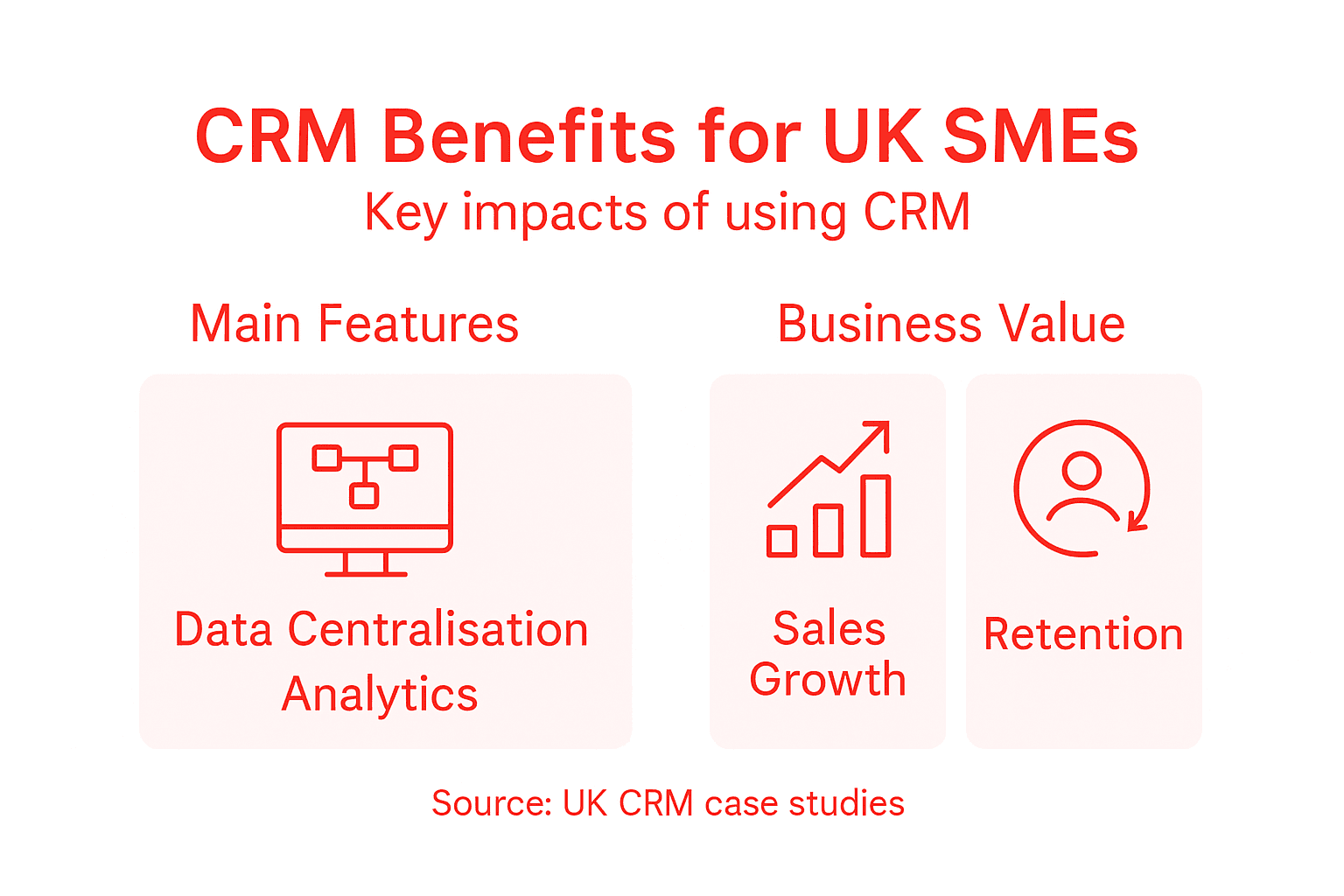
Here is a summary of how key CRM features deliver business value for UK small businesses:
| CRM Feature | Business Objective | Measurable Impact |
|---|---|---|
| Automated sales workflow | Accelerate sales cycles | Reduced time to close deals |
| Real-time performance tracking | Monitor business activity | Increased forecast accuracy |
| Personalised customer management | Improve experience | Higher customer retention |
| Seamless collaboration tools | Enhance team productivity | Fewer internal communication gaps |
| Centralised information hub | Simplify data access | Fewer duplicated customer records |
Pro tip: Start by mapping your current customer interaction processes before selecting a CRM system to ensure you choose a solution that genuinely meets your specific business needs.
Core Functions and Essential CRM Features
Customer Relationship Management (CRM) systems offer a comprehensive suite of tools designed to streamline business operations and enhance customer interactions for small businesses in the United Kingdom. Core CRM functions are essential for transforming how businesses manage their sales processes, customer data, and marketing strategies.
The fundamental features of an effective CRM system for UK small businesses include several critical components that enable more efficient and strategic business management:
- Contact Management: Centralised database of customer information
- Lead Scoring: Prioritisation of potential customer opportunities
- Workflow Automation: Streamlining repetitive business tasks
- Sales Pipeline Tracking: Real-time monitoring of sales opportunities
- Marketing Campaign Management: Targeted communication strategies
Advanced CRM platforms go beyond basic data storage, providing intelligent tools that support business growth. These systems offer AI-driven analytics, mobile accessibility, and seamless third-party integrations that help businesses make data-informed decisions and enhance customer engagement.
Operational Benefits of implementing a robust CRM include improved team collaboration, more precise sales forecasting, and the ability to create personalised customer experiences. By consolidating customer interactions across multiple channels, small businesses can develop a more comprehensive understanding of their client base and respond more effectively to their needs.

Pro tip: Conduct a thorough audit of your current customer interaction processes before selecting a CRM system to ensure you choose a solution that precisely matches your business requirements and growth objectives.
Benefits for Retail and Hospitality SMEs
Small and medium-sized enterprises (SMEs) in the retail and hospitality sectors can unlock significant competitive advantages by implementing robust Customer Relationship Management (CRM) systems. CRM adoption significantly improves SME performance by transforming how businesses interact with and understand their customers.
Key benefits for retail and hospitality SMEs include:
- Enhanced Customer Retention: Increase loyalty by 25-40%
- Sales Growth: Potential revenue boost of 15-30%
- Personalised Marketing: Targeted communication strategies
- Operational Efficiency: Streamlined business processes
- Real-Time Inventory Management: Improved stock control
For retail businesses, CRM systems provide powerful tools to track customer preferences, manage inventory, and create personalised shopping experiences. Hospitality SMEs can leverage these platforms to automate booking processes, track guest preferences, and deliver exceptional customer service that sets them apart from competitors.
CRM transforms small businesses from reactive operators to proactive customer experience leaders, providing insights that drive strategic decision-making.
Advanced CRM capabilities enable these businesses to capture detailed customer data, analyse purchasing patterns, and develop more targeted marketing approaches. By understanding customer behaviour more deeply, retail and hospitality SMEs can create more meaningful connections and develop loyalty programmes that truly resonate with their client base.
The following table contrasts retail and hospitality SME CRM usage and strategic outcomes:
| Sector | Primary CRM Uses | Key Advantage |
|---|---|---|
| Retail | Inventory and preference tracking | Personalised shopping promotions |
| Hospitality | Guest booking and experience management | Effortless guest service |
Pro tip: Select a CRM system with industry-specific features that match your exact business needs, and invest time in comprehensive staff training to maximise the platform’s potential.
Automation, Integration, and Legal Compliance
Small businesses in the United Kingdom must navigate a complex landscape of technological innovation and regulatory requirements when implementing Customer Relationship Management (CRM) systems. UK GDPR compliance for CRM systems demands a strategic approach that balances operational efficiency with robust data protection standards.
Key considerations for legal and technological compliance include:
- Data Residency: Ensuring data is stored within UK/EU jurisdictions
- Consent Management: Granular tracking of customer permissions
- Subject Access Requests: Capability to handle instant data retrieval
- Right to Erasure: Comprehensive data deletion mechanisms
- Audit Trail Maintenance: Detailed logging of data interactions
Automation technologies offer significant benefits for UK SMEs, but require careful implementation to mitigate potential compliance risks. Businesses must develop safeguards that prevent algorithmic bias, maintain transparency, and protect individual privacy rights.
Effective CRM automation requires a delicate balance between technological efficiency and stringent regulatory compliance.
Successful integration involves selecting CRM platforms with built-in compliance features, implementing robust security controls, and maintaining human oversight of automated processes. This approach ensures that technological advancements support, rather than compromise, legal and ethical business practices.
Pro tip: Conduct a comprehensive compliance audit of your CRM system annually, and invest in ongoing staff training to ensure your automation strategies remain legally and ethically sound.
Common Mistakes and What to Avoid
Implementing a Customer Relationship Management (CRM) system requires strategic planning and awareness of potential pitfalls that can derail success. Common CRM implementation mistakes can significantly impact a small business’s ability to leverage this powerful technological tool effectively.
Most frequent errors UK small businesses encounter include:
- Lack of Clear Objectives: Implementing CRM without defined goals
- Insufficient User Training: Neglecting team skill development
- Overcomplicating Systems: Selecting unnecessarily complex platforms
- Siloed Departmental Usage: Treating CRM as a sales-only tool
- Ignoring Scalability: Choosing systems without growth potential
Businesses often make the critical mistake of selecting CRM systems that do not align with their specific workflow requirements. This misalignment leads to poor user adoption, reduced system effectiveness, and ultimately wasted investment. Successful implementation demands a thorough understanding of organisational needs and a phased approach to system integration.
Selecting the right CRM is not about finding the most advanced system, but the most appropriate one for your specific business context.
To mitigate risks, companies should involve stakeholders from multiple departments during the selection process, start with essential features, and plan incremental system expansions. Regular system reviews and continuous staff training are crucial for maintaining CRM effectiveness and ensuring ongoing user engagement.
Pro tip: Appoint a dedicated CRM champion within your organisation who can provide ongoing support, gather user feedback, and drive continuous improvement of your system implementation.
Elevate Your Small Business Success with Expert CRM and Digital Marketing Support
Struggling to fully harness the power of Customer Relationship Management as outlined in the article? Many UK small businesses face challenges like fragmented customer data, inefficient follow-ups, and unclear sales processes. These issues reduce your ability to create personalised customer experiences and slow your growth potential. The article emphasises how a well-implemented CRM system with features such as automated lead nurturing and real-time performance tracking can transform your business from reactive to proactive.
At Bamsh Digital Marketing, we understand these pain points deeply. We combine expert CRM setup and automated lead nurturing with proven digital marketing strategies to ensure your business not only manages relationships efficiently but also attracts and converts more ideal customers. Whether you need help with optimising your digital presence through Digital Marketing Bristol or want to automate lead capturing and nurturing processes, we provide clear, honest, and results-driven solutions. Don’t let missed leads or disorganised customer data hold you back. Take control of your growth and partner with us today.
Ready to transform your CRM challenges into growth opportunities? Book a free 15-minute discovery call now at Bamsh Digital Marketing and start creating the personalised, automated, and compliant customer journeys your small business deserves.
Frequently Asked Questions
What is a CRM system and how can it benefit small businesses?
A CRM system is a digital platform that consolidates customer data, automates key processes, and provides insights for growth. It helps small businesses manage customer interactions, improve customer satisfaction, and increase profitability.
What are the key features to look for in a CRM system?
Key features include centralised customer information, automated marketing and sales workflows, real-time performance tracking, team collaboration tools, and personalised customer interaction management.
How can CRM software enhance customer relationships for small businesses?
CRM software enables businesses to analyse customer data, personalise interactions, and create targeted marketing strategies, ultimately leading to improved customer retention and loyalty.
What common mistakes should small businesses avoid when implementing a CRM system?
Common mistakes include lack of clear objectives, insufficient user training, overcomplicated systems, siloed departmental usage, and ignoring scalability. It’s crucial to align the CRM with business needs and involve multiple stakeholders in the selection process.