

TL;DR:
- Small UK businesses can significantly boost sales using affordable and accessible AI tools.
- AI automates tasks like lead scoring, personalized messaging, and sales forecasting to improve efficiency.
- Success depends on a cultural mindset shift, involving the team and implementing AI gradually.
Most small business owners assume AI is something only large corporations can afford or use effectively. That assumption is costing them sales. UK SMEs are already using AI to streamline their sales processes and see significant revenue gains, and the tools available today are more accessible and affordable than ever before. This article breaks down exactly what AI means for your sales process, which tools are making the biggest difference, and how you can start using them without needing a tech team or a massive budget.
Table of Contents
- What does AI in sales really mean for UK SMEs?
- AI tools making the biggest impact on UK sales processes
- How AI personalises customer interactions and boosts conversions
- Five steps to integrate AI into your SME sales process
- A fresh take: why AI in sales is less about tech, more about mindset
- Next steps: unlock AI-driven sales growth for your business
- Frequently asked questions
Key Takeaways
| Point | Details |
|---|---|
| AI is accessible | Affordable, user-friendly AI tools are now within reach for UK SMEs of any size. |
| Tools drive real results | Chatbots, predictive analytics, and lead scoring offer quick wins and measurable sales improvement. |
| Personalisation matters | AI customises sales interactions, increasing conversion rates with less manual effort. |
| Start small, scale up | A phased approach delivers the best outcomes and minimises risk for SME adoption. |
| Culture beats tech | Success depends as much on mindset and staff buy-in as technology selection. |
What does AI in sales really mean for UK SMEs?
Let’s be honest. When most people hear “artificial intelligence,” they picture robots or supercomputers. In reality, AI in a sales context is far more practical. It means software that analyses data, spots patterns, and makes decisions or recommendations automatically, so you and your team can focus on the work that actually needs a human touch.
For a small or medium-sized business in the UK, this could look like:
- Automated email sequences that send the right message at the right time
- Contact scoring that tells you which leads are most likely to buy
- Reminders and follow-up prompts triggered by customer behaviour
- Sales forecasting that reduces guesswork and helps you plan ahead
The good news is that AI adoption among SMEs is rising precisely because the tools have become affordable and straightforward to use. You no longer need an in-house data scientist. Many platforms are plug-and-play, designed specifically for businesses like yours.
Think about what happens when a lead visits your website, downloads a guide, and then goes quiet. Without AI, that lead might sit in a spreadsheet until someone remembers to follow up, which could be weeks later. With AI, a personalised email goes out automatically within minutes, keeping that prospect warm while your team focuses elsewhere.
“AI in sales is not about replacing your salespeople. It’s about giving them better information, better timing, and better tools so they can close more deals with less effort.”
You can explore practical lead generation examples to see how UK businesses are already putting these ideas into practice. The AI sales transformation for small businesses is well underway, and SMEs that act now will have a clear advantage over those who wait.
Improved sales forecasting is another underrated benefit. AI tools analyse your historical data and current pipeline to predict which deals are likely to close and when. That means fewer nasty surprises at the end of the month and more confidence when planning your resources.
AI tools making the biggest impact on UK sales processes
Now you know what AI in sales means, let’s look at the specific tools that are delivering real, measurable results for SMEs right now.
AI chatbots and automated lead scoring are leading the way in sales productivity gains. A chatbot on your website can answer FAQs, qualify prospects, and even book demos or appointments, all without any human involvement. That means your business is working for you at 2am on a Sunday, capturing leads you would otherwise miss.
Predictive analytics tools go a step further. They analyse your existing customer data and identify patterns that signal buying intent. Instead of treating every lead the same, you can prioritise the ones most likely to convert, saving your team time and improving your close rate.
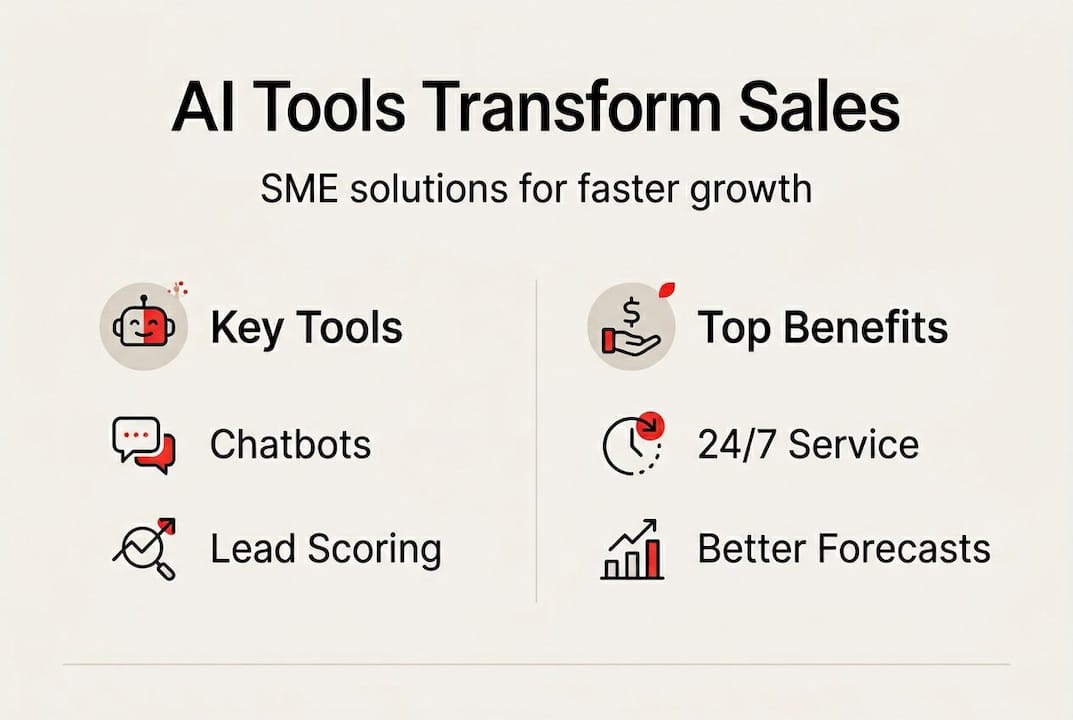
Lead scoring solutions sit somewhere in the middle. They assign a score to each contact based on their behaviour, such as pages visited, emails opened, or forms submitted, and surface the hottest prospects automatically. Explore AI lead generation software comparisons to find the right fit for your business size and budget.
| Tool type | Best for | Key benefit | Typical cost |
|---|---|---|---|
| AI chatbots | Website lead capture | 24/7 availability, instant responses | Low to mid |
| Predictive analytics | Sales forecasting and targeting | Identifies high-value opportunities | Mid to high |
| Lead scoring | Prioritising your pipeline | Focuses effort on the hottest leads | Low to mid |
The AI revolution in sales is not slowing down. McKinsey research consistently shows that businesses using AI in their sales processes outperform those that do not. You can also review AI in digital marketing lists to see how these tools fit into a broader growth strategy.
Pro Tip: If you are not sure where to start, add a chatbot to your website first. It is the quickest win, requires minimal setup, and immediately starts capturing leads around the clock.
How AI personalises customer interactions and boosts conversions
Here is where things get genuinely exciting. AI does not just automate tasks. It makes every customer interaction feel more relevant, more timely, and more personal, which directly improves your conversion rate.

AI-powered personalisation increases conversion rates by tailoring offers and messages to each lead’s specific behaviour. Rather than sending the same email to your entire list, AI segments your audience and adjusts the content, timing, and tone based on what each person has actually done.
Here is what that looks like in practice:
- A prospect who viewed your pricing page three times gets a follow-up email with a case study and a clear call to action
- A customer who bought six months ago receives a timely upsell recommendation based on their purchase history
- A new lead who abandoned a contact form gets a friendly nudge within the hour
- A dormant contact is re-engaged with a relevant piece of content rather than a generic newsletter
Automated nurture sequences keep prospects warm without requiring your team to remember every follow-up. This is especially valuable for SMEs where the sales team might be just one or two people juggling multiple responsibilities. You can read more about AI-driven lead generation tips to see how nurture sequences fit into a wider strategy.
Response time matters enormously in sales. AI’s effect on sales process is well documented, with research showing that responding to a lead within five minutes dramatically increases the chance of conversion. Automated AI chatbots make that kind of speed possible without adding headcount.
Pro Tip: Connect your CRM to your AI tools so that outreach is triggered by actual customer behaviour, not just scheduled dates. A prospect who just visited your services page is far more ready to hear from you than one who last engaged three weeks ago.
Five steps to integrate AI into your SME sales process
Ready to get started? Here is a straightforward roadmap that avoids the overwhelm and gets you results faster.
- Set clear objectives. Decide what you want AI to achieve. More leads? Faster follow-ups? Better forecasting? A specific goal keeps you focused and makes it easier to measure success.
- Select the right tools. Match the tool to your objective. If you want more leads from your website, start with a chatbot. If you want to prioritise your pipeline, look at lead scoring software.
- Train your team. Even the best AI tool fails without staff buy-in. Run a short session to show your team how the tool works and how it makes their jobs easier, not harder.
- Pilot in one area. Do not try to automate everything at once. Pick one part of your sales process, such as initial lead response, and test it thoroughly before expanding.
- Measure and refine. Track your key metrics before and after. A phased, goal-driven approach consistently delivers the best outcomes for SMEs. Adjust based on what the data tells you.
| Phase | Timeline | Key action | Resource needed |
|---|---|---|---|
| Planning | Week 1 to 2 | Set goals, research tools | Management time |
| Setup | Week 3 to 4 | Install and configure chosen tool | Tool provider support |
| Training | Week 4 to 5 | Staff onboarding and walkthrough | 2 to 3 hours |
| Pilot | Month 2 | Run in one area of sales process | Minimal |
| Review | Month 3 | Analyse results, plan next step | Management time |
Avoid the temptation to automate everything immediately. That is the most common mistake. Businesses that rush the rollout often end up with confused staff, poor data quality, and disappointing results. You can also look at how PPC strategies with AI and content marketing for AI sales can complement your new tools once the foundation is in place. The AI sales transformation for UK businesses is most successful when it is methodical and people-centred.
A fresh take: why AI in sales is less about tech, more about mindset
Here is something most AI articles will not tell you. The majority of AI sales failures have nothing to do with the technology. They trace back to a lack of clarity about what the business actually needs, and a failure to bring the team along for the journey.
We have seen it repeatedly. A business invests in a shiny new AI platform, the owner is excited, but the sales team sees it as a threat or an extra burden. Within three months, the tool is barely used and the investment is written off as a failure.
AI is not a switch you flip. It is a gradual shift in how your business operates. The SMEs that get the most from it are the ones that treat it as a culture change, not a software purchase. They involve their team early, celebrate small wins, and build confidence incrementally.
The practical advice? Before you choose a tool, have an honest conversation with your team. What slows them down? What do they wish they could automate? Their answers will point you straight to the highest-impact starting point. Explore future AI marketing trends to understand where this is all heading and why getting the culture right now pays dividends later.
Next steps: unlock AI-driven sales growth for your business
AI transformation does not have to be complex, expensive, or disruptive. The right tools, the right strategy, and the right support make all the difference. At Bamsh Digital Marketing, we help UK SMEs implement AI sales solutions that are practical, affordable, and built around your specific goals. Whether you are just starting out or ready to scale, our AI Lead Engine for SMEs brings together everything you need in one place. You can also explore answer engine optimisation and discover how to maximise online leads as part of a joined-up growth strategy. Book a free consultation with our team today and let’s build something that actually works for your business.
Frequently asked questions
How quickly can AI improve SME sales results?
Many SMEs see improvements in lead quality and sales efficiency within 3 to 6 months of adopting basic AI tools, particularly when chatbots and lead management are implemented together. AI use delivers ROI in months for SMEs that take a focused, phased approach.
Is AI expensive for small UK businesses?
Not at all. Modern AI packages offer simple pricing on monthly subscriptions, making them accessible for businesses with modest budgets. Many tools have free trials so you can test before committing.
What types of sales tasks does AI automate?
AI chatbots and automation tools cover a wide range of routine sales processes, including lead qualification, follow-up messaging, reporting, and identifying upsell or cross-sell opportunities.
Do I need technical staff to benefit from AI?
No. AI for SMEs focuses on user-friendly interfaces and hands-on support rather than heavy IT requirements. Most tools are designed so that any member of your team can use them with minimal training.