
TL;DR:
- Predictive lead scoring uses machine learning to improve lead qualification accuracy and increase conversions. It results in up to three times higher conversion rates and shorter sales cycles. Integrating scoring with automation enhances sales efficiency and marketing alignment for UK SMBs.
Chasing leads that never convert is one of the most draining experiences a business owner can face. You spend time, money, and energy following up with enquiries that go nowhere, while genuinely interested buyers slip through the cracks. Predictive lead scoring changes that entirely. By using historical data and machine learning to identify which leads are most likely to buy, UK SMBs can focus their efforts where it actually counts. The result? Conversion rates can rise by up to 3x and sales cycles become shorter. This article walks you through how it works, what it delivers, and how to put it into practice.
Table of Contents
- What is predictive lead scoring and how does it work?
- The impact of predictive lead scoring on sales performance
- Implementing predictive lead scoring: Steps for UK SMEs
- Integrating predictive lead scoring with automation and lead nurturing
- Why predictive lead scoring is about people as much as data
- Transform your lead generation with expert support
- Frequently asked questions
Key Takeaways
| Point | Details |
|---|---|
| Focus on high-potential leads | Predictive lead scoring directs your team away from time-wasting prospects to those most likely to convert. |
| Boost conversion rates | UK SMBs see up to 3x increased conversion and shorter sales cycles with predictive scoring. |
| Combine with automation | Integrate predictive scoring and lead nurturing tools for seamless, data-driven sales workflows. |
| Human input matters | Ongoing feedback from sales and marketing keeps predictive models relevant and effective. |
| Affordable, scalable solution | Most businesses can start predictive lead scoring with current data and basic software, scaling as needs grow. |
What is predictive lead scoring and how does it work?
Let’s start with the basics. Lead scoring is a method of ranking your prospects based on how likely they are to become paying customers. Traditional scoring assigns points manually — a contact fills in a form, that’s 10 points; they visit your pricing page, that’s another 15. It’s a reasonable idea, but it relies heavily on guesswork and gut instinct.
Predictive lead scoring takes this a step further. It uses machine learning algorithms to analyse patterns in your historical data and automatically assigns scores based on what has actually worked in the past. No gut instinct. No manual rules. Just data. If you want to understand the basics of lead scoring before going deeper, that foundation will help.
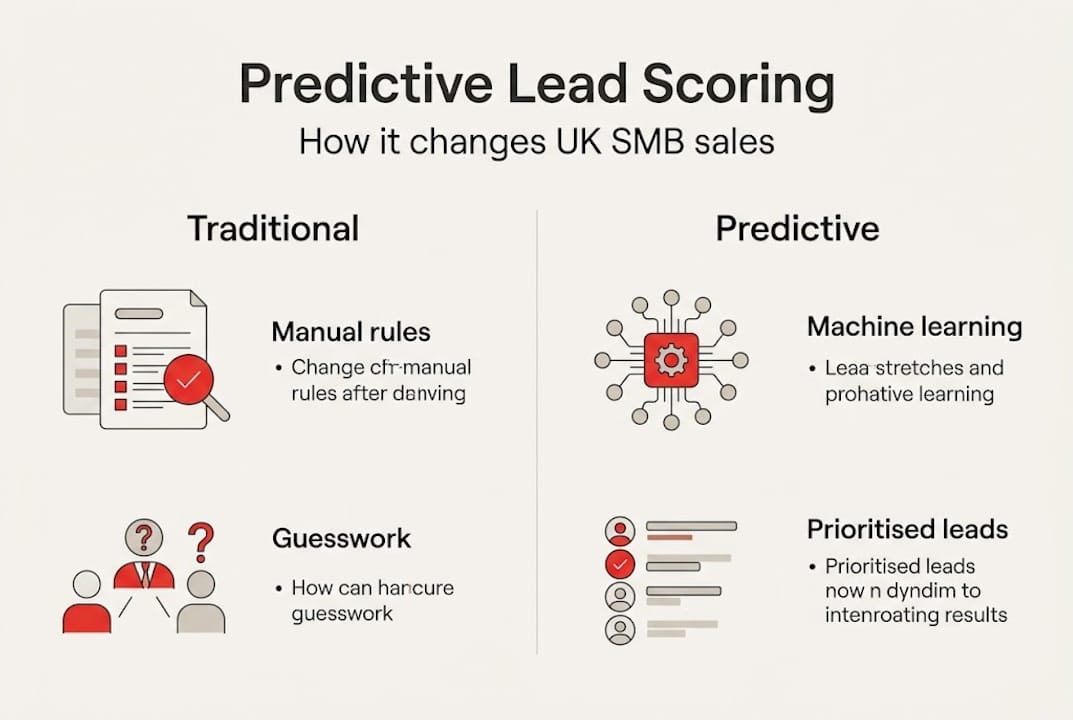
Traditional vs predictive lead scoring
| Feature | Traditional scoring | Predictive scoring |
|---|---|---|
| Method | Manual rules | Machine learning |
| Accuracy | Prone to bias | Data-driven |
| Scalability | Limited | Scales with data |
| Update frequency | Manual updates | Continuous learning |
| Time investment | High | Low after setup |
Predictive models use historical data to increase accuracy far beyond what manual scoring can achieve. The model looks at firmographic details (company size, sector, location), behavioural signals (pages visited, emails opened, content downloaded), and engagement history to build a picture of what a high-value lead really looks like.
Here is how the process typically works:
- Collect data — Pull together your CRM records, website analytics, email engagement stats, and sales history.
- Identify patterns — The algorithm finds common traits among your best past customers.
- Build the model — A scoring framework is created based on those patterns.
- Score incoming leads — New prospects are scored automatically as they enter your pipeline.
- Refine over time — As more data comes in, the model improves its predictions.
Pro Tip: Don’t wait until you have perfect data to begin. Start with what you have inside your CRM and build from there. Most UK SMBs already hold enough customer history to generate a useful initial model.
The impact of predictive lead scoring on sales performance
With the mechanics explained, what can predictive lead scoring actually achieve for your business? The numbers are encouraging.
Businesses adopting predictive scoring have reported 20 to 40% more sales-qualified leads and 15 to 25% shorter sales cycles. That is not a marginal improvement. That is a genuine shift in how effectively your pipeline operates.

Benchmark performance improvements
| Metric | Without predictive scoring | With predictive scoring |
|---|---|---|
| Conversion rate | Baseline | Up to 3x higher |
| Sales-qualified leads | Baseline | 20 to 40% increase |
| Sales cycle length | Baseline | 15 to 25% shorter |
| Sales team efficiency | Lower | Significantly improved |
“Predictive lead scoring can raise conversion rates by up to 3x and shorten sales cycles — giving sales teams a measurable edge over competitors relying on manual methods.”
For optimising your lead conversion process, this kind of performance lift can be transformative. Here is what that looks like in practice:
✅ Increased focus — Your team spends time only on leads with the highest potential.
✅ Better ROI — Marketing spend goes to campaigns that attract buyers, not tyre-kickers.
✅ Greater team efficiency — Sales reps close more deals in less time.
✅ Improved alignment — Marketing and sales agree on what a good lead looks like.
✅ Predictable revenue — Consistent scoring leads to consistent pipeline performance.
For small and medium-sized businesses in the UK, this alignment between marketing and sales is particularly valuable. When both teams work from the same data-driven definition of a qualified lead, the friction that normally slows deals down starts to disappear.
Implementing predictive lead scoring: Steps for UK SMEs
Understanding the benefits is one thing. Putting predictive lead scoring into practice requires a systematic approach. Here is a step-by-step process that works for most UK SMBs.
- Audit your existing data — Review what is already in your CRM. Look at closed deals, lost opportunities, and common traits among your best customers. Even modest data sets are a starting point.
- Define your ideal customer profile — Before any model can be built, you need a clear picture of who you are trying to attract and convert.
- Select your scoring tool — Evaluate automation tools for SMBs that include predictive scoring features, such as HubSpot, ActiveCampaign, or Salesforce. You can also explore dedicated AI lead generation options for more advanced capabilities.
- Set up your initial model — Work with your chosen platform to configure the scoring based on your historical data and customer profile.
- Test and review — Run the model for four to six weeks before making adjustments. Compare scored leads against actual outcomes.
- Iterate continuously — Adopting automation tools amplifies the value of predictive scoring, but only when the model is kept current.
Pro Tip: Bring both your marketing and sales teams into the process from day one. If only one team owns the scoring model, you lose the qualitative feedback that makes it more accurate over time.
Avoid these common mistakes:
- Overfitting the model — If your scoring is too specific to past data, it will fail to identify new types of ideal customers.
- Ignoring qualitative signals — Sales conversations reveal insights that no data set can fully capture. Feed that back into your model regularly.
- Tracking vanity metrics — Focus on lead-to-close rates and revenue, not just the volume of scored leads.
- Setting and forgetting — Predictive models degrade without regular review and updated data.
Integrating predictive lead scoring with automation and lead nurturing
To maximise these results, predictive scoring should not function in isolation. The real power comes when it is connected to your automation and lead nurturing systems.
Here is why. A high lead score tells you a prospect is ready for more direct engagement. A low score tells you they need nurturing first. When your CRM and automation tools can read those scores and act on them automatically, you stop wasting time on manual triage entirely.
Integrated automation can boost conversion rates significantly by focusing outreach on high-intent leads, rather than blasting the same message to everyone. The key is connecting your scoring system to the right tools and workflows.
Core integration points to set up:
- CRM sync — Ensure lead scores update automatically within your CRM so your sales team always sees the latest information.
- Email workflows — Trigger different email sequences based on score thresholds. High scorers get a direct sales follow-up; lower scorers enter a nurturing sequence.
- Scoring triggers — Set automated actions when a lead crosses a threshold. For example, a score above 80 could automatically assign the lead to a sales rep.
- Re-engagement campaigns — Use low scores to identify cold leads and route them into reactivation campaigns rather than letting them sit idle.
- Reporting dashboards — Track how scored leads progress through the funnel, so you can keep refining the model.
For practical guidance on automating lead follow-up and understanding why lead nurturing drives higher conversions, both are worth reading alongside this article.
The time savings for UK SMBs are real. Instead of your team manually deciding who to call next, the system does it for them. That frees up hours every week and ensures your highest-value opportunities never go cold.
Why predictive lead scoring is about people as much as data
Here is an uncomfortable truth: many businesses implement predictive lead scoring, see an initial lift, and then watch performance plateau. Why? Because they treat it as a technology project rather than a team process.
The model is only as good as the feedback loop behind it. If your sales team is not reporting why deals are won or lost, the algorithm is working blind. If marketing stops questioning whether the right leads are being prioritised, the model drifts out of alignment with reality.
We have seen this happen more than once. A business invests in a solid scoring tool, connects it to their CRM, and then steps back expecting it to run itself. Over time, market conditions shift, buyer behaviour changes, and the model keeps scoring based on old assumptions.
The businesses that get the best results are those that treat predictive scoring as a living system. They hold regular reviews. They encourage sales reps to flag when a high-scoring lead turns out to be a poor fit. They use building a conversion process as an ongoing discipline, not a one-time setup. The technology is the engine. Your people are the steering wheel.
Transform your lead generation with expert support
Ready to put predictive lead scoring to work for your business? You do not have to figure it out alone. At Bamsh Digital Marketing, we build automated lead generation systems that capture, score, nurture, and convert enquiries, even while you sleep. Our AI Lead Engine brings together CRM, scoring, automation, and AI in one joined-up system designed specifically for UK SMBs. We also help businesses get found in AI-powered search through Answer Engine Optimisation, so the right leads are finding you in the first place. Get in touch with the Bamsh team today and let’s build a smarter pipeline together.
Frequently asked questions
What makes predictive lead scoring better than manual methods?
Predictive lead scoring uses machine learning to identify buyer intent based on real data, which is far more accurate than manually assigned rules. Predictive accuracy drives a 3x increase in conversion rate compared to traditional approaches.
How much data is needed to get started with predictive lead scoring?
You do not need a vast database to begin. Businesses can build initial models from their current customer data, then improve the model as more records accumulate over time.
How do automation and predictive lead scoring work together?
Lead scores trigger automated actions within your CRM and email tools, routing high-intent prospects to sales and lower-scoring leads into nurture sequences. Integrated automation yields greater ROI by concentrating effort on your best opportunities.
Is predictive lead scoring expensive to implement?
Entry-level platforms are accessible for most UK SMBs and typically pay for themselves quickly. Predictive lead scoring reduces wasted sales time, which means your team becomes more efficient even at modest investment levels.
What UK regulations must I consider with predictive lead scoring?
You must comply with UK GDPR when collecting and processing customer data for modelling purposes. Always ensure your data collection practices are lawful, transparent, and documented appropriately.