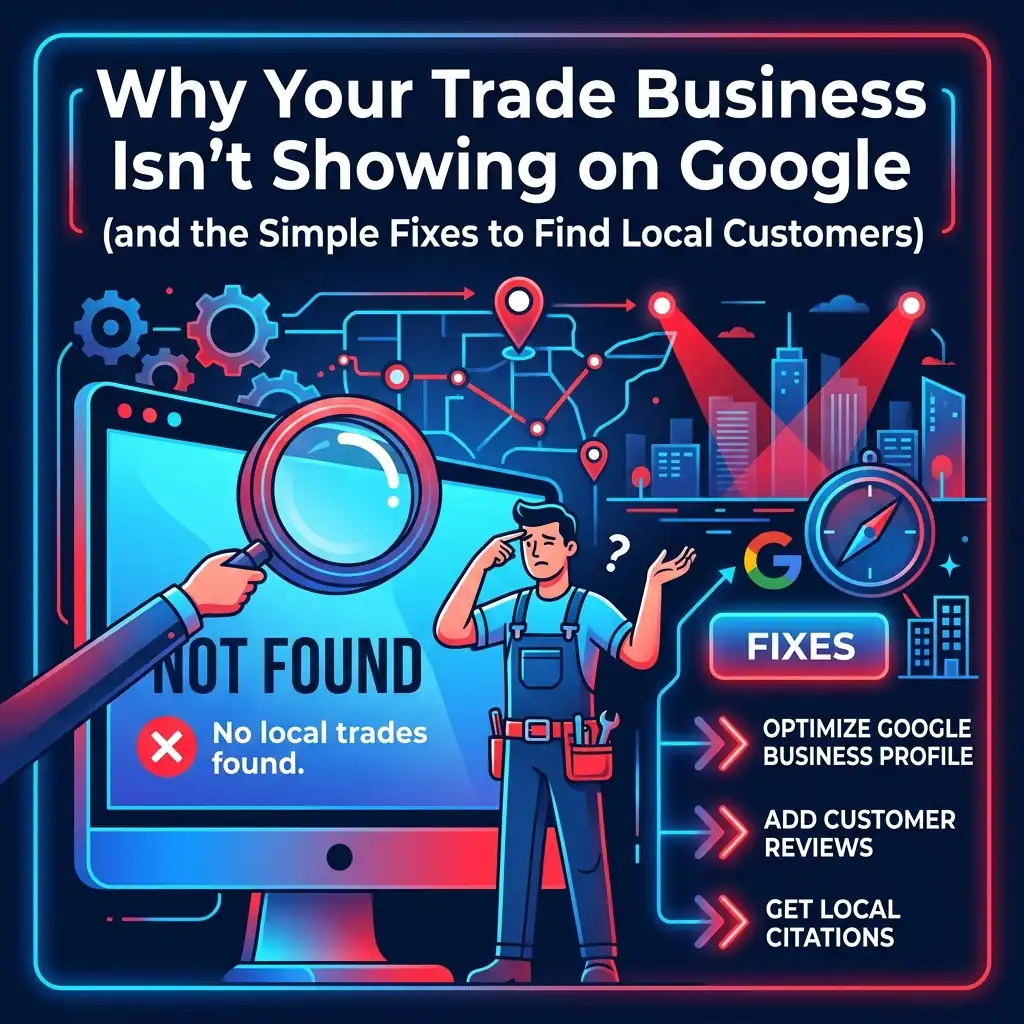
You search Google for your trade and town.
Your competitors appear. The large national companies appear. You might even see businesses that have been trading for far less time than you.
But your business is nowhere to be found.
If your trade business is not showing on Google, it does not mean Google has decided your competitors are better tradespeople. Google is trying to work out which businesses are relevant, trustworthy and useful for that particular local search.
If it cannot clearly understand what you do, where you work or whether your business information is reliable, you can struggle to appear when local customers need you.
The good news is that many of the common problems can be identified.
Try This Right Now
Open a private or incognito browser tab.
Search:
your main trade + your town
For example:
electrician Bristol
roofer Bath
plumber Weston-super-Mare
Then answer two questions:
- Are you on page one of the normal Google results?
- Are you appearing in the Google Map Pack?
Do not search your company name. Someone who already knows your business can usually find you.
The important test is whether a potential customer who doesn’t know you exist yet can find you.
If the answer to both questions is no, keep reading.
Why Is My Trade Business Invisible on Google?
There is rarely one simple reason.
Google needs to understand what your business does, where it operates and whether your website and Google Business Profile are relevant to the search being made.
For tradespeople, visibility usually involves two connected areas.
The first is your Google Business Profile, which can help you appear on Google Maps and within local results.
The second is your website, which gives Google much more information about your services, expertise and locations.
Problems with either can limit how easily customers find you.
3 Things That Are Almost Certainly Causing the Problem
Before looking for complicated SEO problems, check these three areas.
1. Your Google Business Profile Is Missing, Incomplete or Poorly Set Up
Your Google Business Profile is one of the most important parts of local search visibility.
It is the business listing customers can encounter in Google Maps and local search results.
If you have not created and verified your profile, start there.
If you already have one, check whether it accurately represents the business.
Important areas include:
- Business name
- Primary category
- Additional relevant categories
- Phone number
- Website
- Opening hours
- Service areas
- Services
- Business description
- Photographs
- Reviews
Do not add information simply because you think it might improve rankings.
Your profile should accurately represent the real business.
For mobile tradespeople, pay particular attention to how the address and service area are configured. If customers do not visit your business address, your profile should be set up appropriately as a service-area business rather than using your home as a customer-facing location simply to target an area.
If maintaining all of this is becoming another job in itself, BAMSH provides Google Business Profile management for businesses that want their profile professionally managed.
2. Your Website Has No Useful Local Content
Google needs to connect your services with the areas you genuinely serve.
Imagine two electricians.
One website simply says:
“We provide professional electrical services. Contact us today.”
The other explains the electrical work the company undertakes, where it operates, common customer problems, previous projects and the questions customers ask before booking.
The second gives both customers and search engines considerably more context.
Your website should make it clear:
- What trade you specialise in
- Which services you provide
- Which areas you genuinely cover
- What types of customers you work with
- What common problems you solve
- What customers can expect
- How they can contact you
That does not mean creating hundreds of near-identical town pages with only the place name changed.
Useful local content should exist because you genuinely serve that area and have something worthwhile to tell customers there.
This is a fundamental part of SEO for local trades businesses.
3. You Have Few or No Recent Reviews
Reviews help potential customers decide whether they can trust you.
They can also contribute to your local search presence.
If your competitors continue receiving genuine customer feedback while your last review was two years ago, their profiles may look much more established and current to somebody comparing businesses.
Build review requests into your normal process.
When a customer is happy with the completed job, make it easy for them to leave feedback.
Do not buy reviews, create fake accounts or offer rewards specifically in exchange for positive feedback.
You want a natural stream of genuine customer experiences.

Is Your Google Business Profile Set Up Correctly?
Having a profile is not the same as having a well-managed profile.
Start with your primary category.
It should describe the core business as accurately as Google’s available categories allow.
If you are a gas engineer, electrician or roofing contractor, make sure the categories genuinely reflect what you do.
Then look at your services.
Are important services missing? Are old services still listed even though you no longer provide them?
Check your opening hours as well.
If somebody finds you through Google only to discover that the phone number does not work or the opening hours are wrong, the profile is not doing its job.
Photographs also matter to customers.
Show real work where possible:
- Completed projects
- Work in progress
- Your team
- Vans
- Equipment
- Business premises where relevant
These are much more useful to somebody choosing a tradesperson than a profile containing only a logo.
What Is NAP Consistency and Why Does It Matter?
NAP stands for Name, Address and Phone number.
Your core business details should be consistent across important places where your company appears online.
That might include:
- Your website
- Google Business Profile
- Yell
- Checkatrade
- Relevant trade directories
- Social media profiles
- Local business directories
Problems often occur after a business moves, changes telephone number or rebrands.
Your Google profile might contain the new information while an old directory still displays an address you left three years ago.
Search for your own phone number and business name.
Look at what appears.
If you find outdated details on genuine business listings, correct them.
The goal is not to create hundreds of directory listings. It is to make sure the legitimate information already associated with your business is accurate.
Does Your Trade Website Actually Answer Customer Questions?
Many trade websites say roughly the same thing:
“We provide quality workmanship.”
“We have years of experience.”
“We pride ourselves on excellent customer service.”
Those statements may be true, but they do not necessarily answer what customers actually want to know.
A homeowner looking for an electrician might be asking:
- How much does a rewire cost?
- How long will it take?
- Can I stay in the property while the work is completed?
- What happens during an electrical inspection?
- Do I need a new consumer unit?
Someone looking for a roofer might want to know:
- Can this roof be repaired or does it need replacing?
- What causes this type of leak?
- How much will a repair cost?
- How quickly does it need attention?
This is where the They Ask, You Answer approach becomes useful.
Listen to the questions customers ask you every week and answer them clearly on your website.
Useful content can demonstrate genuine knowledge while helping search engines understand your services.
This is also part of the thinking behind BAMSH’s Websites for Tradespeople approach.
Why Can’t Customers Find My Trade Business Online Even Though I Have a Website?
Simply having a website does not guarantee visibility.
Your website may still have problems such as:
- Google has difficulty crawling important pages
- Important services do not have useful pages
- Page titles do not describe the content properly
- The site is difficult to use on mobile
- Pages load slowly
- Several pages compete for the same search
- Internal linking is poor
- Location information is vague
- Content does not satisfy what customers are searching for
- Important pages are too thin to be genuinely useful
This is where technical and on-page SEO become important.
The objective is not to trick Google.
It is to remove unnecessary barriers and make your website easier for search engines and customers to understand.
Our SEO services cover this wider work rather than treating local SEO as simply adding a few town names to a page.
If You’re a Tradesperson in Bristol, Here’s What You’re Up Against
Bristol is not one single local search market.
A plumber searching from Clifton may see different local results from someone making the same search in Filton, Bedminster or Kingswood.
That happens partly because Google considers the searcher’s location when producing local results.
You are also competing against several types of businesses at once:
- Established Bristol trades companies
- Sole traders
- Businesses based just outside Bristol
- Larger regional companies
- National brands
- Trade directories
- Lead-generation websites
And the competition changes by trade.
“Electrician Bristol” does not necessarily have the same competitive landscape as “landscaper Bristol”, “roofer Bristol” or “bathroom fitter Bristol”.
The Google Map Pack creates another challenge because only a small number of businesses receive that prominent initial visibility.
This is why local SEO for tradespeople in the UK needs to consider where the business is actually based, where its customers are and which services are commercially important.
Do not try to rank everywhere in the South West simply by creating dozens of thin location pages.
Start with the places where you genuinely work.
A Bristol tradesperson might then have legitimate reasons to discuss projects or services in areas such as:
- Clifton
- Bedminster
- Redland
- Horfield
- Filton
- Kingswood
- South Gloucestershire
If you also genuinely work in Bath, Weston-super-Mare or elsewhere across the South West, your website can reflect that too.
But each location strategy needs to make sense for the real business.
Note for publishing: Add verified Bristol/South West keyword volumes here once they have been taken from BAMSH’s keyword tool or Search Console research. I would not invent search-volume numbers or a competitor count without the underlying data.

Your Website and Google Business Profile Should Support Each Other
Do not treat Google Maps and your website as two completely separate marketing channels.
Your Business Profile can introduce somebody to the company.
Your website can then give them the depth they need to make a decision.
For example, somebody searching for a local roofer may find your Maps listing, read several reviews and then visit your website.
Once there, they might want to see:
- Roof repair services
- Areas covered
- Previous roofing projects
- Typical costs
- Accreditations
- Who runs the business
- Contact information
The information should make sense together.
If your Google Business Profile says you specialise in one service but your website barely mentions it, there is a disconnect worth addressing.
Common SEO Myths That Hold Tradespeople Back
“SEO Is a One-Time Fix”
It isn’t.
Websites change. Competitors improve. Search behaviour changes. New reviews arrive. Services change and technical issues develop.
SEO therefore requires monitoring and improvement rather than a single optimisation session.
“I Need Google Ads to Rank Organically”
You do not need to pay Google Ads to improve organic rankings.
Paid and organic search are different channels.
Google Ads can provide visibility while you are paying for campaigns, while SEO aims to improve your unpaid search presence over time.
Many businesses use both.
“I Need to Mention My Town as Many Times as Possible”
Repeating “plumber Bristol” in every paragraph is not a local SEO strategy.
Write naturally.
Make the location clear where relevant and provide useful evidence that you genuinely serve the area.
“More Pages Mean Better Rankings”
Only if those pages deserve to exist.
Creating 50 virtually identical location pages is very different from producing genuinely useful service and location information.
Quality, relevance and purpose matter more than simply increasing the page count.
The Cost of Being Found: DIY vs Professional SEO
There is plenty you can do yourself.
Creating a Google Business Profile is free. Asking customers for reviews costs nothing. You can add project photographs and write useful answers to common customer questions yourself.
The real question is whether you have the time and knowledge to do it consistently.
| Area | DIY approach | Managed approach |
|---|---|---|
| Google Business Profile | You manage information, photos and reviews | Profile monitored and managed for you |
| Website content | Written when you have time | Planned around services, customer questions and search demand |
| Technical SEO | Requires technical knowledge | Audited and monitored |
| Local SEO | You research and implement it | Strategy managed around genuine locations and services |
| Reporting | You interpret the data | Performance reviewed and explained |
| Time requirement | Your own time | Agency handles agreed work |
Do not assume DIY is automatically the wrong option.
For a sole trader with time and an interest in marketing, it can make sense.
But if every hour spent fighting with your website is an hour you could have spent completing paid work, outsourcing may eventually become the more practical option.
You can see the wider range of support available through our digital marketing services.
How Long Does It Take for a Trade Business to Show Up on Google?
There is no universal three-month or six-month answer.
A new business starting with a new website and Google Business Profile is in a very different position from an established company fixing several technical issues.
The timeframe can depend on:
- Competition
- Your location
- Website history
- Existing authority
- Google Business Profile quality
- Reviews
- Technical issues
- Content quality
- Which search terms you are targeting
Be cautious about anybody guaranteeing a particular organic ranking by a particular date.
Instead, look for progress across meaningful measures.
Are more relevant searches generating impressions?
Are important pages moving upwards?
Is your Google Business Profile receiving more calls or website visits?
Most importantly, are you receiving more suitable enquiries?
What Should You Fix First?
If you have read this far, do not try to change everything at once.
Start with the basics.
First, search your trade and town in a private browser and establish whether you appear.
Second, check that your Google Business Profile is claimed, accurate and complete.
Third, search your company name and phone number and correct outdated business information.
Fourth, review your website. Does it clearly explain your services and locations?
Fifth, look at your reviews. Are genuine customers continuing to leave feedback?
Those checks will give you a much clearer idea of where the problem lies.
You can also download the BAMSH trades brochure for more practical advice on improving your online visibility.
If you want professional help, see our SEO services, Google Business Profile management or our full range of digital marketing services.
If you are unsure which problem you actually have, book a free 15-minute call and we can discuss where your visibility is breaking down.
Frequently Asked Questions
Why is my trade business not showing on Google?
There can be several reasons. Your Google Business Profile may be incomplete or incorrectly configured, your website may lack relevant service and location information, or competitors may currently have stronger local search signals. Technical website problems can also prevent important pages from performing properly.
Why can’t customers find my trade business online?
Start by searching for your main service and town rather than your business name. If you cannot find yourself, review both your Google Business Profile and website. Make sure Google can clearly understand what you offer, where you operate and how the information on your website relates to the services customers are searching for.
How do I get my trade business to appear on Google Maps?
Create or claim your Google Business Profile and make sure it accurately represents the business. Check your category, contact details, opening hours, services, service areas and photographs. Genuine customer reviews and accurate information elsewhere online can also support your wider local presence.
Can I rank on Google without a website?
A business can appear in Google Maps through a Google Business Profile without having its own website. However, a website gives you much more space to explain your services, locations, experience and customer questions and can support your wider organic search visibility.
How does local SEO work for tradespeople in the UK?
Local SEO helps search engines understand the relationship between your business, services and geographic area. It can involve Google Business Profile optimisation, useful service and location content, reviews, accurate business information, technical SEO and relevant local links or mentions.
How long does it take to show up on Google?
There is no guaranteed timeframe. A new business in a competitive market may require considerably more work and time than an established business correcting a small problem. Monitor visibility, calls, website visits and enquiries rather than expecting every optimisation to produce an immediate ranking change.
Do Google reviews help a trade business?
Reviews are valuable because they help prospective customers assess your reputation and can contribute to local visibility. Concentrate on building a steady process for requesting genuine feedback from real customers rather than chasing an arbitrary review number.
Do I need Google Ads to appear on Google?
No. Google Ads can provide paid search visibility, but you do not need to advertise to rank in Google’s organic results. SEO and paid advertising are separate channels and can be used independently or together.
Does my Google Business Profile need the same details as my website?
Your core business information should be consistent. Check your business name, telephone number, address where applicable, website and other important details. If you change your contact information, remember to update relevant directories and other genuine business listings too.
Can BAMSH manage my local SEO for me?
Yes. BAMSH provides SEO services, Google Business Profile management and other digital marketing services for businesses that would rather have the work managed professionally.

Simple Fixes You Can Do Today For Your Trade Business Website
If you want to start finding local customers, follow these steps:
- Claim your profile: Go to Google Business Profile and ensure you own the listing.
- Add photos: Upload 10 high-quality photos of your recent work. Google loves fresh, original images.
- Ask for reviews: Send a link to your last five happy customers and ask for an honest review.
- Update your hours: Ensure your opening times are accurate, especially for bank holidays.
- Check your website on mobile: Open your site on your phone. If it is hard to read or the buttons are too small, you are losing customers.
How Bamsh Helps Tradespeople Grow
Bamsh specialises in helping tradespeople move from being “invisible” to being the go-to choice in their local area. This is not about tricks or “gaming the system.” It is about building a digital infrastructure that works as hard as you do.
Whether you are an invisible tradesperson starting from scratch or a frustrated tradesperson who is tired of wasted marketing spend, Bamsh provides straight-talking advice and clear pricing.
You can explore digital marketing costs to see what fits your budget or learn more about the AEO series for advanced visibility.
Next Steps
Ready to stop being invisible and start finding local customers?
- Option 1: Book a 15-minute introductory call with the team to discuss your trade business goals.
- Option 2: Use the Digital Marketing Costs Estimator to see what a professional campaign looks like for your budget.
- Option 3: Call the office directly on 0333 900 3322 for a no-nonsense chat about your website.
Visit https://bamsh.co.uk/websites-for-tradespeople/ to see how Bamsh builds sites that actually generate leads.