
You’re staring at your website. It’s not terrible, but it’s not great either. The fonts look a bit dated, the layout doesn’t work brilliantly on mobile, and you’re pretty sure your competitor’s site looks sharper than yours.
Here’s the question that keeps you up at night: Do you patch things up with a redesign, or do you burn it down and start fresh with a complete rebuild?
Let’s have an honest conversation about this. No sales pitch, no dodging the difficult bits. Just the truth about what each option really involves, what it costs, and how to make the right call for your business.
What’s the Actual Difference?
Before we dive into the decision, let’s get clear on what we’re talking about.
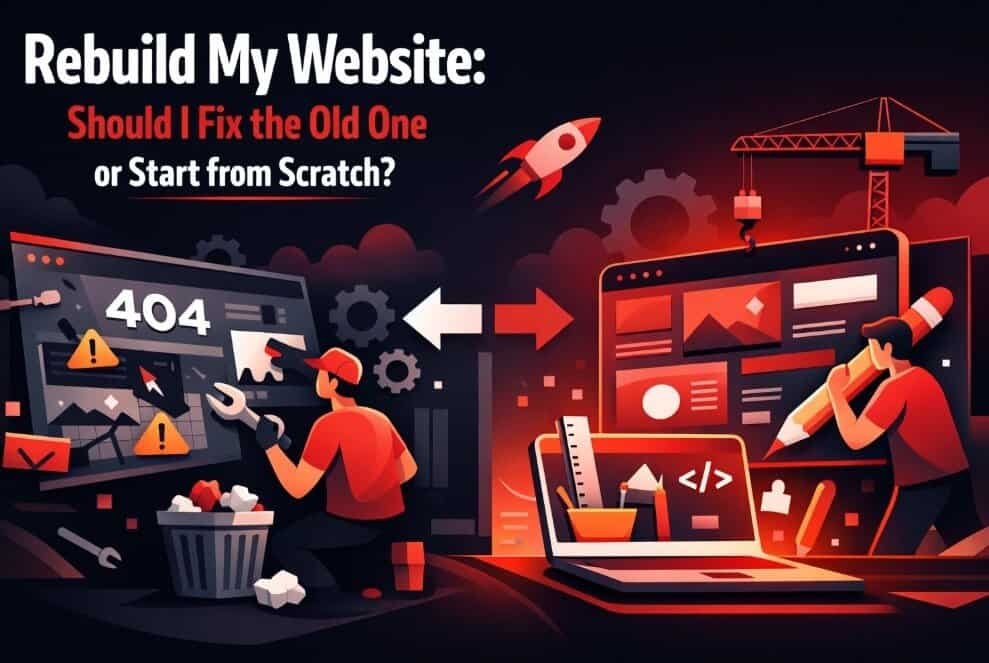
A redesign means updating the visual appearance of your existing site. Think of it like redecorating your house – new paint, new furniture, maybe knock down a non-structural wall or two. The foundations stay put. You’re keeping the same platform (WordPress, Shopflow, whatever you’re currently using) and the underlying structure, but giving everything a fresh coat of paint and improving the user experience.
A rebuild is tearing the house down to the foundations and building something new. You’re potentially moving to a different platform, restructuring how everything works behind the scenes, and creating something from the ground up. It’s a bigger commitment, no question about it.
The choice between them isn’t about which is “better” – it’s about which one solves your actual problems.
When a Redesign Makes Perfect Sense
Let’s start with the scenarios where fixing what you’ve got is absolutely the right move.
Your site works, but looks outdated. If your website functions properly, loads reasonably quickly, and doesn’t throw error messages at visitors, you might just have a visual problem. Maybe the design screams 2018, or the colour scheme makes people squint. A redesign sorts this out without the complexity of starting over.
You’re worried about your Google rankings. Here’s the thing – if you’ve spent years building up organic search traffic, you don’t want to risk that lightly. A redesign typically keeps your URL structure intact, which means your SEO equity stays safe. You’re not gambling with years of ranking progress.
Budget and timeline matter. Redesigns generally cost less and happen faster. We’re talking weeks rather than months, and thousands rather than tens of thousands. If you need results quickly or you’re working with limited resources, this is often your best bet.

Your CMS still does the job. If WordPress, Shopify, or whatever you’re using still meets your needs and receives regular updates, there’s no compelling reason to abandon ship. Modern platforms can do remarkable things with the right design approach.
When You Actually Need a Rebuild
Right, now let’s talk about the situations where patching things up just won’t cut it.
Your site has performance issues you can’t fix. Slow loading times, crashes under traffic, or pages that take ages to respond – these aren’t just annoying, they’re costing you business. If your current platform is the bottleneck and you’ve already tried optimising it, a rebuild with modern technology becomes necessary.
Security keeps you awake at night. Running an outdated CMS version that no longer receives security patches? Rebuild. Getting hacked repeatedly? Rebuild. If your platform is fundamentally insecure and can’t be patched, you’re gambling with your business and your customers’ data.
You’ve outgrown your current setup. Maybe you started with a simple brochure site and now you need e-commerce, membership areas, complex integrations with your CRM, or other advanced functionality. Sometimes your current platform simply can’t deliver what your business now requires.
The tech is genuinely obsolete. If your site runs on Flash (remember that?), an unsupported CMS, or technology that even developers struggle to work with, you’re building on sand. A rebuild gets you onto solid ground with modern, maintainable code.

The Honest Cost Comparison
Let’s talk money, because you’re thinking about it anyway.
A redesign for a small to medium business website typically runs between £3,000 and £12,000. Timeline? Usually 4-8 weeks from start to launch. You’re paying for design work, some development to implement it, and testing.
A full rebuild? You’re looking at £8,000 to £30,000+ depending on complexity, and a timeline of 8-16 weeks or more. You’re paying for strategy, information architecture, complete development from scratch, extensive testing, and migration.
The price difference isn’t arbitrary – it reflects the actual work involved. A rebuild requires solving problems that a redesign doesn’t touch: database structure, backend functionality, platform selection, and comprehensive testing of every feature.
The SEO Question Nobody Likes to Ask
Here’s what you’re really worried about: “Will I lose all my Google rankings?”
With a redesign, the risk is minimal. Your URLs stay the same, your site structure remains intact, and Google sees it as the same website with a fresh look. Rankings typically hold steady or even improve thanks to better user experience.
With a rebuild, there’s definitely risk – but it’s manageable with proper planning. The key is implementing 301 redirects from every old URL to its new equivalent, maintaining your metadata, and keeping your content quality high. We’ve seen sites maintain or improve their rankings post-rebuild when it’s handled properly.
The truth is, if your current site performs terribly (slow loading, poor mobile experience, high bounce rates), you might actually be hurting your SEO by not rebuilding. Google cares about user experience, and a clunky site doesn’t do you any favours.

What About a Hybrid Approach?
Sometimes the answer isn’t either/or – it’s both, just not at the same time.
If you need immediate improvements but know a full rebuild is eventually necessary, start with a strategic redesign. Focus on the most critical visual and UX updates, buy yourself breathing room, and plan the rebuild properly over the next 6-12 months.
This approach gives you quick wins whilst avoiding the pressure of rushing a complex rebuild. You can research platforms properly, plan your new structure thoughtfully, and budget appropriately.
Making Your Decision: The Framework
Here’s a practical way to think through this:
Start with these questions:
- Does your current platform receive regular security updates?
- Can your site handle your traffic without performance issues?
- Can your existing setup deliver the functionality you need for the next 2-3 years?
- Is your main concern purely visual/UX rather than technical?
If you answered yes to all four, lean towards a redesign. If you answered no to two or more, a rebuild deserves serious consideration.
Then consider your priorities:
- Speed to market – Redesign wins
- Budget constraints – Redesign wins
- Long-term scalability – Rebuild wins
- Technical debt – Rebuild wins
- SEO preservation – Redesign has less risk (but both can work)
What We Actually Recommend
After working with hundreds of businesses on this exact decision, here’s our honest take: most businesses jump to “rebuild” too quickly when a strategic redesign would solve their actual problems.
The excitement of starting fresh is real, but so is the disruption, cost, and risk. If your fundamental technical infrastructure works, don’t replace it just because it feels old.
However, if you’re genuinely constrained by your current setup – if you can’t add the features you need, if performance is chronically poor, if security is compromised – then delaying a rebuild is false economy. You’ll spend more in the long run trying to prop up inadequate technology.
The best decision comes from honest assessment of your actual problems, not your aesthetic preferences. A gorgeous redesign on a broken platform still gives you a broken platform. A rebuild that you didn’t actually need costs you time and money you could have invested elsewhere.
Your Next Step
Look at your website right now – honestly. Write down the specific problems it has. Not “it looks old” but “the mobile menu doesn’t work properly” or “we can’t add product variants” or “load time exceeds 5 seconds.”
If your list contains mostly visual and UX issues, start exploring web design services that specialise in strategic redesigns. If your list is full of technical limitations, performance problems, and functionality gaps, you need to have the rebuild conversation.
Either way, the worst decision is no decision. Your website doesn’t improve by waiting, and your competitors aren’t standing still. Whether you fix or rebuild, make the call and move forward.
Need help figuring out which path makes sense for your specific situation? That’s exactly what we do. No hard sell, just honest advice about what will actually work for your business.
Frequently Asked Questions
1. What is the difference between a website redesign and a rebuild?
A redesign updates the visual appearance of your existing site while keeping the same platform and underlying structure. A rebuild means creating a completely new website from the ground up, often on a different platform.
2. When does a website redesign make sense?
A redesign makes sense when your site works properly but looks outdated, your CMS still meets your needs, and your main goal is improving the design and user experience.
3. Why might businesses prefer a redesign instead of rebuilding?
Redesigns usually cost less and happen faster. They often take weeks rather than months and allow businesses to improve the site without replacing the entire system.
4. Will a website redesign affect my Google rankings?
A redesign typically keeps your URL structure intact, which helps preserve your SEO equity and reduces the risk of losing rankings.
5. When should a business consider a full website rebuild?
A rebuild becomes necessary when your website has performance problems, security issues, outdated technology, or cannot support the functionality your business needs.
6. What are common signs that a website needs a rebuild?
Slow loading times, repeated security problems, unsupported platforms, and missing functionality are clear indicators that rebuilding may be the best option.
7. How much does a website redesign typically cost?
A redesign for a small to medium business website typically costs between £3,000 and £12,000 and usually takes around four to eight weeks.
8. How much does a full website rebuild cost?
A rebuild can cost between £8,000 and £30,000 or more depending on the complexity and usually takes eight to sixteen weeks or longer.
9. Can a rebuild affect SEO rankings?
Yes, there is some risk, but proper planning such as implementing 301 redirects, maintaining metadata, and preserving content can protect rankings.
10. Is a hybrid approach between redesign and rebuild possible?
Yes. Businesses sometimes start with a redesign for immediate improvements and plan a full rebuild later once the strategy and budget are ready.