

Most british small businesses in the South West face a tough choice: balancing ongoing SEO work with fast-acting PPC campaigns to generate leads. Over 60% of small firms in the UK struggle to decide where to invest first. With budgets often stretched, every decision carries extra weight. This guide helps you untangle the key differences, offering clear insights so you can shape a marketing plan that fits both your growth goals and your local market.
Table of Contents
- Defining Seo And Ppc Strategies
- Types And Use Cases For Uk Firms
- How Seo And Ppc Deliver Results
- Comparing Costs, Speed And Roi
- Risks, Common Pitfalls And Mistakes
- Balancing Seo And Ppc For Growth
Key Takeaways
| Point | Details |
|---|---|
| SEO Focuses on Long-Term Growth | SEO builds organic authority over time, providing sustainable traffic without ongoing costs. |
| PPC Provides Immediate Results | PPC delivers quick visibility and precise targeting, ideal for time-sensitive marketing efforts. |
| Hybrid Strategies Enhance Performance | Combining SEO and PPC allows businesses to leverage immediate results while building long-term brand authority. |
| Continuous Optimisation is Crucial | Regularly review and adjust digital marketing strategies to maximise returns and adapt to market changes. |
Defining SEO and PPC Strategies
In the dynamic world of digital marketing, Search Engine Optimisation (SEO) and Pay-Per-Click (PPC) advertising represent two foundational strategies for attracting potential customers online. These approaches might seem similar at first glance, but they operate through distinctly different mechanisms to help businesses increase their digital visibility and generate quality leads.
SEO is fundamentally about improving web page rankings through strategic optimisations, encompassing technical, content, and popularity-based techniques. It involves carefully crafting website content, enhancing technical infrastructure, and building authoritative links to organically boost search engine rankings. Unlike paid advertising, SEO focuses on earning visibility through relevance and quality, which means businesses invest time and expertise rather than direct advertising spend.
PPC advertising, by contrast, provides an immediate pathway to visibility by allowing businesses to bid on specific keywords and place targeted adverts directly in search results. These adverts appear prominently when potential customers search for relevant terms, with businesses paying only when someone actually clicks on their advert. This model offers precise targeting, immediate results, and transparent cost tracking, making it an attractive option for businesses seeking quick, measurable lead generation.
While both strategies aim to drive website traffic, they differ significantly in approach, cost, and long-term value. SEO builds sustainable organic growth, whereas PPC delivers immediate, controllable visibility. Smart digital marketing strategies often combine both to create a comprehensive, multi-layered approach to online lead generation.
Here’s a concise comparison of SEO and PPC in terms of core business impact:
| Aspect | SEO | PPC |
|---|---|---|
| Traffic Generation | Gradual, sustained growth | Immediate, controlled surge |
| Cost Structure | High upfront, low ongoing | Ongoing spend per click |
| Measurement | Indirect, long-term metrics | Direct, real-time cost and conversion data |
| Longevity | Lasting results over months/years | Ceases instantly if budget stops |
| Strategic Role | Builds authority and brand trust | Drives fast awareness and targeted leads |
Pro tip: Regularly audit and adjust your digital marketing strategy, testing different keyword combinations and tracking performance metrics to optimise your SEO and PPC investments.
Types and Use Cases for UK Firms
UK businesses across various sectors leverage SEO and PPC strategies differently, depending on their specific marketing objectives, target audience, and competitive landscape. Understanding the complementary roles of organic and paid search strategies becomes crucial for developing a robust digital marketing approach.
For e-commerce businesses like online retailers, PPC advertising offers immediate visibility for product launches, seasonal promotions, and competitive keyword targeting. These firms can quickly appear at the top of search results, driving traffic and generating sales during critical shopping periods. In contrast, SEO strategies provide long-term brand authority, helping businesses like tech startups and professional services establish credibility by creating comprehensive, informative content that ranks consistently in search results.

Small to medium enterprises (SMEs) in the UK often benefit from a hybrid approach. Local service businesses might use PPC for immediate lead generation in specific geographical areas, while simultaneously investing in SEO to build sustainable organic traffic. Professional services such as legal firms, accountants, and consultants typically combine both strategies – using PPC for urgent client acquisition and SEO for establishing thought leadership and long-term trust.
The choice between SEO and PPC isn’t binary but strategic. Businesses must consider factors like budget, competition, industry dynamics, and specific marketing goals. Some sectors, such as competitive B2B markets or specialised professional services, might allocate more resources to SEO, while e-commerce and retail might lean more heavily on PPC for immediate sales generation.
Below is a summary of typical use cases for UK businesses utilising SEO and PPC:
| Business Type | SEO Focus | PPC Focus |
|---|---|---|
| E-commerce Retailers | Authority, product content, brand ranking | Seasonal promotions, new launches, quick sales |
| Local Service Providers | Building local credibility, informative pages | Targeting immediate leads in specific areas |
| Professional Services | Thought leadership, expertise-based ranking | Client acquisition, urgent campaigns |
| Tech Start-ups | Organic growth, niche authority | Market validation, emerging visibility |
Pro tip: Develop a flexible digital marketing strategy that allocates budget and resources between SEO and PPC based on your specific business objectives, regularly reviewing and adjusting your approach to maximise return on investment.
How SEO and PPC Deliver Results
Understanding how SEO and PPC generate tangible business results requires a nuanced appreciation of their distinct yet complementary approaches to digital marketing. These strategies deliver results through fundamentally different mechanisms of driving website traffic and generating leads, each offering unique advantages for businesses seeking online visibility.
Search Engine Optimisation (SEO) delivers sustainable, long-term results by systematically improving a website’s organic search rankings. This approach focuses on creating high-quality, relevant content, optimising technical website infrastructure, and building authoritative backlinks. The primary benefit of SEO is its ability to generate consistent traffic without direct per-click expenses, essentially creating a compounding return on marketing investment. Businesses investing in SEO can expect gradually increasing visibility, with top-ranking content continuing to attract potential customers months or even years after initial creation.
Pay-Per-Click (PPC) advertising, conversely, provides immediate and highly targeted results. By bidding on specific keywords, businesses can position their adverts prominently in search results, ensuring instant visibility to potential customers actively searching for their products or services. PPC’s primary strength lies in its precision targeting, allowing businesses to reach specific demographics, geographical locations, and user intent with remarkable accuracy. This approach is particularly effective for time-sensitive promotions, product launches, or entering new market segments where rapid visibility is crucial.
The most successful digital marketing strategies often integrate both SEO and PPC, recognising that these approaches are not mutually exclusive but complementary. By leveraging the immediate impact of PPC alongside the sustainable growth of SEO, businesses can create a robust, multi-layered approach to online lead generation that maximises both short-term opportunities and long-term brand authority.
Pro tip: Develop a dynamic digital marketing strategy that allocates resources between SEO and PPC based on your specific business goals, regularly analysing performance metrics to optimise your approach and balance immediate results with sustainable growth.
Comparing Costs, Speed and ROI
Comparing SEO and PPC requires a nuanced understanding of their distinct financial dynamics and performance metrics. The economic landscape of digital marketing reveals profound differences in cost structures, speed of results, and return on investment, making each strategy uniquely suited to different business objectives.
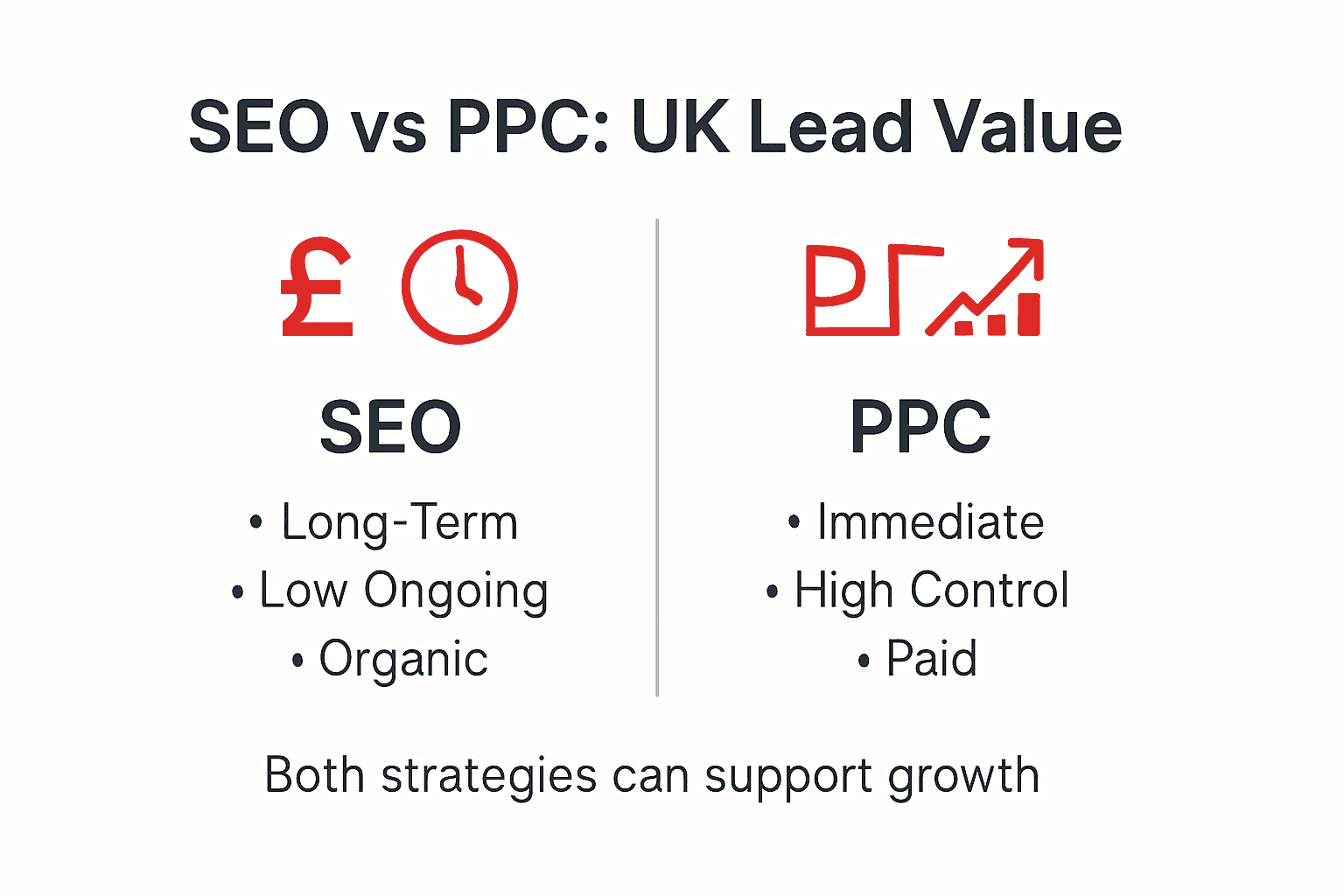
Search Engine Optimisation (SEO) represents a long-term investment strategy with a unique financial profile. Initial costs are substantial, involving comprehensive website audits, content creation, technical optimisation, and link-building efforts. However, these upfront expenses transform into increasingly efficient marketing over time. Once established, SEO generates organic traffic without continuous direct expenditure, creating a compounding effect where initial investments continue delivering results months or even years after implementation. Businesses can potentially achieve consistent lead generation at progressively lower per-acquisition costs as their organic rankings improve.
Pay-Per-Click (PPC) advertising offers a contrasting financial model characterised by immediate visibility and precise cost control. Businesses pay directly for each click, with costs varying dramatically based on keyword competitiveness and industry sector. While PPC delivers instant traffic and enables rapid testing of marketing messages, it requires ongoing financial investment to maintain visibility. The moment advertising spend ceases, so does the traffic – creating a more volatile and potentially expensive marketing approach. High-competition sectors can see click costs escalate quickly, demanding sophisticated budget management and continuous performance monitoring.
Ultimately, the most effective digital marketing strategies often blend both approaches, balancing the immediate impact of PPC with the sustainable growth potential of SEO. By understanding each strategy’s unique economic characteristics, businesses can develop a nuanced approach that maximises short-term lead generation while building long-term digital authority. The key lies in strategic resource allocation, continuous performance analysis, and adaptability to changing market dynamics.
Pro tip: Implement a hybrid digital marketing budget that allocates resources between SEO and PPC proportionally, tracking individual channel performance and adjusting spend to optimise overall marketing efficiency.
Risks, Common Pitfalls and Mistakes
Navigating the digital marketing landscape requires a sophisticated understanding of potential risks and challenges inherent in both SEO and PPC strategies. Common mistakes can significantly undermine marketing effectiveness, leading to wasted resources and missed opportunities, making strategic awareness crucial for businesses.
In Search Engine Optimisation (SEO), significant risks emerge from algorithmic complexity and evolving search engine requirements. Over-optimisation represents a substantial pitfall, where aggressive tactics like keyword stuffing or low-quality link building can trigger punitive actions from search engines. Businesses often make critical errors by pursuing short-term ranking gains through manipulative techniques, which can result in dramatic visibility reductions or complete removal from search results. Additionally, SEO demands consistent, high-quality content creation and technical website maintenance – a resource-intensive process that requires ongoing commitment and expertise.
Pay-Per-Click (PPC) advertising carries its own set of complex risks, primarily centred around budget management and targeting precision. Poorly configured campaigns can rapidly deplete marketing budgets without generating meaningful returns. Common mistakes include inadequate keyword selection, imprecise audience targeting, and neglecting critical landing page optimization. The most expensive PPC errors often involve bidding on overly broad or irrelevant keywords, resulting in high cost-per-click rates with minimal conversion potential. Businesses must continuously monitor and refine their PPC strategies to maintain efficiency and prevent escalating, unproductive advertising expenditure.
Successful digital marketing demands a holistic approach that acknowledges and mitigates these inherent risks. By implementing robust tracking mechanisms, maintaining flexibility in strategy, and investing in continuous learning and optimisation, businesses can transform potential pitfalls into opportunities for growth and improvement. The most resilient marketing approaches integrate comprehensive performance analysis, adaptive techniques, and a nuanced understanding of both SEO and PPC dynamics.
Pro tip: Establish a monthly review process that critically evaluates your digital marketing performance, systematically identifying and addressing potential risks in both SEO and PPC strategies before they become significant challenges.
Balancing SEO and PPC for Growth
Successful digital marketing demands a sophisticated approach that strategically integrates Search Engine Optimisation (SEO) and Pay-Per-Click (PPC) advertising to create a comprehensive growth strategy. Understanding the power of traffic generation requires businesses to view these strategies not as competing channels but as complementary tools designed to achieve specific marketing objectives.
Effective integration begins with understanding each strategy’s unique strengths. SEO builds long-term organic credibility through consistent, high-quality content and technical website optimisation, creating a sustainable foundation for digital presence. PPC, conversely, provides immediate visibility and precise targeting, allowing businesses to rapidly test marketing messages, capture time-sensitive opportunities, and generate quick leads. The most successful businesses develop a nuanced approach that leverages the immediate impact of PPC while simultaneously investing in the sustainable growth potential of SEO.
A strategic balance involves allocating resources based on specific business goals, industry dynamics, and competitive landscape. For instance, emerging businesses might initially rely more heavily on PPC to generate immediate visibility and validate market positioning, while gradually building SEO capabilities. Established firms with strong market recognition can afford to shift more resources towards organic growth strategies, using PPC for specific campaign objectives or market expansion. The key lies in continuous performance analysis, understanding customer acquisition costs, and maintaining flexibility to adjust strategies as market conditions evolve.
Implementing a truly integrated approach requires breaking down traditional marketing silos. Insights gained from PPC keyword performance can inform SEO content strategies, while organic search data can help refine paid advertising targeting. This cross-channel learning creates a powerful feedback loop where each marketing approach informs and enhances the other, ultimately driving more efficient and effective customer acquisition.
Pro tip: Develop a monthly cross-channel marketing review process that analyses performance data from both SEO and PPC, using insights from each strategy to continuously optimise your overall digital marketing approach.
Achieve the Best Balance Between SEO and PPC for Your UK Business
Struggling to decide between SEO and PPC for generating valuable leads in the UK market? This article highlights the challenges businesses face in choosing the right strategy to boost visibility while controlling costs. Whether your goal is sustainable organic growth or immediate targeted traffic, understanding the distinct advantages and pitfalls of each approach is essential. At Bamsh Digital Marketing, we specialise in creating tailored solutions that combine both SEO and PPC strategies to meet your unique business needs and maximise your return on investment.
Our award-winning team will help you cut through the confusion with a transparent, results-driven approach. From optimising your website and content for organic search with our SEO Agency Bristol – Bamsh Digital Marketing services to managing precision Google Ads campaigns designed to lower costs and increase quality leads, we provide clear, measurable solutions that align with your growth ambitions. Discover how our Bamsh – Bamsh Digital Marketing expertise can empower your business to attract, convert and retain your ideal customers effectively.
Take control of your digital marketing today. Book a free 15-minute strategy session with Bamsh and start turning both SEO and PPC into a powerful growth engine for your business.
Frequently Asked Questions
What is the main difference between SEO and PPC?
SEO focuses on improving website rankings organically through optimisations, while PPC provides immediate visibility by paying for advertisements that appear in search results.
How does SEO deliver long-term value for businesses?
SEO builds sustainable organic traffic by enhancing website content, technical infrastructure, and backlinks, generating leads without ongoing advertising costs over time.
What are the costs associated with SEO and PPC?
SEO often involves substantial initial costs for optimisations, but can result in lower ongoing expenses as organic traffic grows. PPC requires continual spending based on clicks and may vary based on competition for keywords.
How can businesses effectively balance SEO and PPC strategies?
Businesses should integrate both strategies by allocating resources based on specific goals, using insights from one to enhance the other, and continuously analysing performance to optimise their digital marketing approach.