

TL;DR:
- CTR indicates whether your message resonates across various digital channels and impacts ad costs.
- Measuring and optimizing CTR requires understanding channel benchmarks, segmenting data, and testing headlines and calls to action.
- Focusing solely on CTR can be misleading; it’s essential to consider conversions and the full customer journey for real business growth.
Many UK business owners check their clicks religiously but rarely stop to ask what those numbers actually reveal. Click-through rate (CTR) is one of the most telling metrics in digital marketing, yet it’s also one of the most misunderstood. It sits at the heart of your Google Ads, email campaigns, and organic search performance, quietly signalling whether your messaging is landing or falling flat. This article breaks down exactly what CTR is, how to measure it properly, the pitfalls to avoid, and the practical steps you can take to improve it across every channel you use.
Table of Contents
- Defining click-through rate: The basics and why it matters
- How to measure CTR: Tools, methods and practical examples
- Common mistakes and pitfalls: Why your CTR might not tell the full story
- Ways to improve your CTR: Actionable tactics for UK businesses
- Why focusing on CTR alone could be holding your business back
- Take your marketing to the next level with expert support
- Frequently asked questions
Key Takeaways
| Point | Details |
|---|---|
| CTR definition | CTR shows the percentage of viewers who click your ad or link, vital for tracking marketing success. |
| Measurement methods | CTR can be measured automatically in most platforms or manually using the basic formula. |
| Common pitfalls | High CTR doesn’t always mean high sales—ensure relevance and check conversion data. |
| Improvement strategies | Optimise creative, targeting, and landing pages to boost CTR with practical, local tactics. |
| Holistic perspective | CTR matters, but it’s only one metric—balance it with conversion rates and business growth. |
Defining Click-Through Rate: The Basics and Why it Matters
Let’s start with the formula. CTR is calculated as (Clicks divided by Impressions) multiplied by 100. So if your Google Ad is shown 1,000 times and 30 people click it, your CTR is 3%. Simple enough. But the real value of this metric goes much deeper than a single percentage.
CTR is not a one-size-fits-all figure. It behaves very differently depending on the channel you’re measuring. CTR applies across Google Ads, email campaigns, display advertising, and organic SEO, and each has its own typical range. Understanding which channel you’re looking at is essential before drawing any conclusions.
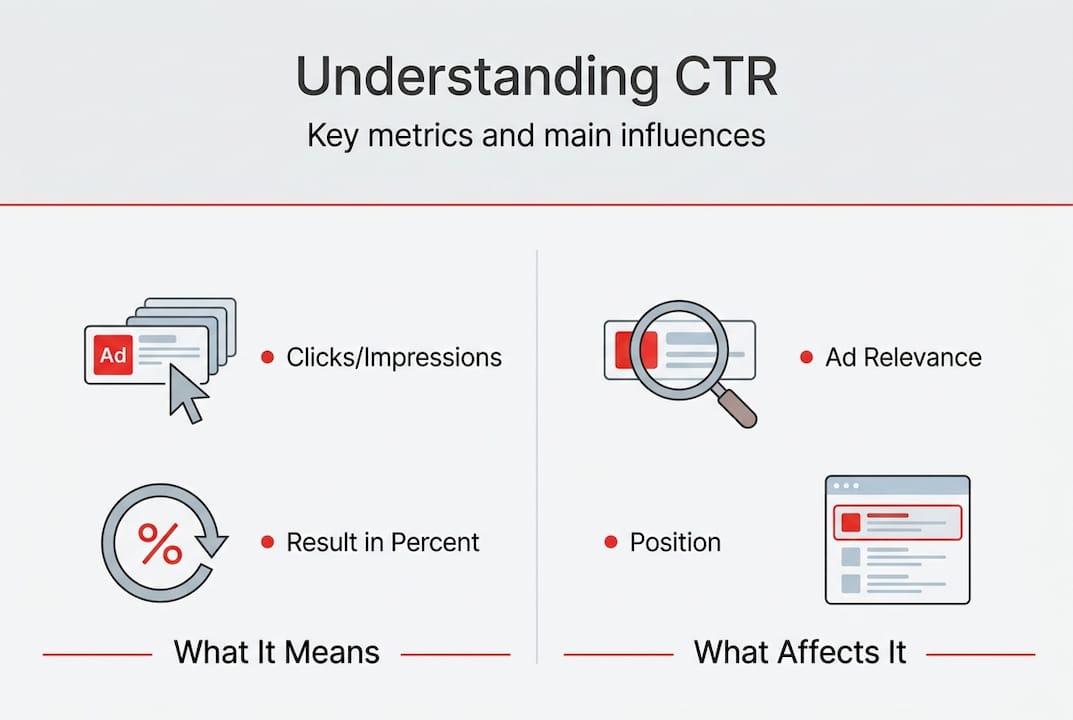
Here’s a quick comparison of typical CTR benchmarks for UK SMB campaigns:
| Channel | Typical CTR range | What influences it |
|---|---|---|
| Google Search Ads | 3% to 6% | Ad relevance, Quality Score, bid |
| Display Ads | 0.1% to 0.5% | Creative, audience targeting |
| Email marketing | 2% to 5% | Subject line, list quality, offer |
| Organic SEO | 1% to 4% | Title tag, meta description, ranking |
Why does click-through rate matter so much? Because it tells you whether your message is resonating. A low CTR on a paid ad means you’re paying for impressions that go nowhere. In Google Ads, CTR also feeds directly into your Quality Score, which affects how much you pay per click and where your ad appears. A stronger CTR can literally lower your advertising costs.
For email, a low CTR suggests your content or offer isn’t compelling enough to prompt action, even when someone has opened the email. For SEO, it signals that your page title and meta description aren’t enticing enough, even if you’re ranking well.
Here’s what a healthy CTR can do for your business:
- Reduce your cost per click in paid campaigns
- Improve ad placement without increasing your budget
- Signal to Google that your content is relevant
- Reveal which messages resonate with your audience
- Help you prioritise where to focus your marketing effort
Understanding the difference between SEO and PPC performance is also key here, as CTR benchmarks and optimisation tactics differ significantly between the two.
How to Measure Click-Through Rate: Tools, Methods and Practical examples
Most major platforms measure CTR automatically, which makes your job easier. But knowing where to find the data and how to interpret it is a skill worth developing.
Google Ads computes CTR automatically from clicks and impressions data, displaying it in your campaign dashboard. Google Search Console does the same for organic search. Email platforms like Mailchimp or Klaviyo report CTR per campaign. The data is there. The challenge is using it correctly.
Here’s a step-by-step approach to measuring CTR effectively:
- Choose your channel. Decide whether you’re measuring paid ads, email, or organic search. Each requires a different platform.
- Set your date range. Always compare the same time period when tracking changes. Avoid comparing December to January, as seasonal shifts distort the data.
- Identify your impressions and clicks. Pull these figures directly from your platform’s reporting dashboard.
- Apply the formula. Divide clicks by impressions, then multiply by 100. This gives you your CTR percentage.
- Benchmark against your industry. A 2% CTR might be excellent for display ads but underwhelming for a branded search campaign.
Let’s look at a practical UK example. A Bristol-based plumbing company runs a Google Ads campaign targeting emergency callouts. Over one month, their ad receives 2,400 impressions and 96 clicks. Their click-through rate is 4%. That’s solid for a local service ad. But if they compare this against their email newsletter, which had 800 opens and only 8 clicks, the email CTR of 1% signals a problem with the call to action or content relevance.

Pro Tip: Always compare like-for-like data. Comparing CTR across different time frames, audiences, or devices will give you misleading conclusions. Segment your reporting by device, location, and audience type to get a clear picture. Exploring PPC management platforms can help you automate this kind of segmented reporting. If you’re using PPC as part of your lead generation strategy, tracking CTR at campaign and ad group level is essential for identifying what’s working.
Common Mistakes and Pitfalls: Why Your CTR Might Not Tell The Full Story
Here’s where things get interesting. A high click-through rate feels like a win. But it can actually mask serious problems if you’re not looking at the full picture.
The most common mistake is treating click-through rate as the end goal rather than a signal. High CTR with low conversions is a classic warning sign of an ad-to-landing-page mismatch. Your ad promises one thing, and the page delivers something different. The visitor clicks, feels misled, and leaves immediately.
Other pitfalls to watch for:
- Click fraud. Competitors or bots clicking your ads inflate your CTR without adding any genuine interest. This is particularly common in competitive industries.
- Creative fatigue. The same ad shown repeatedly to the same audience stops getting clicks over time. Click-through rate drops, but it’s not because your offer is weak. It’s because people have seen it too many times.
- Broad targeting. Showing your ad to a wide, untargeted audience might generate impressions but few relevant clicks, dragging your click-through rate down.
- Mobile and speed issues. A user clicks your ad on a mobile device, but your landing page loads slowly or isn’t mobile-friendly. They bounce instantly. This harms your Quality Score and your conversion rate.
“A click is just the beginning. What happens after the click is where the real marketing work starts.”
This is why it’s worth reading about why websites miss leads, because often the CTR looks fine but the post-click experience is where businesses lose potential customers.
Pro Tip: Never evaluate a campaign on click-through rate alone. Always pull conversion data alongside it. If your CTR is 5% but your conversion rate is 0.2%, the problem is not awareness. It’s what happens after the click.
Ways to Improve Your Click-Through Rate: Actionable Tactics for UK Businesses
Now for the part you’ve been waiting for. Here are proven steps to improve your CTR across paid ads, email, and organic search.
- Rewrite your headlines first. Your headline is the single biggest lever for click-through rate improvement. Test benefit-led headlines against curiosity-driven ones. For Google Ads, include the search term in the headline where possible.
- Sharpen your call to action. Vague phrases like “Click here” or “Learn more” underperform. Use specific, action-oriented language like “Get your free quote today” or “Book your consultation now.”
- Use ad extensions in Google Ads. Sitelinks, callouts, and structured snippets make your ad larger and more informative, which naturally increases click-through rate.
- Segment your audience. Broad targeting wastes impressions and drops click-through rate performance over time. Narrower, more relevant audiences click more because the message speaks directly to them.
- Refresh your creatives regularly. Creative fatigue is real. Rotate new visuals and copy every four to six weeks to maintain engagement.
For email specifically:
- Test subject lines with A/B splits before sending to your full list
- Personalise the subject line with the recipient’s name or location
- Keep your preview text compelling, as it acts as a second subject line
- Send at the right time, as mid-morning on Tuesday and Wednesday tends to perform well for UK B2B audiences
For organic SEO, CTR effectiveness can be improved by rewriting your title tags and meta descriptions to be more specific and benefit-focused. Use numbers, questions, and power words to stand out in search results.
Pro Tip: Prioritise the changes with the biggest potential impact first. Headlines and calls to action will move the needle faster than colour changes or font tweaks. Pair this with solid retargeting strategies to re-engage people who clicked but didn’t convert, and explore higher conversion tips to make the most of every click you earn.
Why Focusing on Click-Through Rate Alone Could be Holding Your Business Back
Here’s an uncomfortable truth: we’ve seen businesses obsess over CTR to the point where it actually hurts their results. They optimise their ads to attract as many clicks as possible, often by making bold promises or using clickbait-style headlines. The click-through rate soars. The sales don’t.
Click-through rate is a signal, not a destination. What matters is the full journey: from impression to click, click to landing page, landing page to enquiry, enquiry to sale. If you’re only watching one step, you’re flying blind on the rest.
We’ve worked with UK businesses who had a 6% CTR on their Google Ads and were still losing money. Why? Because the clicks were coming from the wrong audience, and the landing page wasn’t converting. Shifting focus to SEO vs PPC for leads and understanding the full customer journey changed everything for them.
The businesses that grow consistently are the ones who treat CTR as one piece of a larger puzzle, alongside conversion rate, cost per acquisition, and customer lifetime value. Keep click-through rate in its proper place: a useful indicator, not the final word.
Take Your Marketing to The Next Level With Expert Support
Improving your CTR is a great starting point, but it’s only one part of building a digital marketing engine that consistently brings in leads and revenue. At Bamsh, we help UK businesses get more from every click through expert PPC campaign management that’s transparent, targeted, and built around your goals. If you prefer to start on your own terms, our DIY SEO tool gives you the insights to improve your organic CTR without needing an agency. And if you’d like to talk through your specific situation, you can book a free 15-minute call with our team. No pressure, no jargon, just clear advice.
Frequently Asked Questions About Click-Through Rate
What is a good click-through rate for UK businesses?
A good CTR varies by channel, but 2% to 5% is considered strong for Google Ads in the UK. Always compare by channel and benchmark against your specific industry average rather than a generic figure.
How can I manually calculate click-through rate?
Divide your total clicks by your total impressions, then multiply by 100. The CTR formula is straightforward: (Clicks / Impressions) x 100 gives you your percentage.
Does a higher click-through rate always mean more sales?
No. A high CTR with low conversions typically points to a mismatch between your ad and your landing page. Clicks signal interest, but your page still needs to do the work of converting that interest into action.
Why is click-through rate important for SEO?
A higher organic CTR signals to Google that your result is relevant and useful, which can positively influence your rankings. CTR in SEO is shaped primarily by how compelling your title tag and meta description are to searchers.