
TL;DR:
- Many business owners mistakenly believe their CRM “does AI” when it merely automates tasks or stores data. True AI in CRM involves systems that read signals, predict outcomes, and take actions autonomously, driven by machine learning and predictive analytics. Implementing AI requires clean data, redesigned workflows, and reinvestment of time saved into high-value activities to maximise growth and efficiency.
Most business owners assume their CRM is already “doing AI” the moment a vendor slaps that label on the dashboard. It is not. What is AI in CRM is one of the most misunderstood questions in modern business technology, and getting the answer wrong costs you real money. True AI in customer relationship management goes far beyond storing contact records or sending automated emails. It is an active system that reads signals, predicts outcomes, and takes action, often without you lifting a finger. This guide breaks down exactly what that means, what you gain from it, and how to make it work for your business.
Table of Contents
- Key takeaways
- What is AI in CRM: definition and core capabilities
- How AI improves CRM workflows and decision-making
- Benefits and measurable impacts of AI in CRM
- Challenges and success factors when implementing AI in CRM
- Practical next steps: how to start with AI in your CRM
- My honest take on AI CRM adoption
- How Bamsh can help you harness AI in your CRM
- FAQ
Key takeaways
| Point | Details |
|---|---|
| AI CRM is not just automation | True AI in CRM uses machine learning and predictive analytics to drive decisions, not merely trigger pre-set actions. |
| Data quality determines results | AI is only as good as the data it works with; clean, structured records are non-negotiable before deployment. |
| Time savings must be reinvested | AI frees up nearly five hours per week per seller, but only those who redirect that time into high-value work see growth. |
| Architecture matters as much as features | Deploying AI on top of a poorly designed CRM produces suggestions, not outcomes. |
| Start focused, then expand | Begin with one or two modules such as lead scoring or automated follow-up, measure the impact, and build from there. |
What is AI in CRM: definition and core capabilities
At its core, an AI-powered CRM is not a traditional CRM with a few smart features bolted on. True AI CRM requires AI-native architecture, where large language models and autonomous agents form the structural foundation of the system, not an afterthought added to an existing database.
Traditional CRM stores information. You log a call, update a deal stage, and record a note. The system holds the data; you do the thinking. AI in customer relationship management flips this entirely. The system observes, interprets, and acts.
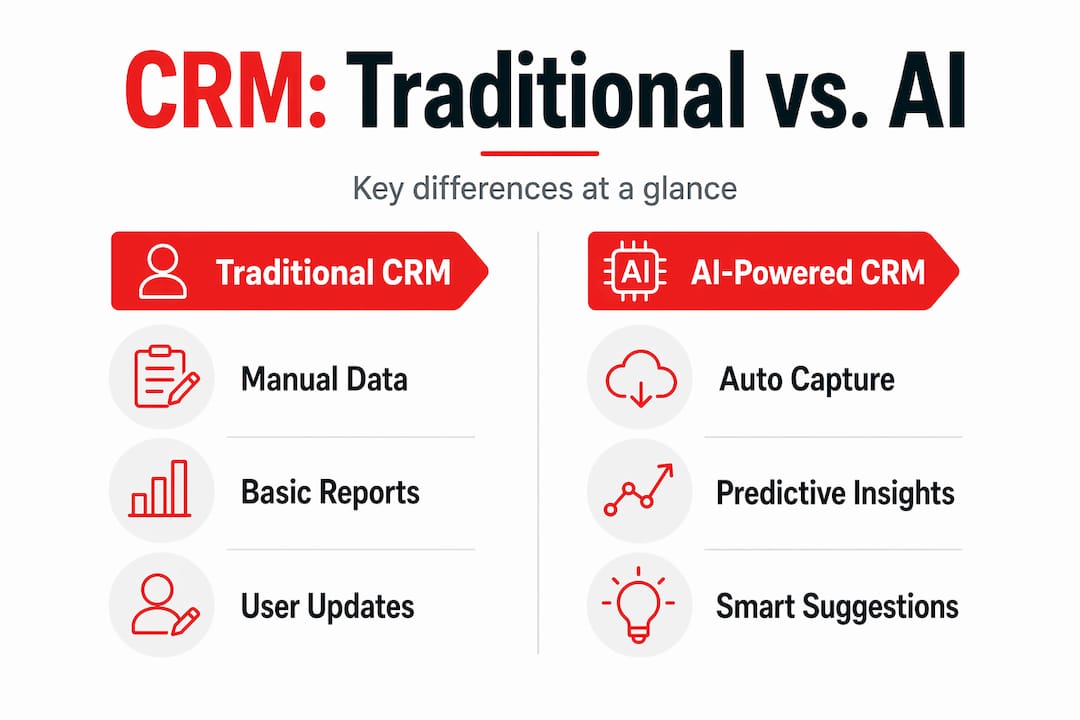
Here is the clearest way to see the difference:
| Feature | Traditional CRM | AI-powered CRM |
|---|---|---|
| Data entry | Manual, user-driven | Automatic capture from calls, emails, and web activity |
| Lead prioritisation | Based on gut instinct or simple filters | Predictive scoring using firmographic and engagement signals |
| Pipeline management | Updated by sales reps | Self-updating based on deal velocity and behaviour |
| Follow-up actions | Manually scheduled | Autonomously triggered and routed |
| Forecasting | Historic averages | Real-time modelling based on current engagement |
The core technologies driving this are machine learning (which identifies patterns in your data), natural language processing (which reads and summarises conversations), and predictive analytics (which calculates likely outcomes before they happen).
Pro Tip: Ask any CRM vendor whether their AI is a native part of the architecture or a plugin layer. If they hesitate, that tells you everything.
How AI improves CRM workflows and decision-making
This is where things get genuinely useful for your day-to-day operations. Understanding how AI improves CRM is not about theory; it is about what stops happening manually and what starts happening automatically.
AI CRM automatically captures and summarises customer interactions, prioritises leads using engagement signals, and forecasts deals based on deal velocity rather than guesswork. That means your sales team stops wasting time updating records and starts spending time talking to the right people.
Here is what that looks like in practice:
- Automatic interaction logging: Every email, call recording, and meeting note is captured and summarised without a rep touching the keyboard. The most effective AI CRM systems extract recommended next steps from those summaries automatically.
- Predictive lead scoring: Rather than relying on a rep’s instinct about who is “hot,” AI scores every lead using dozens of signals including company size, website visits, email opens, and response timing.
- Pipeline self-management: Deals move through stages based on actual activity, not what a rep remembers to update on a Friday afternoon.
- Autonomous follow-up orchestration: AI systems plan and execute follow-up actions within set parameters, routing enquiries, sending sequences, and triggering alerts without human instruction.
- Next best action recommendations: Rather than wondering what to do with a stalled deal, the system tells the rep exactly what action is most likely to move it forward.
The practical outcome is that your pipeline reflects reality, not memory. Your reps work a focused list, not a bloated spreadsheet. And your lead follow-up happens automatically, even when your team is busy with other things.
Pro Tip: The single biggest workflow win from AI CRM is eliminating manual data entry. AI-powered automatic capture preserves CRM accuracy and keeps adoption rates high. Without it, your AI has nothing reliable to learn from.
Benefits and measurable impacts of AI in CRM
Let us get specific, because vague promises about “better customer relationships” do not help you justify an investment or set realistic expectations.

The research here is worth paying attention to. AI saves sellers nearly five hours per week on average, according to Gartner. That is significant. But the headline beneath it is even more revealing: 72% of sales organisations fail to reinvest that time into high-value activities. The teams that do reinvest are 2.2 times more likely to exceed their customer growth goals. The benefit is real. The discipline to capture it is what separates winners from the rest.
Here is a summary of the measurable benefits businesses typically see:
| Benefit area | Impact |
|---|---|
| Sales rep time savings | Nearly 5 hours per week freed from admin |
| Customer growth likelihood | 2.2x higher for teams that reinvest AI time savings |
| Forecast accuracy | Improved through real-time deal velocity modelling |
| Lead conversion | Higher through predictive scoring and timely follow-up |
| Team capacity | SMBs can compete with larger organisations without adding headcount |
“For startups and small businesses, AI CRM acts as a digital backbone, enabling them to compete with larger organisations through automation and smarter data use.”
This competitive levelling effect is particularly important for UK SMEs. You do not need a 20-person sales team to run an intelligent, responsive customer relationship system. You need the right AI technology for CRM, configured properly and connected to your marketing and service workflows. Bamsh sees this regularly with clients who thought they needed more staff but actually needed a smarter system. The AI applications in customer service and sales can do the heavy lifting that previously required significant headcount.
AI embedded close to customer-facing execution guides decisions as they happen, supporting sales quotes, service interactions, and campaigns in real time rather than retrospectively.
Challenges and success factors when implementing AI in CRM
Let us be honest. AI in CRM is not a plug-and-play solution. Many businesses switch on AI features and expect transformation. What they get instead is a slightly smarter version of their existing mess. The technology does not fix broken processes; it accelerates whatever you already have.
Many teams overestimate AI CRM capabilities when underlying data quality and workflows are not aligned. The result? AI stays stuck at the suggestion layer rather than executing within workflows. You get a dashboard of recommendations that nobody acts on.
Here is how to avoid that outcome:
- Audit your data quality first. If your CRM records are incomplete, duplicated, or out of date, AI will learn from bad inputs. Clean the foundation before building on it.
- Redesign workflows around AI capabilities. Do not ask AI to fit into your old process. Map out where decisions happen and rebuild those steps to let AI handle the routine ones.
- Distinguish between suggestion AI and execution AI. A key operational difference is whether your AI only surfaces recommendations in the UI or actually routes, triggers, and orchestrates actions autonomously. Execution AI delivers far greater ROI.
- Eliminate manual data entry as a priority. This is non-negotiable. If reps are still logging calls by hand, you will never get clean enough data for AI to work properly.
- Plan what you will do with the time saved. This sounds obvious, but reinvesting AI time savings into high-value sales activities is the step most businesses skip, and it is the step that determines whether AI moves the needle on revenue.
Pro Tip: Before evaluating any AI CRM platform, write down the three biggest time wasters in your current sales process. If the platform cannot directly address at least two of them, it is probably not the right fit for your stage of growth.
Practical next steps: how to start with AI in your CRM
You do not need to overhaul everything at once. The most effective approaches start focused and expand once you have proof of impact.
Start by identifying which AI CRM platform fits your business size and sector. Smaller businesses often benefit from platforms that bundle AI capabilities with CRM out of the box, rather than enterprise tools that require significant configuration. Once you have a platform in mind, focus your early efforts here:
- Lead scoring module: Set this up first. It gives you an immediate signal on where to focus, and the wins are visible within weeks.
- Automated follow-up sequences: Connect your CRM to email and SMS so that enquiries receive timely responses without manual intervention. This alone can transform conversion rates.
- Interaction capture and summarisation: Turn on automatic logging for calls and emails immediately. This builds the data foundation that all other AI features depend on.
- Predictive forecasting: Once you have three to six months of clean data, activate forecasting. It will change how you run your pipeline reviews.
When aligning your team, frame AI as the system that handles the paperwork so they can focus on the conversations that close deals. Resistance usually comes from fear of replacement, not logic. Address it directly.
Measure ROI by comparing conversion rates, pipeline accuracy, and time-on-admin before and after implementation. Review quarterly and adjust which modules you are using based on what the data shows. Explore how AI transforms sales growth for UK SMEs to understand what realistic benchmarks look like at different growth stages.
My honest take on AI CRM adoption
I have worked with dozens of businesses over the years who came to us frustrated that their “AI CRM” had not delivered the results they expected. Almost every time, the issue was not the technology. It was the approach.
There is a pattern I have seen repeatedly. A business owner invests in an AI-capable platform, tells the team it is live, and waits for the magic to happen. Three months later, the pipeline is still messy, the reps are still updating records manually, and the AI recommendations are being ignored. Nothing has fundamentally changed because nothing about the underlying process changed.
What I have learned is that AI in CRM is not a feature you switch on. It is a new way of operating. The businesses that get the most from it are the ones willing to ask uncomfortable questions about their data, their workflows, and their team habits. That is genuinely hard work upfront. But when it is done properly, you end up with a system that works for you around the clock, catches the leads your team would have missed, and gives you a level of visibility into your pipeline that most business owners have never experienced before.
My advice? Stop thinking about CRM as software and start thinking about it as your growth infrastructure. AI does not replace your people. It makes your people better at the parts of their job that actually win business.
— Martyn
How Bamsh can help you harness AI in your CRM
If you have read this far, you already know that AI in CRM is not optional for businesses serious about growth. The question is how to make it work for your business without wasting months on the wrong setup.
At Bamsh, we help UK businesses build CRM systems and automated pipelines that do the heavy lifting for you. From lead capture to nurturing to conversion, our AI Lead Engine brings together CRM, automation, and AI into one connected system that generates leads predictably. We also offer expert guidance on Google and digital presence to make sure your CRM has a steady flow of quality enquiries to work with.
If you want to see what AI-powered CRM could do for your business, get in touch with Bamsh today.
FAQ
What is AI in CRM, in simple terms?
AI in CRM means your customer relationship management system uses machine learning and predictive analytics to automate data capture, score leads, update pipelines, and trigger follow-up actions without manual input. It moves from a passive record-keeper to an active participant in your sales and service process.
How does AI improve CRM for small businesses?
AI enables small businesses to operate like larger organisations by automating repetitive tasks, prioritising the best leads, and ensuring no enquiry falls through the gaps. Research shows AI CRM acts as a digital backbone that allows SMBs to compete with bigger competitors through smarter data use.
What are the main benefits of AI in CRM?
The core benefits include saving sales reps nearly five hours per week on admin, improving forecast accuracy, increasing lead conversion through timely follow-up, and enabling smaller teams to handle higher volumes of customer interactions without adding headcount.
Does AI in CRM work without good data?
No. AI is only as effective as the data it learns from. Poor data quality keeps AI stuck at producing suggestions rather than executing actions. Cleaning your CRM records and eliminating manual data entry are prerequisites before AI can deliver measurable results.
What is the difference between automation and AI in CRM?
Automation follows fixed rules you set in advance, such as sending an email when a form is submitted. AI in CRM learns from patterns, adapts over time, predicts outcomes, and can make decisions within parameters without you pre-programming every scenario. It is a fundamentally more capable and responsive system.