

Most UK small business owners chase leads relentlessly, pouring budget into ads and outreach while their brand remains invisible to the wider market. This tunnel vision creates a costly cycle: high acquisition costs, low trust, and prospects who’ve never heard of you. Brand visibility builds top-of-mind awareness, trust, and reduces customer acquisition costs for UK SMEs in competitive markets. This guide explains why balanced visibility is essential, how it drives sustainable growth, and practical steps to integrate brand awareness with lead generation for maximum return.
Table of Contents
- Key takeaways
- What is brand visibility and why it matters for UK SMEs
- The tangible benefits of brand visibility on sales and growth
- Why a balance between brand awareness and lead generation is crucial
- How SME owners adapt and innovate to boost brand visibility
- How Bamsh can help you boost your brand visibility and generate leads
- How can UK SMEs measure the effectiveness of their brand visibility efforts?
- What are the most cost-effective channels for increasing brand visibility for small businesses?
- How do brand visibility and lead generation work together to grow a business?
Key Takeaways
| Point | Details |
|---|---|
| Brand visibility builds trust | Repeated exposure across channels builds recognition and trust among potential customers. |
| Lower customer acquisition costs | Higher visibility means prospects recognise your brand before buying, reducing the need for cold outreach. |
| Balanced visibility maximises ROI | A balanced mix of brand building and lead generation increases overall return on investment. |
| Integrated visibility drives growth | Coordinating visibility across search, social and local channels creates compounding effects that sustain growth. |
What is brand visibility and why it matters for UK SMEs
Brand visibility measures how often and how prominently your business appears in front of your target audience across channels they use daily. It’s not just about being seen once, it’s about repeated exposure that builds recognition, trust, and the perception that your business is stable and credible. When prospects encounter your brand multiple times through search results, social feeds, local listings, and ads, they start to remember you and associate your name with solutions to their problems.
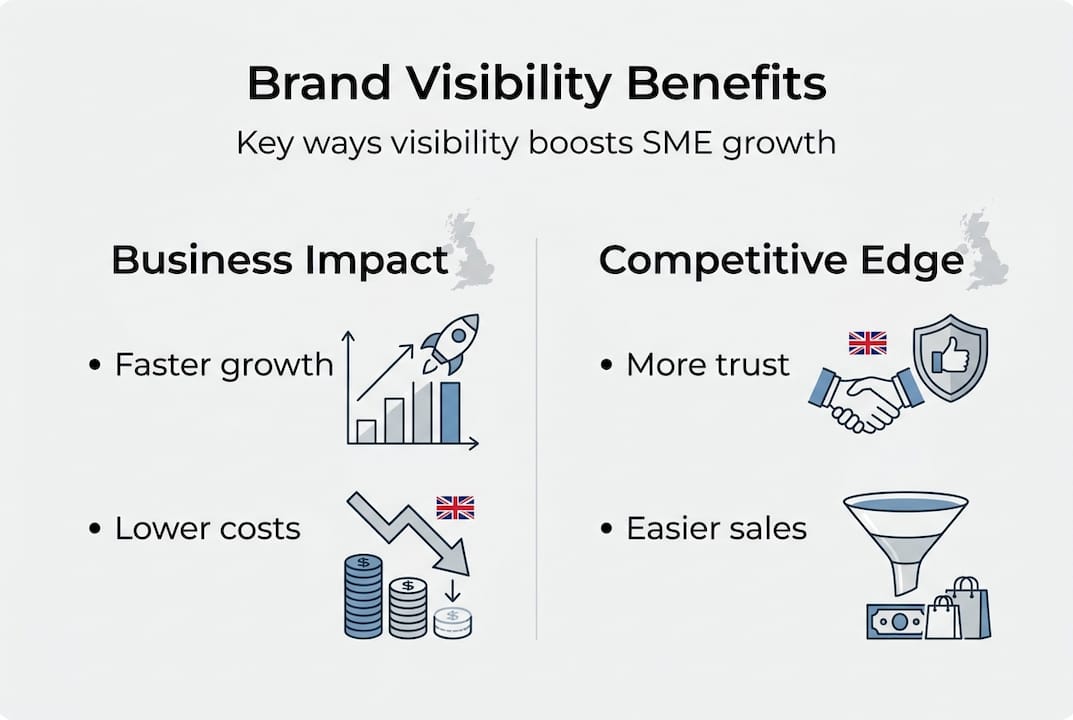
For UK SMEs competing against larger rivals with bigger budgets, visibility levels the playing field. Empirical studies confirm branding, including visibility, drives SME sales performance, growth, and competitive advantage by making smaller businesses appear established and trustworthy. High visibility reduces customer acquisition costs because prospects already know who you are when they’re ready to buy, eliminating the need to start from scratch with cold outreach. You’re not convincing strangers, you’re converting warm leads who’ve seen your name repeatedly.
Common visibility channels include SEO to rank in Google searches, social media presence to engage audiences where they spend time, paid advertising to amplify reach quickly, PR and partnerships to build authority, and local listings like Google Business Profile to capture nearby customers. Each channel reinforces the others, creating a compound effect that makes your brand impossible to ignore.
“UK SMEs prioritise brand building as their top strategic goal, with visibility driving awareness, trust, and preference among target customers, directly impacting revenue growth and market position.”
Investing in boosting business visibility isn’t vanity marketing, it’s a strategic move that pays dividends across every stage of the customer journey. When your brand is visible, marketing becomes easier, sales cycles shorten, and customer lifetime value increases because people prefer to buy from businesses they recognise and trust.
The tangible benefits of brand visibility on sales and growth
Strong brand visibility translates directly into measurable sales performance and competitive advantages that protect your market share. Research spanning over a decade shows that SMEs investing in branding and visibility consistently outperform competitors in revenue growth, customer retention, and profitability. Visibility isn’t a soft metric, it’s a leading indicator of commercial success.
| Visibility level | Average annual sales growth | Customer acquisition cost |
|---|---|---|
| High visibility SMEs | 18-24% increase | 35% lower than average |
| Low visibility SMEs | 3-7% increase | 50% higher than average |
The table above illustrates the stark difference visibility makes. High visibility SMEs grow faster because their marketing efforts compound over time, each campaign building on existing brand equity rather than starting from zero. Lower acquisition costs mean more budget available for product development, customer service, and scaling operations instead of constantly feeding the lead generation machine.
Competitive advantages from visibility extend beyond sales figures. Market differentiation becomes easier when your brand is recognised, you’re not just another option, you’re the option customers think of first. Customer loyalty strengthens because repeated exposure builds emotional connections and trust that survive price competition. When a crisis hits or a competitor launches, visible brands weather storms better because they’ve built goodwill and recognition that protects them.

Pro Tip: Track visibility metrics like search impressions, social reach, and branded search volume alongside sales KPIs to prove ROI. Set quarterly goals for both brand and revenue metrics, then adjust spend based on which channels drive the strongest correlation between visibility gains and sales growth. This data-driven approach ensures you’re building brand equity that converts, not just awareness for its own sake.
For practical tactics on converting visibility into revenue, explore how to increase sales with digital marketing strategies tailored to UK SMEs.
Why a balance between brand awareness and lead generation is crucial
Many UK SMEs fall into the trap of focusing exclusively on lead generation because it feels more immediate and measurable. Ads generate clicks, forms capture emails, and sales teams follow up. But this approach ignores a fundamental truth: SMEs can’t afford pure brand-building; need integrated visibility-to-leads funnel combining awareness, SEO, content, paid ads, and nurture sequences. Without prior brand awareness, lead generation becomes expensive and inefficient, you’re paying premium rates to convince cold prospects who’ve never heard of you.
The marketing funnel illustrates why balance matters. At the top, brand visibility creates awareness among a broad audience who may need your services in future. Middle-funnel content and SEO capture those prospects when they start researching solutions. Bottom-funnel paid ads and direct outreach convert warm leads who already recognise your brand. Nurture sequences keep prospects engaged until they’re ready to buy. Each stage depends on the previous one, skip awareness and the entire funnel leaks.
Balanced 60/40 awareness/lead gen recommended for SMEs to optimise budgets and maximise long-term ROI. This split ensures you’re building brand equity that reduces future acquisition costs while still capturing ready-to-buy prospects today. Pure lead generation burns through budget with diminishing returns, pure brand building takes too long to impact revenue for cash-conscious SMEs.
- Build broad awareness through SEO, social media, and local listings to reach potential customers early in their journey.
- Create valuable content that educates prospects and positions your brand as the expert solution when they research.
- Use targeted paid ads to capture high-intent searches and retarget engaged audiences who’ve interacted with your content.
- Implement automated nurture sequences that keep your brand top-of-mind until prospects are ready to convert.
- Measure conversion rates at each funnel stage to identify bottlenecks and optimise spend between awareness and direct response.
Pro Tip: Run small tests comparing cold outreach to retargeting campaigns aimed at audiences who’ve seen your brand multiple times. Track cost per lead and close rates for each. Most SMEs find retargeting warm audiences costs 40-60% less and converts 3-5 times better, proving the value of upfront visibility investment.
For actionable tactics across the funnel, review lead generation tactics for SMEs and broader digital marketing strategies that integrate awareness and conversion.
How SME owners adapt and innovate to boost brand visibility
UK SME owner-managers bring a unique advantage to brand building: their personal voice and adaptability. Unlike large corporations bound by rigid processes, SME leaders can pivot quickly, test new channels, and inject personality into their brand that resonates with target audiences. This agility, combined with creative use of available tools, enables SMEs to punch above their weight in visibility.
Digital bricolage describes how owner-managers extend personality to brand; digital bricolage and AI/GEO emerging for visibility improvement. SME leaders creatively combine free and low-cost tools, repurpose content across platforms, and leverage their own networks to amplify reach without enterprise budgets. This resourcefulness turns constraints into competitive advantages.
- Publishing thought leadership content on LinkedIn to build personal and business brand simultaneously
- Using AI tools to generate social posts, ad copy, and SEO-optimised content faster and cheaper than agencies
- Leveraging geo-targeting in Google and Facebook ads to dominate local markets with precision
- Partnering with complementary local businesses for cross-promotion and shared visibility
- Engaging directly with customers on social media to build authentic relationships and word-of-mouth
| Traditional visibility tools | New adaptive visibility tools |
|---|---|
| SEO optimisation for organic search | Answer engine optimisation for AI search tools like ChatGPT |
| Broad demographic paid ads | Hyper-targeted geo and behavioural ads |
| Manual content creation and posting | AI-assisted content generation and scheduling |
| Generic brand messaging | Personalised owner-led storytelling |
The personal brand of the owner-manager often becomes inseparable from the business brand for SMEs. Customers trust individuals more than faceless companies, so SME leaders who share their expertise, values, and personality build deeper connections and stronger visibility. This authenticity differentiates SMEs from corporate competitors and creates loyal communities around the brand.
Emerging trends like AI-driven content tools and geo-targeting capabilities are democratising visibility for SMEs. Tools that once required specialist knowledge or big budgets are now accessible, enabling smaller businesses to compete on visibility without matching enterprise spend. Flexibility and willingness to experiment with new channels give SMEs the edge.
For specific tactics leveraging these trends, explore the role of social advertising for UK SMEs and ad targeting strategies that maximise visibility on limited budgets.
How Bamsh can help you boost your brand visibility and generate leads
If you’re ready to move beyond guesswork and build a visibility strategy that actually converts, Bamsh Digital Marketing specialises in helping UK SMEs like yours get found, trusted, and chosen. We combine answer engine optimisation to ensure you appear in Google and AI tools like ChatGPT, targeted PPC management for UK businesses that puts you top of search when customers are ready to buy, and Google Business Profile management to dominate local visibility. Every service is designed to build brand recognition while capturing leads, balancing awareness and conversion for maximum ROI. We’re transparent, results-driven, and focused on one thing: boosting your bottom line with marketing that works.
How can UK SMEs measure the effectiveness of their brand visibility efforts?
What metrics should SMEs track to measure brand visibility?
Track website traffic growth, search impressions in Google Search Console, branded search volume showing how many people search your business name, social media reach and engagement rates, and lead conversion rates from different channels. These metrics together reveal whether visibility efforts are reaching more people and converting them into prospects.
How do SMEs set up analytics to monitor visibility campaigns?
Integrate Google Analytics to track traffic sources and user behaviour, Google Search Console for search performance data, and social media platform analytics for reach and engagement. Set up conversion tracking in Google Ads and Facebook Ads to measure how visibility translates to leads. Establish baseline metrics before campaigns launch, then review monthly to spot trends.
What KPIs indicate successful brand visibility for small businesses?
Increasing branded search volume shows more people know your name. Growing organic traffic indicates better search visibility. Higher social engagement rates mean your content resonates. Lower cost per lead in paid campaigns suggests brand recognition is reducing acquisition costs. Rising direct traffic reflects offline visibility driving online visits.
Where can SMEs find guidance on tracking marketing results?
For comprehensive guidance on measuring marketing performance and proving ROI, review clear marketing results for SMEs which covers analytics setup, KPI selection, and reporting frameworks tailored to small business needs.
What are the most cost-effective channels for increasing brand visibility for small businesses?
Which visibility channels deliver best ROI for SMEs on tight budgets?
Organic SEO provides long-term visibility without ongoing ad spend, making it highly cost-effective. Social media marketing on platforms like LinkedIn and Facebook reaches target audiences for free or low cost. Google Business Profile optimisation captures local searches at no cost. Targeted paid ads on Google and social platforms deliver measurable reach with controlled budgets.
How can SMEs maximise visibility using free resources?
Leverage free tools like Google Business Profile, social media business pages, and content marketing through blogs and videos. Engage consistently with your audience through comments and messages to build community. Use free analytics tools to understand what content resonates. Explore free social media guide for tactics that build visibility without budget.
What low-cost tactics build brand affinity quickly?
Consistent, valuable content that solves customer problems builds trust and recall. Active participation in local business networks and online communities raises your profile. Encouraging and responding to customer reviews boosts credibility and visibility. Partnering with complementary businesses for cross-promotion expands reach affordably.
How do brand visibility and lead generation work together to grow a business?
Why does brand visibility make lead generation more effective?
Visibility creates trust and familiarity that dramatically lower the cost to convert leads. When prospects already recognise your brand from repeated exposure, they’re more receptive to your offers and less price-sensitive. Warm leads who know your brand convert 3-5 times better than cold prospects, making every pound spent on lead generation more productive.
What role does lead generation play when brand is already known?
Lead generation captures prospects who are ready to buy now, converting brand awareness into revenue. While visibility builds the pipeline over time, lead generation harvests ready-to-convert prospects immediately. The two work together: visibility fills the funnel, lead tactics close the sale.
How should SMEs integrate awareness and conversion tactics?
Build integrated marketing funnels that guide prospects from first awareness through to purchase. Start with broad visibility campaigns on SEO and social to reach potential customers early. Layer in content marketing to educate and nurture interest. Use targeted paid ads to capture high-intent searches and retarget engaged audiences. Implement automated follow-up to convert leads efficiently. For practical examples, explore lead generation tactics for SMEs that show how to connect visibility efforts to measurable sales outcomes.