

Many UK small business owners juggle spreadsheets, sticky notes, and memory to track customer interactions, losing valuable leads in the chaos. Without a centralised system, marketing becomes reactive rather than strategic, wasting time and money on campaigns that miss the mark. CRM systems centralise customer data and automate marketing tasks to transform this scattered approach into a coordinated growth engine. This guide explains how CRM revolutionises marketing efficiency and customer insight for UK businesses in 2026.
Table of Contents
- Understanding The Role Of CRM In Marketing
- Benefits Of Using CRM In Marketing For UK Small Businesses
- Comparing CRM Marketing Strategies: Manual Vs Automated Approaches
- Implementing CRM In Your Marketing Workflow: Practical Steps For UK SMBs
- Explore Expert Digital Marketing And CRM Support
Key Takeaways
| Point | Details |
|---|---|
| Centralised data | CRM consolidates customer information in one accessible location, eliminating data silos |
| Marketing automation | Automated workflows handle routine tasks like email follow-ups and lead scoring |
| Personalised campaigns | Customer insights enable targeted messaging that resonates with specific audience segments |
| Performance tracking | Real-time analytics reveal which marketing efforts drive conversions and revenue |
| Lead nurturing | Systematic follow-up processes convert more prospects into paying customers |
Understanding The Role of CRM in Marketing
CRM stands for Customer Relationship Management, a system that organises every interaction your business has with prospects and customers. For marketing, this means having complete visibility into who your customers are, what they need, and how they engage with your brand. Many SMBs operate with fragmented data across email inboxes, paper records, and individual team members’ heads, making consistent marketing impossible.
Without Customer Relationship Management, common challenges plague marketing efforts. Customer details get lost between enquiry and follow-up. Email campaigns reach the wrong people with irrelevant messages. Sales teams lack context about marketing interactions, creating awkward conversations. Manual processes consume hours that could drive growth.
Customer Relationship Management systems centralise customer data and automate marketing tasks to solve these problems systematically. Every customer interaction, from website visits to email opens to purchase history, lives in one searchable database. Automated workflows trigger personalised follow-ups based on customer behaviour. Marketing campaigns reach precisely targeted segments with relevant messages at optimal times.
Many business owners mistakenly believe CRM only benefits sales teams or requires technical expertise beyond their capabilities. Modern Customer Relationship Management platforms serve marketing functions equally well, with intuitive interfaces designed for non-technical users. The barrier to entry has dropped dramatically, making sophisticated marketing automation accessible to businesses of all sizes.
Key marketing tasks improved by CRM include:
- Email campaign management with automated personalisation and scheduling
- Lead scoring that prioritises high-value prospects for immediate attention
- Customer segmentation based on behaviour, demographics, and purchase patterns
- Campaign performance tracking with clear ROI metrics
- Multi-channel coordination across email, social media, and direct outreach
- Automated nurture sequences that guide prospects through the buying journey
Benefits of Using CRM in Marketing for UK Small Businesses
CRM enables better targeted lead nurturing and increased marketing conversions through five substantial advantages that directly impact your bottom line.
- Improved marketing automation eliminates repetitive manual tasks that drain productivity. Set up email sequences once, then let the system send personalised messages based on customer actions. A prospect downloads your guide at 2am? The CRM instantly sends a follow-up email and notifies your team, capturing interest whilst it’s fresh.
- Enhanced customer segmentation divides your audience into meaningful groups based on actual behaviour and characteristics. Instead of blasting generic messages to everyone, you send tailored content to specific segments. New customers receive onboarding tips whilst long-term clients get loyalty rewards, each feeling individually valued.
- Personalised campaigns leverage customer data to create relevant messaging that resonates. When you know a prospect viewed your pricing page three times, your next email addresses common cost concerns directly. Data-driven marketing supported by CRM boosts business growth by personalising outreach based on real customer signals rather than guesswork.
- Real-time performance tracking shows exactly which marketing activities generate revenue. Dashboard reports reveal email open rates, conversion percentages, and cost per lead instantly. You stop wasting budget on ineffective channels and double down on what works, making every marketing pound count.
- Increased conversion rates result from systematic follow-up and timely engagement. Studies show most sales require five to twelve contact attempts, yet most businesses give up after one or two. CRM ensures no lead falls through the cracks, maintaining consistent communication until prospects convert or explicitly opt out.
Pro Tip: Start with CRM features that automate lead follow-ups to swiftly increase conversion rates before expanding to more complex marketing workflows.
For UK businesses, CRM also supports GDPR-compliant data handling through built-in consent management and data protection features. Track exactly how you obtained each contact, what permissions they granted, and when to refresh consent. This legal compliance builds customer trust whilst protecting your business from regulatory penalties.
Comparing CRM Marketing Strategies: Manual vs Automated Approaches
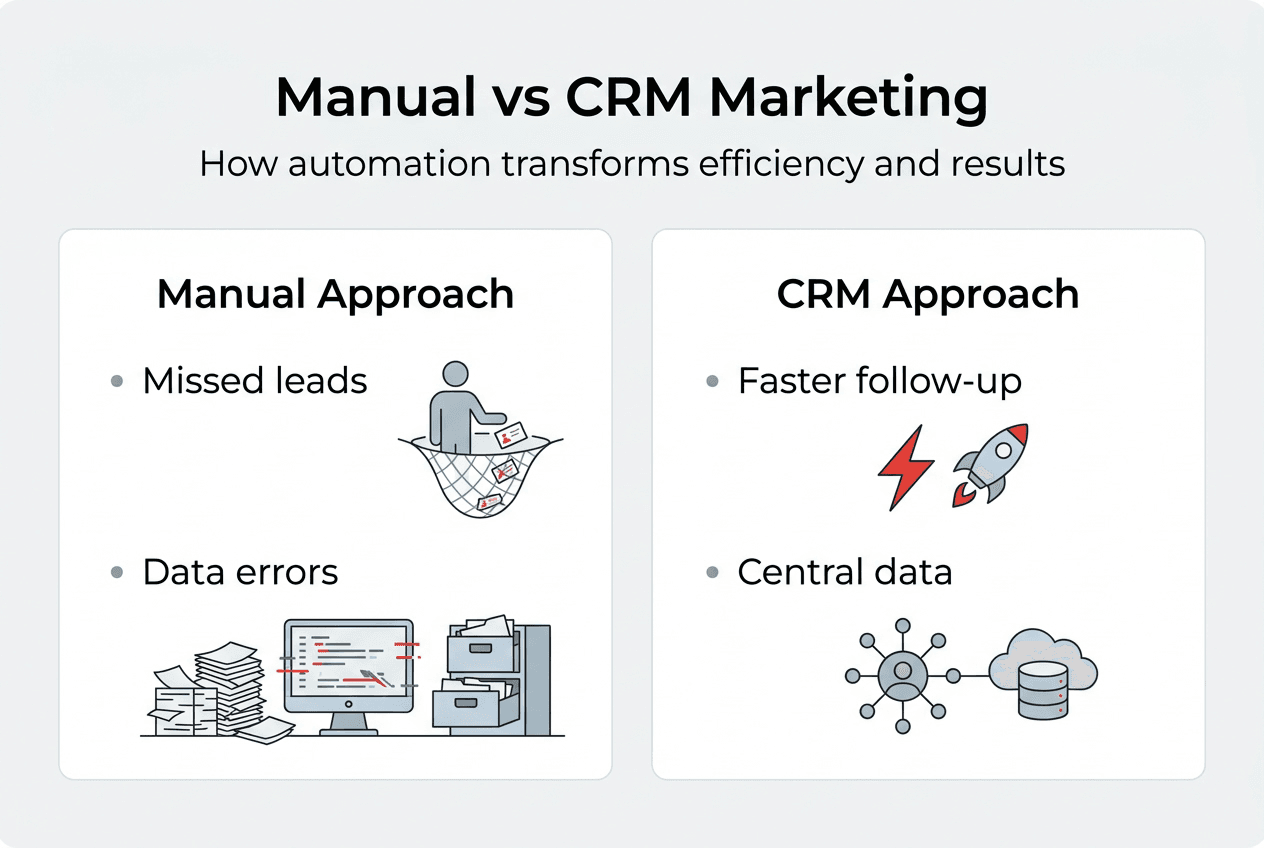
Traditional manual marketing demands constant attention and introduces human error at every step. A team member forgets to follow up with a hot lead. Spreadsheets contain duplicate or outdated information. Email campaigns go out with the wrong names in personalisation fields. These mistakes cost real money and damage your professional reputation.

The contrast between manual and automated approaches becomes stark when examined systematically:
| Criteria | Manual Marketing | CRM-automated Marketing |
|---|---|---|
| Efficiency | Hours spent on repetitive tasks daily | Minutes to set up workflows that run automatically |
| Accuracy | Prone to data entry errors and oversights | Consistent execution without human error |
| Personalisation | Generic messages or time-consuming custom creation | Dynamic content tailored to individual customer data |
| Scalability | Linear growth requires proportional staff increase | Handle thousands of contacts with same effort as hundreds |
| Time investment | Continuous manual effort for every campaign | Upfront setup then minimal ongoing maintenance |
Manual marketing’s drawbacks extend beyond inefficiency. Without centralised data, different team members hold contradictory information about the same customer. Marketing sends promotional offers whilst sales discusses contract renewal, creating confusion. Customer service lacks visibility into marketing promises, leading to inconsistent experiences.
Automation in marketing via CRM significantly improves campaign consistency and lead conversion by addressing each manual limitation:
- Eliminates data silos through single source of truth accessible to all teams
- Removes human error from routine processes like email sends and follow-up scheduling
- Enables sophisticated personalisation at scale using customer behaviour triggers
- Frees staff to focus on strategy and relationship building rather than administrative tasks
- Provides audit trails showing exactly what communication each customer received and when
- Maintains consistent brand voice across all automated touchpoints
The productivity gain alone justifies CRM adoption. A business owner spending ten hours weekly on manual follow-ups reclaims that time for strategic growth activities. Marketing coordinators manage larger campaigns without additional headcount. The entire organisation operates more smoothly because information flows freely rather than sitting trapped in individual inboxes.
Implementing CRM in Your Marketing Workflow: Practical Steps for UK SMBs
Successful CRM adoption follows a structured approach that minimises disruption whilst maximising returns. Rushing implementation creates confusion, but methodical rollout builds team confidence and delivers quick wins.
- Define marketing goals with specific, measurable targets. Do you want to increase email open rates by 25%? Convert 15% more website visitors into leads? Reduce time spent on manual follow-ups by ten hours weekly? Clear objectives guide platform selection and feature prioritisation.
- Choose suitable CRM platform based on your business size, budget, and technical capabilities. Evaluate options considering ease of use, essential features like email integration and automation, scalability as you grow, and total cost including setup and training. Many platforms offer free trials, allowing hands-on testing before commitment.
- Import and clean customer data by consolidating information from spreadsheets, email systems, and other sources into your new CRM. Remove duplicates, standardise formatting, and verify contact details. Quality data foundation prevents problems later, so invest time getting this right initially.
- Set up campaign automation starting with simple workflows like welcome emails for new subscribers or follow-up sequences for quote requests. Test thoroughly before activating to ensure messages send correctly with proper personalisation. Gradually add complexity as your team gains confidence.
- Train team and monitor results through regular reviews of campaign performance and user adoption. Schedule brief weekly check-ins initially to address questions and share successes. Track key metrics against your defined goals, adjusting strategies based on actual results rather than assumptions.
Pro Tip: Pilot CRM on a small campaign to adjust settings before full rollout, reducing risk whilst building team expertise.
Integrating CRM with marketing strategies improves overall business growth and lead generation by connecting previously isolated activities. When your CRM links with email marketing, website forms, and sales processes, you create a seamless customer journey from first contact through purchase and beyond.
Integration extends beyond internal systems. Connect your CRM with advertising platforms to track which campaigns generate quality leads. Link to accounting software to understand customer lifetime value and marketing ROI precisely. These connections transform CRM from a contact database into a comprehensive growth engine.
Ongoing review and optimisation sustain results over time. Marketing effectiveness evolves as customer preferences shift and competition changes. Schedule monthly analysis of key metrics, testing new approaches whilst refining successful ones. The businesses that extract maximum CRM value treat it as a living system requiring regular attention rather than a set-it-and-forget-it tool.
Explore Expert Digital Marketing and CRM Support
Implementing CRM effectively requires both technical setup and strategic planning to align with your business goals. Bamsh specialises in CRM and email marketing for small businesses, building automated pipelines that capture enquiries, nurture leads, and convert prospects into customers. Our transparent approach means you understand exactly how your CRM drives growth, with clear reporting on every campaign’s performance. We also support broader marketing strategies including Google expertise for visibility and PPC management for UK businesses that generates quality leads whilst your CRM nurtures them to conversion. Most clients go live within a week, starting to see results whilst competitors still debate whether to adopt CRM.
Frequently Asked Questions
Is CRM worth it for small businesses?
Absolutely. CRM delivers strong ROI by automating time-consuming tasks and improving customer engagement systematically. Small businesses particularly benefit because limited staff resources gain leverage through automation, handling larger customer bases without proportional headcount increases. The productivity gains alone often justify the investment within months.
How does CRM improve marketing personalisation?
By centralising customer data and tracking behaviour across touchpoints, CRM enables tailored messaging that resonates with individual needs and preferences. You see which products a customer viewed, what emails they opened, and where they are in the buying journey. This insight allows relevant, timely communication that feels personal rather than generic, significantly increasing conversion rates.
Can CRM systems integrate with other marketing tools?
Most modern CRM platforms integrate seamlessly with email services, social media platforms, analytics tools, and advertising systems through native connections or APIs. These integrations create a unified marketing ecosystem where data flows automatically between systems. You gain complete visibility into customer interactions across all channels whilst eliminating manual data entry between platforms.
How to choose the right CRM for my small business?
Consider ease of use first, ensuring your team can adopt the system without extensive technical training. Evaluate essential features like contact management, email integration, and basic automation against your defined marketing goals. Assess scalability to accommodate growth without switching platforms later. Compare total costs including setup, training, and monthly fees against your budget, remembering that the cheapest option often costs more long-term through limited functionality or poor support.