
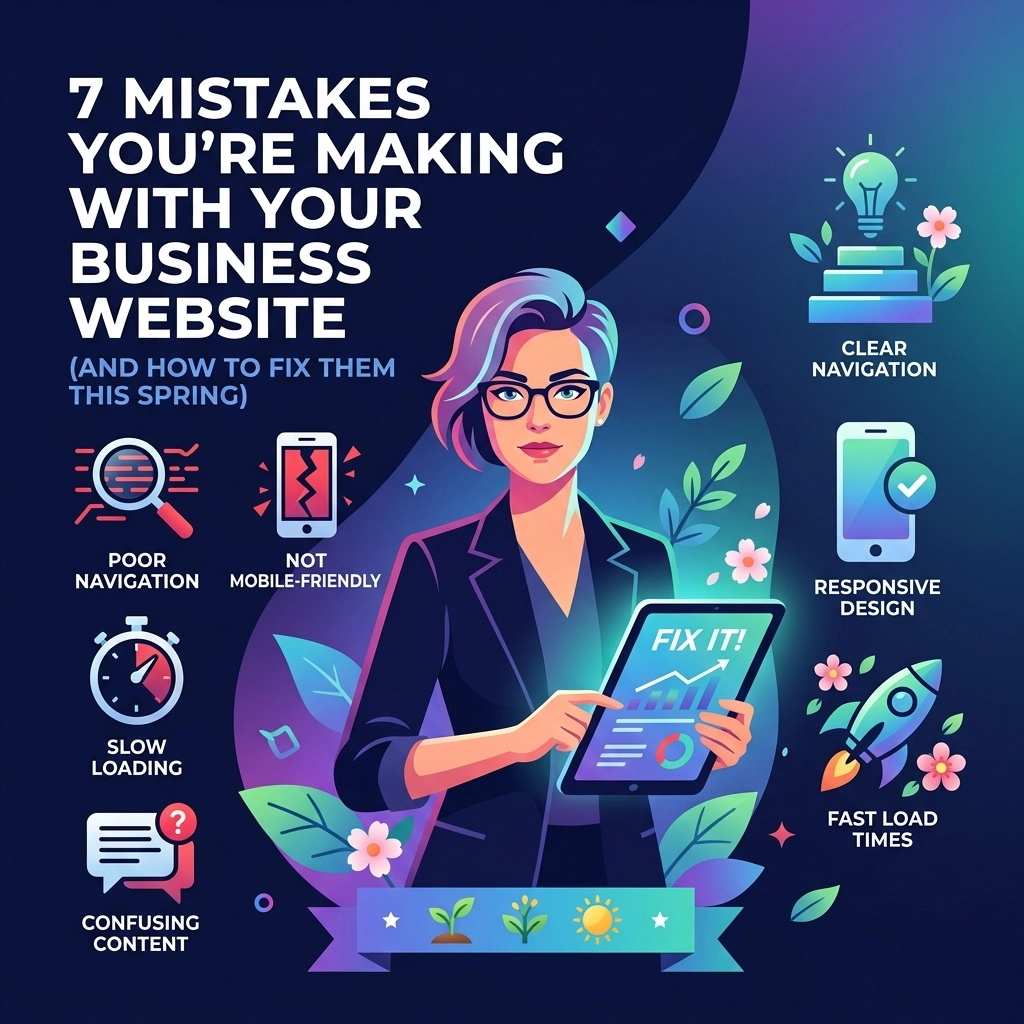
It’s officially Spring in Bristol. While you might be thinking about tidying up the garden or finally clearing out that office cupboard, there’s one area of your business that probably needs a “Spring Sprint” more than anything else: your website.
If we’re honest, many business owners treat their website like a digital brochure they printed in 2022 and then forgot about. But the reality is that your website isn’t just a placeholder; it’s your hardest-working salesperson. Or at least, it should be. If it’s not bringing in leads while you’re grabbing a coffee on Gloucester Road, something is wrong.
At Bamsh Digital Marketing, we see the same handful of errors popping up time and again. These aren’t just “design” issues; they are profit-killers. Let’s dive into the seven most common mistakes Bristol businesses are making right now and, more importantly, how you can fix them.
1. The “Waiting Game” (Slow Loading Speeds)
We’ve all been there. You click a link, and… nothing. You wait two seconds. Still nothing. By the three-second mark, you’ve hit the back button and clicked on a competitor.
Why This Matters
Research shows that a mere one-second delay can result in a 7% reduction in conversions. In a world where everyone is in a rush, a slow website is the fastest way to lose a customer. Google also uses speed as a ranking factor, so a slow site is essentially telling Google you don’t want to be found.
How It Helps You
When your site loads instantly, you build immediate trust. It shows you’re professional and respect your visitor’s time.
The Fix: Start by compressing your images. Huge files are the number one cause of “bloated” sites. If you’re using a cheap, shared hosting plan that’s struggling to keep up, it might be time for an upgrade.
2. Navigational Nightmares
Have you ever walked into a shop and couldn’t find the exit, let alone the product you wanted? That’s what a confusing website menu feels like. If your visitors can’t find what they need within three seconds, they’ll bounce.
Why This Matters
Bounce rates increase by over 30% when navigation is unclear. If you use clever names for your pages like “The Journey” instead of “Our Services,” you’re making people work too hard.
How It Helps You
Clear navigation acts like a roadmap. It guides your potential customers exactly where you want them to go: usually to your contact page or shop.
The Fix: Keep it simple. Use standard labels like “Services,” “About,” and “Contact.” If you have a lot of pages, use a “fat footer” at the bottom of the site to organise links without cluttering the top menu.

3. The “Shy Seller” (Weak or Missing CTAs)
A CTA (Call to Action) is simply a button or link that tells the user what to do next. “Submit,” “Learn More,” or “Click Here” are the wallflowers of the digital world. They’re boring and they don’t inspire action.
Why This Matters
Without a clear directive, visitors will simply browse and leave. They need to be told how to take the next step in their journey with you.
How It Helps You
Strong CTAs turn passive readers into active leads. By using action-oriented language, you remove the guesswork.
The Fix: Replace “Submit” with “Get My Free Quote” or “Book My Bristol Consultation.” Make sure your buttons stand out visually: don’t let them blend into the background.
4. The Digital Junk Drawer (Cluttered Design)
More is not always better. When you cram every bit of information, every award you’ve ever won, and ten different pop-ups onto one page, you create “decision paralysis.”
Why This Matters
When faced with too many choices or too much text, the human brain tends to shut down. Users will choose the easiest option: leaving your site. This is often where “website embarrassment” kicks in: you know your site is a mess, so you stop sending people to it.
How It Helps You
A clean, “breathing” design focuses the user’s attention on what really matters: your value proposition.
The Fix: Embrace white space. Use bullet points instead of long paragraphs. If a piece of information doesn’t directly help the user make a decision, move it to a sub-page or delete it.
5. Playing “Hard to Get” (Unclear Value Proposition)
Within five seconds of landing on your site, a visitor should know exactly what you do and how you solve their specific problem. If they have to scroll through three paragraphs of your company history to find out you’re a plumber in Bedminster, you’ve already lost them.
Why This Matters
The “imagination gap” is real. If people can’t immediately see how your service fits into their life, they won’t bother trying to figure it out.
How It Helps You
A clear value proposition (e.g., “We help Bristol SMEs grow their leads with local SEO”) builds instant relevance.
The Fix: Put your main message “above the fold” (the part of the screen visible without scrolling). State clearly: What you do, who you do it for, and the benefit they get.
6. Ignoring the Mobile Majority
In 2026, more people in Bristol are searching for your business on their phones while waiting for a bus than on a desktop computer. If your site looks “wonky” on a smartphone: buttons too small to click or text that requires zooming: you’re essentially closing your doors to half your market.
Why This Matters
Google predominantly uses the mobile version of your site for indexing and ranking. A poor mobile experience doesn’t just annoy users; it kills your local Bristol SEO.
How It Helps You
A “mobile-first” approach ensures a seamless experience. If someone can call you with one tap of their thumb, you’re much more likely to get the lead.
The Fix: Test your site on multiple devices. If you’re struggling to see how your site looks on different screens, use our Website Preview Tool for instant visual proof of how your brand appears to the world.
7. Treating SEO Like an Afterthought
Many business owners think SEO (Search Engine Optimisation) is something you “add on” later. In reality, SEO starts with the very structure of your website.
Why This Matters
Missing headings (H1s, H2s), lack of image descriptions (alt text), and poor internal linking make it impossible for search engines to understand your site. If Google doesn’t understand you, it won’t show you to customers.
How It Helps You
Good SEO foundations mean you get “free” traffic from people searching for exactly what you offer. It’s the ultimate lead generation system.
The Fix: Ensure every page has one clear H1 tag containing your main keyword. Link your pages together naturally (e.g., link your blog posts to your service pages). For more tips, check out our guide on improving local SEO.
Comparing Your Options: DIY vs. Professional Agency
Many Bristol business owners wonder if they should fix these issues themselves or hire an expert. Here’s a quick breakdown:
| Feature | DIY Website Builder (Wix/Squarespace) | Professional Agency (Bamsh) |
|---|---|---|
| Initial Cost | Low (£20-£50/month) | Higher upfront investment |
| Time Investment | Very High (You do the work) | Low (We handle the heavy lifting) |
| SEO Capability | Basic/Limited | Advanced & Custom-tailored |
| Speed Optimisation | Often restricted by platform | Fully optimised for performance |
| Strategy | You have to figure it out | Expert-led lead generation |
| The “Vibe” | Can look “templatey” | Unique, professional brand identity |
Frequently Asked Questions (FAQ)
How much does a website redesign actually cost in the UK?
It varies wildly based on your needs. A simple site might be a few thousand, while a complex lead-generation machine costs more. To avoid the “guessing game,” you can use our Digital Marketing Costs Estimator to get a realistic idea for your project.
Do I really need a new website, or can I just fix my old one?
Sometimes a “facelift” works, but if your site’s foundation is outdated (not mobile-friendly or very slow), a complete rebuild is often more cost-effective in the long run than patching up an old system.
How long does it take to see results from a new website?
While the “visual” change is instant, SEO results usually take 3–6 months to fully kick in. However, you should see an immediate improvement in how many people contact you once the “user experience” is fixed.
What is the “imagination gap”?
It’s the disconnect between what you know you can do and what the customer perceives. If your website looks amateur, customers imagine your service is amateur too. Professional design bridges that gap instantly.

Stop the Website Embarrassment This Spring
If you’re hesitant to send potential clients to your website because you know it doesn’t reflect the quality of your work, it’s time for a change. You don’t have to guess what’s wrong or worry about high-pressure sales tactics.
Start by getting some instant visual proof. Use our Website Preview Tool to see how your site actually performs and looks across different devices.
Once you’ve seen the gaps, find out exactly what it would take to fix them by using our Bamsh Digital Marketing Costs Estimator. No jargon, no hidden fees: just a clear path to a website that actually grows your Bristol business.
Let’s make Spring 2026 the season your website finally starts working as hard as you do.