

Artificial intelligence is transforming small businesses across the UK, yet fewer than 20% have adopted it. This hesitation comes at a cost. SMEs using AI report 19% higher turnover per worker and significant operational efficiencies. For South West UK business owners, understanding AI’s practical benefits and overcoming adoption barriers could be the difference between thriving and simply surviving in an increasingly digital marketplace.
Table of Contents
- Why AI Matters For Small Businesses In The South West UK
- The Economic Impact Of AI On UK Small Businesses
- Operational Efficiencies Enabled By AI
- Barriers To AI Adoption And How To Overcome Them
- Real-World UK SME AI Use Cases And Success Stories
- Framework For Evaluating AI Readiness And ROI For Small Businesses
- Common Misconceptions About AI In Small Businesses
- Discover How Bamsh Can Help Your Business Leverage AI And Digital Marketing
- Frequently Asked Questions About AI In Small Businesses
Key Takeaways
| Point | Details |
|---|---|
| Economic potential | AI adoption could add £78 billion to UK economy by 2035 |
| Productivity gains | SMEs using AI see 19% higher turnover per employee |
| Adoption barriers | Top obstacles include unclear use cases (39%), cost (21%), skill gaps (16%) |
| Operational benefits | AI automates routine admin and marketing tasks, freeing time and cutting costs |
| Government support | £100 million invested in AI research and SME support programs |
Why AI Matters for Small Businesses in the South West UK
The UK has positioned itself as a global AI leader, with strong government backing driving innovation and adoption. Despite this supportive environment, less than 20% of UK SMEs have adopted AI despite its proven growth potential. This gap presents both a challenge and an opportunity for South West businesses.
Small businesses in the region face mounting pressures from digitally savvy competitors and customer expectations for instant, personalised service. Traditional operational methods no longer provide the efficiency needed to compete effectively. AI offers a practical solution to these challenges without requiring massive investment or technical expertise.
The UK government’s AI initiatives include funding, infrastructure support, and skills programs specifically designed for SMEs. Regional partnerships connect South West businesses with AI resources and training. Yet adoption remains hindered by common barriers:
- Unclear understanding of practical AI applications for their specific business
- Perceived high costs and complexity of implementation
- Lack of digital skills among management and staff
- Concerns about data security and compliance
Addressing these obstacles starts with understanding the tangible benefits AI delivers to businesses similar to yours.
The Economic Impact of AI on UK Small Businesses
The numbers tell a compelling story. AI adoption could add £78 billion to the UK economy over the next decade. This isn’t just theoretical potential. SMEs already using AI technologies report 19% higher turnover per employee compared to non-adopters.
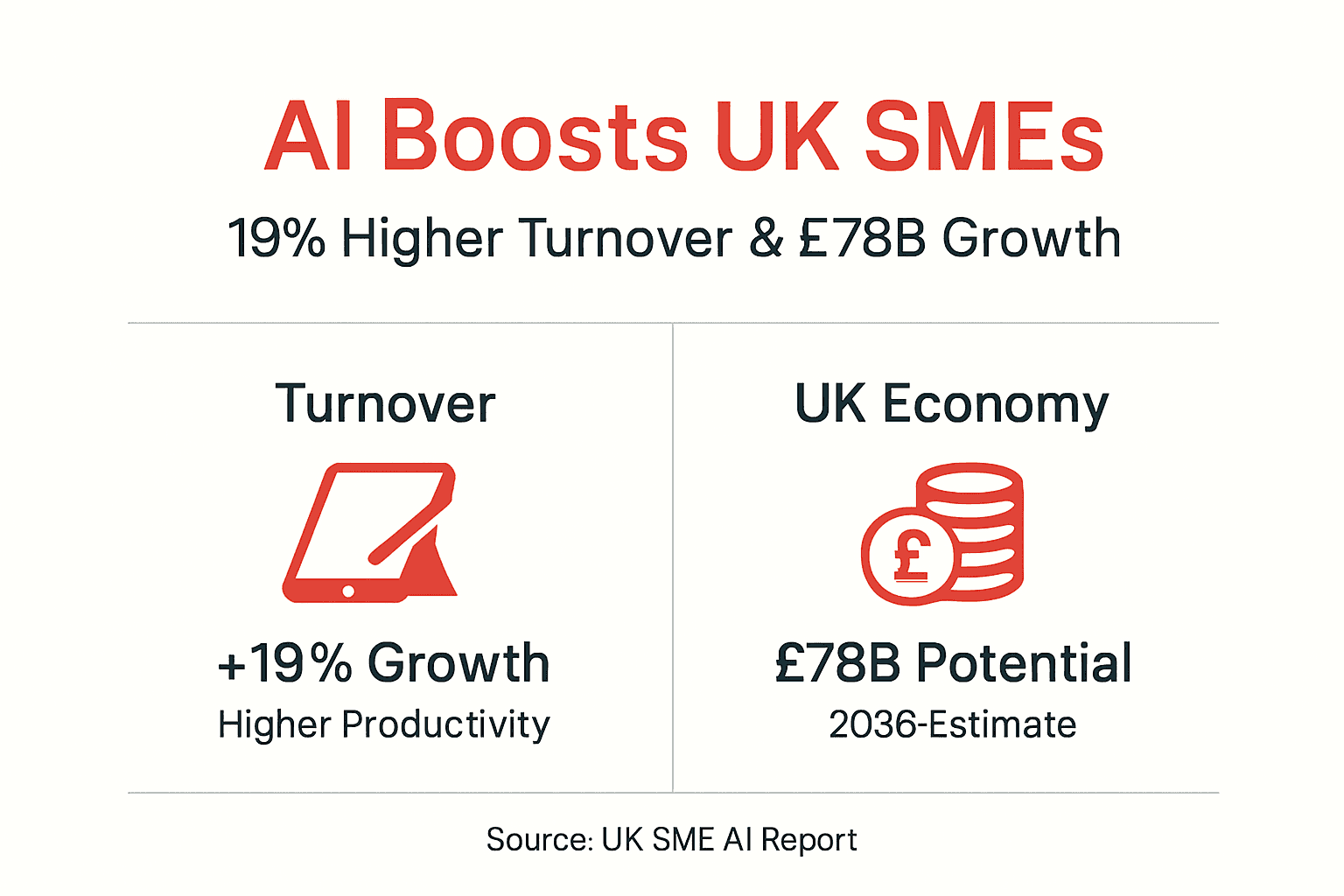
These productivity gains translate directly to your bottom line. When each team member can accomplish more in less time, your business scales without proportional increases in labour costs. AI handles repetitive tasks that previously consumed hours of staff time, freeing your team to focus on high-value activities that drive revenue.
| Metric | AI Adopters | Non-Adopters | Difference |
|---|---|---|---|
| Turnover per worker | 19% higher | Baseline | +19% |
| Task automation rate | 40-60% | 5-10% | +50% average |
| Customer response time | Minutes | Hours | 75% faster |
| Lead conversion rate | 25-35% | 15-20% | +50% relative |
The competitive advantage extends beyond internal efficiency. Businesses adopting AI position themselves as innovative and customer-focused, attracting clients who value modern service delivery. This perception drives growth through referrals and repeat business.
For South West SMEs, these gains matter even more in regional markets where word-of-mouth and local reputation heavily influence buying decisions. When you respond faster, deliver better service, and operate more efficiently than competitors, customers notice. Understanding AI for UK SME growth provides the foundation for capturing this advantage.

Operational Efficiencies Enabled by AI
AI’s real power lies in automating the mundane tasks that drain your team’s energy and time. Generative AI automates document drafting and bookkeeping, improving efficiency across administrative functions. Instead of spending hours on invoices, reports, or routine correspondence, your staff focuses on strategic work that requires human judgment.
Consider these practical applications already working for UK small businesses:
- Customer service chatbots handle common enquiries 24/7, booking appointments and answering FAQs without human intervention
- Email marketing automation segments audiences, personalises messages, and optimises send times for maximum engagement
- Inventory management systems predict stock needs, automate reordering, and reduce waste through intelligent forecasting
- Lead scoring algorithms identify high-quality prospects, prioritising sales efforts where they’ll generate the best returns
- Automated bookkeeping categorises transactions, tracks expenses, and flags anomalies faster than manual review
The customer experience improves dramatically. Chatbots respond instantly to website visitors, capturing leads that would otherwise bounce. Appointment scheduling happens automatically, eliminating phone tag and missed opportunities. Service queries get resolved faster, building customer satisfaction and loyalty.
Marketing becomes more targeted and cost-effective. AI-driven tools analyse customer behaviour, identifying patterns that inform campaign strategy. You spend less acquiring each customer because your messages reach people genuinely interested in your offer. Exploring top marketing AI tools reveals solutions tailored for small business budgets.
Pro tip: Start with one high-impact, low-complexity AI application rather than trying to automate everything at once. A customer service chatbot or email automation system delivers quick wins that build confidence and demonstrate ROI to stakeholders.
The time savings compound quickly. Tasks that consumed five hours weekly now take minutes. Multiply that across multiple processes and team members, and you’ve freed substantial capacity for growth activities. Understanding marketing automation for UK SMEs helps identify your highest-value automation opportunities.
Barriers to AI Adoption and How to Overcome Them
Despite clear benefits, UK SMEs face real obstacles when considering AI adoption. Research identifies unclear use cases (39%), costs (21%), and skill shortages (16%) as the top barriers preventing implementation. Understanding and addressing these challenges determines success.
The confusion about practical applications often stems from marketing hype rather than real limitations. AI has been oversold as a magic solution, creating unrealistic expectations. The reality is more pragmatic. AI excels at specific, well-defined tasks but requires clear objectives and proper implementation.
Cost concerns are valid but often overstated. Enterprise-grade AI systems do carry hefty price tags. However, small business solutions exist at accessible price points, often with subscription models that spread costs predictably. Many tools offer free tiers or trials that let you test before committing.
Skills gaps present a genuine challenge but not an insurmountable one. The UK government invests £100 million in AI research and SME support programs, including training initiatives. Local colleges and business groups offer workshops specifically for small business owners.
Here’s a practical roadmap for overcoming these barriers:
- Identify one specific business problem AI could solve, such as slow customer response times or inefficient scheduling
- Research affordable tools designed for that exact problem, reading reviews from similar businesses
- Start with a pilot program using a free trial or basic tier to test effectiveness before scaling
- Train a champion within your team who takes ownership of the AI implementation and learns the system thoroughly
- Measure results objectively using clear metrics like time saved, costs reduced, or revenue increased
- Scale gradually based on proven ROI, adding new AI applications as confidence and capability grow
Pro tip: Partner with specialists who understand both AI technology and small business realities. Trying to become an AI expert yourself diverts energy from running your business. Finding the right AI lead generation tools requires expertise that specialists already possess.
Government grants and regional development programs often cover training costs or provide matched funding for technology adoption. Business advisors in the South West can connect you with available support, turning perceived barriers into manageable steps.
Real-World UK SME AI Use Cases and Success Stories
Theory becomes tangible when you see businesses like yours achieving measurable results. Across the UK, small businesses are using AI to solve real operational challenges and drive growth.
A Bristol-based energy compliance consultancy implemented AI-powered document analysis to process regulatory submissions. What previously took consultants three days per project now completes in hours. The time savings allowed them to triple their client capacity without hiring additional staff, directly increasing revenue.
A Cornwall fashion resale business deployed AI chatbots to handle customer enquiries about product authenticity, sizing, and shipping. The bot answers 70% of questions instantly, reducing customer service costs while improving response times. Customer satisfaction scores increased 35% within six months.
A Devon marketing agency adopted AI content tools to draft initial blog posts and social media copy for clients. Their writers now spend time refining and personalising rather than staring at blank screens. Output increased 60% while maintaining quality standards, allowing them to serve more clients profitably.
These aren’t isolated examples. UK AI projects created 1,500+ jobs and £800 million in gross value added over the past decade. The economic impact flows from countless small businesses making incremental improvements that compound over time.
“AI isn’t replacing our team. It’s giving them superpowers to deliver work that was previously impossible at our scale. We’re more competitive now than we’ve ever been.” — South West UK business owner
Regional partnerships play a crucial role in these success stories. Universities, local enterprise partnerships, and industry groups provide access to AI expertise and infrastructure that individual small businesses couldn’t afford alone. Collaborative programs reduce risk and accelerate learning.
The pattern across successful implementations is consistent. Businesses start small, prove value, then expand usage. They focus on specific problems rather than vague goals. They invest in training and change management, not just technology. Understanding CRM and AI integration for SMEs demonstrates how foundational systems support advanced applications.
Framework for Evaluating AI Readiness and ROI for Small Businesses
Deciding whether and how to adopt AI requires a structured approach. Rushing into implementation without proper evaluation wastes money and creates frustration. Taking time to assess readiness increases success probability dramatically.
High-quality management practices strongly correlate with better AI adoption rates. Businesses with clear processes, documented workflows, and performance metrics transition to AI more smoothly. If your operations are chaotic, AI won’t fix underlying issues. It will amplify them.
Start by evaluating these readiness factors:
- Management capability: Do you have clear business processes and performance tracking systems in place?
- Digital foundation: Are your core systems (accounting, CRM, website) modern and well-maintained?
- Team adaptability: Is your staff comfortable with technology and open to learning new tools?
- Specific needs: Can you articulate exact problems AI would solve and how you’d measure improvement?
- Budget reality: Do you have allocated funds for implementation, training, and ongoing costs?
Next, calculate potential ROI using concrete numbers:
| Factor | Current State | With AI | Annual Savings |
|---|---|---|---|
| Admin time (hours/week) | 15 | 5 | £12,000 |
| Customer response time | 4 hours | 15 minutes | Leads +30% |
| Lead qualification time | 2 hours/day | 20 minutes | £8,000 |
| Marketing cost per lead | £45 | £28 | £15,000 |
Be conservative with projections. Underestimate benefits and overestimate costs. If AI still shows positive ROI under pessimistic assumptions, you’ve found a solid opportunity.
Consider both direct and indirect returns. Direct savings from reduced labour costs are easy to measure. Indirect benefits like improved customer satisfaction, faster decision-making, and competitive positioning are harder to quantify but equally valuable.
Assessing your specific situation using frameworks like those explained in AI readiness framework for SMEs prevents costly mistakes. The goal isn’t to adopt AI because it’s trendy. The goal is to solve real business problems profitably.
Common Misconceptions About AI in Small Businesses
Misconceptions about AI create unnecessary barriers for small business owners considering adoption. Clearing up these myths helps you make decisions based on reality rather than hype or fear.
Myth: AI is only for large corporations with massive budgets. Reality: Affordable, small-business-focused AI tools exist across every business function. Many cost less than hiring a part-time employee. Many believe AI is too complex and costly; in reality, affordable tools exist for SMEs. Subscription pricing makes costs predictable and scalable.
Myth: You need technical expertise or data scientists on staff. Reality: Modern AI tools are designed for non-technical users. Setup wizards, templates, and support resources guide implementation. You need business judgment, not programming skills. Training programs specifically target small business owners without technical backgrounds.
Myth: AI will replace your employees. Reality: AI handles repetitive tasks, freeing your team for higher-value work requiring human creativity, empathy, and judgment. Successful implementations augment staff capabilities rather than replacing people. Jobs evolve rather than disappear.
Myth: AI requires perfect, extensive data to function. Reality: While data quality matters, modern AI tools work effectively with modest datasets typical of small businesses. Many applications use pre-trained models that don’t require your data for initial functionality. You improve results over time as usage generates more data.
Myth: Implementation takes months and disrupts operations. Reality: Cloud-based AI tools often go live within days. Pilots run alongside existing processes, minimising disruption. You migrate gradually as confidence grows. Most small businesses achieve basic functionality in their first week.
These misconceptions persist because AI marketing often emphasises cutting-edge applications rather than practical small business solutions. The enterprise AI world differs dramatically from tools designed for your needs. Focus on proven applications with clear ROI rather than experimental technology.
Discover How Bamsh Can Help Your Business Leverage AI and Digital Marketing
Understanding AI’s potential is one thing. Implementing solutions that actually deliver results is another. Bamsh Digital Marketing helps South West UK businesses bridge this gap with practical, transparent marketing services designed for small business realities.
Our approach cuts through the confusion. We explain what we’re doing, why it matters, and how it impacts your bottom line. No jargon. No smoke and mirrors. Just honest, results-driven strategies that work. Whether you’re ready for our comprehensive AI Lead Engine or prefer to start with focused improvements, we tailor solutions to your specific needs and budget.
Explore our DIY SEO tool for small businesses if you prefer hands-on control with expert guidance. Need more direct support? Our Google expert services in Bristol provide personalised assistance with search visibility and local presence. For businesses ready to scale lead generation, our PPC management for UK SMEs delivers targeted campaigns with transparent reporting and measurable results.
Frequently Asked Questions About AI in Small Businesses
What initial steps should my small business take to start with AI?
Begin by identifying one specific, repetitive task that consumes significant time, such as appointment scheduling or email responses. Research affordable tools designed for that exact function. Start with a free trial to test effectiveness before committing to paid plans.
Are there affordable AI tools for non-technical small business owners?
Yes, numerous AI tools target small businesses with user-friendly interfaces and subscription pricing starting under £30 monthly. Chatbot platforms, email automation, and scheduling assistants require no coding knowledge. Most offer templates and setup wizards that guide you through implementation step by step.
How can we ensure data privacy compliance when using AI solutions?
Choose AI providers that explicitly state GDPR compliance and data protection certifications. Review their privacy policies to understand where data is stored and how it’s used. Avoid tools that claim ownership of your data or sell information to third parties. Reputable providers offer clear data handling documentation.
What government grants or support are available for AI adoption?
The UK government’s £100 million AI investment includes grants, matched funding, and subsidised training programs for SMEs. Contact your local enterprise partnership or Business Growth Hub for region-specific opportunities. Innovation vouchers and digital transformation grants often cover AI implementation costs.
How soon can I expect ROI from implementing AI technologies?
Simple automation tools like chatbots or scheduling systems typically show positive ROI within 2-3 months through time savings and improved lead capture. More complex implementations may take 6-12 months. Starting with high-impact, low-complexity applications delivers faster returns and builds confidence for broader adoption.