
TL;DR:
- Most UK small businesses lose paid-for leads due to lack of a timely follow-up system, not ambition. Implementing and integrating a user-friendly CRM into daily workflows significantly enhances lead response, pipeline visibility, and sales efficiency. Success depends on cultural adoption and consistent use, supported by expert implementation and ongoing support.
Most UK small business owners are losing leads they already paid to generate. Not because they lack ambition, but because they lack the right system to follow up on time. Understanding the real benefits of CRM for SMEs changes that picture completely. UK SMEs trail other advanced economies in adopting digital tools like CRM, despite clear links to productivity gains. If your business relies on spreadsheets, sticky notes, or memory to manage customer relationships, this guide is for you.
Table of Contents
- Why CRM matters for UK SMEs
- Core benefits of CRM for lead nurturing and sales efficiency
- Choosing the right CRM for your small or medium business
- Measuring and maximising the benefits of CRM impact on your business
- Comparing the benefits of CRM options: free vs paid solutions
- Why CRM success for UK SMEs is about adoption, not just acquisition
- How Bamsh can help UK SMEs unlock CRM benefits
- Frequently asked questions about the benefits of CRM
Why CRM matters for UK SMEs
CRM stands for Customer Relationship Management. At its simplest, it is a system that stores all your customer and prospect information in one place, tracks every interaction, and tells you exactly where each lead is in your sales process. Think of it as a shared memory for your entire business.
The problem is adoption. UK SMEs have low digital uptake of CRM tools despite clear evidence of productivity and sales benefits. Many business owners assume CRM is expensive, complicated, or built for large enterprises. None of that is true in 2026. Modern CRM solutions for small enterprises are affordable, quick to set up, and designed specifically for teams of two to twenty.
The role CRM plays in UK small business growth is more significant than most owners realise. Here is what CRM adoption genuinely addresses:
- Missed follow-ups because enquiries are tracked in inboxes or spreadsheets with no clear ownership
- Slow lead response that hands warm prospects to faster competitors
- No visibility over what stage each deal is at or which leads need attention today
- Time lost on manual data entry instead of selling
- Inconsistent customer experience when different team members hold different information
The key insight is this: it is not enough to simply install a CRM. The businesses that see real results are the ones that build it into their daily workflow. That distinction matters enormously, and we will come back to it.
Core benefits of CRM for lead nurturing and sales efficiency
Understanding the benefits of CRM for small businesses means looking at the real-world difference it makes to your pipeline every single day.

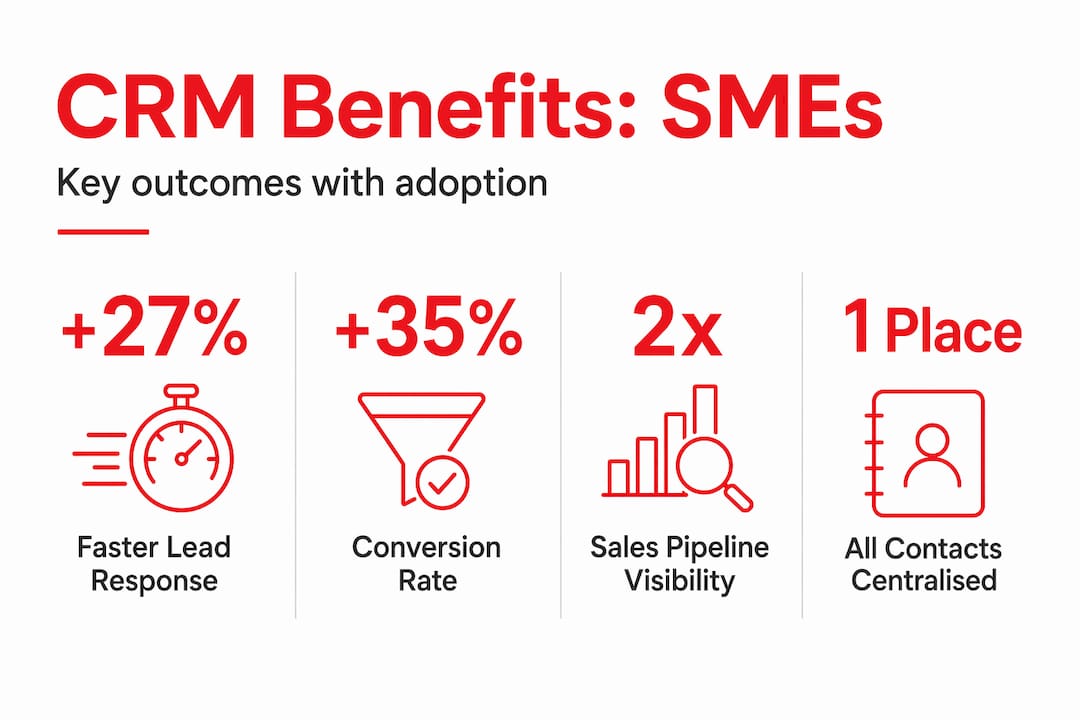
One of the most powerful changes is speed. CRM improves lead response time and directly increases conversion rates. Consider this: a lead that contacts your business expects a reply within minutes, not hours. When your team has instant access to a prospect’s history, needs, and status, response time drops dramatically. That alone can double the number of enquiries you convert.
CRM centralises all customer data into one visible place. No more asking “did anyone follow up with that plumber from Leeds?” because the answer is right there on screen, with timestamps and notes.
Here is how the core benefits of CRM break down practically:
- ✅ Centralised customer data means your whole team works from the same information, reducing errors and miscommunication
- ✅ Automated follow-up reminders ensure no lead goes cold simply because someone forgot to call
- ✅ Pipeline visibility shows you exactly which deals are progressing and which need a nudge
- ✅ Sales productivity rises when admin tasks like logging calls and updating records happen automatically
- ✅ Lead scoring helps you prioritise the hottest prospects so your team spends time where it counts
- ✅ Shared access means colleagues can pick up a conversation without the customer having to repeat themselves
The impact on lead nurturing is particularly significant. Most SMEs think nurturing means sending the occasional email. In reality, effective nurturing is a sequence of timely, relevant touchpoints that keeps your business front of mind until the prospect is ready to buy. CRM tools for small businesses make that process automatic. You set the sequence once, and the system does the work.
Pro Tip: Map your existing sales process before you set up your CRM. Write down every step from first enquiry to closed deal. Then build your CRM pipeline stages to mirror that journey. You will spend far less time configuring the system and far more time using it.
You can combine CRM with the right lead generation tactics for UK SMEs and use predictive lead scoring to further prioritise where your sales effort goes.
Choosing the right CRM for your small or medium business
Knowing the benefits of CRM for SMEs is one thing. Choosing the right system for your specific situation is another. The good news is that you do not need a complex enterprise platform. You need something your team will actually use.
Here is a practical process for selecting a CRM solution for your small enterprise:
- List your must-have features. What does your sales process actually require? Common essentials include contact management, pipeline tracking, email integration, and follow-up reminders. Do not pay for features you will not use in the first six months.
- Check how easy it is to set up and use daily. If your team finds it confusing, they will not use it. Ask for a free trial and get two or three team members to test it for a week before committing.
- Confirm it integrates with your existing tools. Your email, calendar, and any marketing tools you use should connect without friction. Disconnected systems create the same problems you are trying to solve.
- Think about where your business will be in two years. A CRM that suits a team of three may feel cramped when you reach ten people. Check user limits, storage allowances, and automation capabilities before you commit.
- Test the free tier properly. Free CRMs offer essential features but you need to check whether those features support your lead nurturing and reporting requirements specifically. Many free plans cap the number of contacts or automations, which matters the moment your pipeline starts growing.
Pro Tip: Do not choose a CRM based solely on what looks impressive in a demo. Spend thirty minutes entering five real contacts and creating three pipeline stages. If that takes longer than it should, or feels confusing, keep looking.
Explore effective CRM strategies for growth and consider how CRM and email marketing can work together to build a nurturing system that runs with minimal manual effort.
Measuring and maximising the benefits of CRM impact on your business
Once your CRM is live, the temptation is to assume the work is done. It is not. Getting the most from your system means actively measuring results and adjusting what is not working.
Businesses using data-driven workflows see measurable efficiency gains, with 38% reporting improved efficiency from better data use. CRM puts that data directly in your hands. Here is what to track:
- Lead response time: How quickly does your team contact a new enquiry? Aim to get this below five minutes during business hours.
- Conversion rate by stage: Where are leads dropping out of your pipeline? That is your biggest growth opportunity.
- Follow-up completion rate: Are scheduled tasks actually being completed, or are they piling up?
- Deal cycle length: How long does it take from first contact to a closed sale? The benefits of CRM helps you spot where deals stall.
- Revenue per lead source: Which channels bring in the most valuable customers? Use this to guide your marketing spend.
Here is a quick comparison of working with and without CRM:
| Activity | Without CRM | With CRM |
|---|---|---|
| Following up with leads | Manual, inconsistent | Automated reminders and sequences |
| Tracking deal progress | Spreadsheets or memory | Live pipeline dashboard |
| Responding to new enquiries | Hours or days | Minutes, with full context visible |
| Reporting on sales performance | Time-consuming to compile | Instant from CRM dashboard |
| Onboarding new team members | Slow, knowledge scattered | Fast, all data in one place |
Pro Tip: Review your CRM data every Friday for fifteen minutes. Look at which leads moved forward that week, which stalled, and which were lost. That habit alone will sharpen your sales instincts faster than any training course.
See how the benefits of CRM improve marketing efficiency for SMEs and explore the role of automation in marketing to build a system that generates results without constant manual input.
Comparing the benefits of CRM options: free vs paid solutions
For many UK SMEs, budget is a real consideration. The good news is you have genuine options. Free CRMs offer core features but paid plans provide advanced capabilities and better scalability as your pipeline grows.
| Feature | Free CRM | Paid CRM |
|---|---|---|
| Contact management | Yes, often limited | Yes, usually unlimited |
| Pipeline tracking | Basic | Advanced, with custom stages |
| Email automation | Rarely included | Standard in most paid plans |
| Reporting and analytics | Minimal | Detailed and customisable |
| Integrations | Limited | Wide range available |
| User limits | Usually 2 to 5 | Scales with your team |
| Support | Self-serve only | Dedicated or priority support |
Free CRM tools for small businesses make sense when:
- ✅ You are just starting out and testing whether CRM fits your workflow
- ✅ You have fewer than 100 contacts to manage
- ✅ Your sales process is simple and linear
- ✅ Budget is tight and you need to prove ROI before investing
Paid plans become the smarter choice when:
- ✅ You need automated follow-up sequences across email, SMS, or both
- ✅ Your team is growing and collaboration is becoming harder to manage
- ✅ You want detailed reporting to track sales performance monthly
- ✅ You need your CRM to connect with your marketing and service tools
Pro Tip: Start free, but set a clear trigger for upgrading. For example, “When we have more than 150 active leads in the pipeline, we move to a paid plan.” Having that decision made in advance stops you from outgrowing your system without noticing.
Discover which CRM strategies suit SMEs at different growth stages to make the right call for where your business is right now.
Why CRM success for UK SMEs is about adoption, not just acquisition
Here is something most CRM articles will not tell you plainly: buying a CRM does not automatically make your business more productive. Installing software is the easy part. The hard part is getting your team to use it consistently, every day, for every lead.
The biggest benefits of CRM depend on active daily use, not on which platform you buy. We have spoken to UK business owners who spent months evaluating CRM options, then saw their team revert to email folders within three weeks. Not because the CRM was bad, but because nobody changed the habits around it.
The real measure of impact is not how good your CRM looks. It is whether your team opens it first thing in the morning instead of their inbox.
What drives genuine adoption? Culture and simplicity. If your CRM requires ten clicks to log a call, it will not get used. If your sales process lives partly in the CRM and partly in a WhatsApp group, the benefits of CRM will always lose. Adoption means making the benefits of CRM the single source of truth for every customer interaction, and that requires deliberate setup and leadership buy-in from day one.
Context-switching is also a hidden productivity killer that CRM directly addresses. When a sales person has to check their email, then a spreadsheet, then a notebook to understand where a deal stands, they lose two to three minutes of focus every time. Multiply that across ten deals and five team members and you are losing hours each week. CRM eliminates that by keeping everything in one visible place.
Our recommendation is to treat the benefits of CRM rollout like a process change, not a software install. Brief your team. Agree on what gets logged and when. Review it together in your weekly meeting. Make CRM part of daily operations from the first day it goes live, and the productivity gains will follow naturally.
How Bamsh can help UK SMEs unlock CRM benefits
At Bamsh, we know that understanding the benefits of CRM for SMEs is only half the battle. The real challenge is putting it into practice without wasting time or money figuring it out alone. We set up and manage CRM systems specifically for UK small and medium businesses, building automated pipelines that capture enquiries, nurture leads, and convert prospects while your team focuses on doing what they do best. Whether you need help choosing the right system, integrating it with your sales workflow, or building out your lead nurturing strategy, our team handles it from start to finish. We also offer ongoing CRM support to make sure your system keeps delivering results as your business grows. Ready to maximise every online lead your business generates? Let’s talk.
Frequently asked questions
What are the key benefits of CRM for small UK businesses?
CRM centralises customer data for better organisation, enabling faster lead follow-up, clearer sales pipeline visibility, and more consistent, personalised customer engagement. These gains are accessible to small UK businesses regardless of sector or team size.
Is a free CRM suitable for all SMEs?
Free CRM plans offer core features that work well for early-stage businesses with simple pipelines, but they typically cap contacts, automations, and user numbers in ways that limit growth. Most growing SMEs find they need a paid plan within twelve months.
How quickly can a CRM improve sales efficiency?
When properly adopted, results can be immediate. Cutting lead response time from several hours to under five minutes can double conversion rates, and that is achievable within the first few weeks of consistent CRM use.
What is the biggest challenge for UK SMEs in using CRM?
The main barrier is not selecting or buying a CRM but embedding it into daily workflows. Without genuine team adoption and clear habits around logging and reviewing data, most of the productivity and sales benefits never materialise.