
Google Ads can start bringing visitors to your website on the day a campaign launches. For UK small businesses that need enquiries now, that is one of the biggest advantages of pay-per-click (PPC) advertising.
SEO builds organic visibility over time. Some improvements can be noticed within 60–90 days, although meaningful results often take longer. PPC lets you compete for relevant searches much sooner, provided your ads are approved, your targeting is right and your budget is sufficient.
For example, a Bristol plumber who needs emergency call-outs cannot necessarily wait several months for a new website to gain organic visibility. Google Ads can place that business in front of people already searching for an emergency plumber.
At BAMSH, Google Ads management starts from £400 per month, with the advertising budget paid separately to Google and no long-term lock-in.
But there is an important distinction.
PPC can generate enquiries from day one. It does not guarantee them. What matters is how much you spend, which searches you target, how your website converts and whether those enquiries turn into profitable work.
This guide explains the benefits of PPC for SMEs, what Google Ads costs for UK tradespeople, realistic cost-per-lead planning figures and when we would recommend PPC, SEO or both.
Key Takeaways
-
Google Ads can produce visibility, clicks and potentially enquiries as soon as a campaign goes live.
-
BAMSH PPC management starts from £400 per month, with Google Ads spend paid separately.
-
PPC lets small businesses target relevant services, locations and search intent.
-
Cost per lead matters more than clicks alone, but lead quality and customer profitability matter even more.
-
PPC is particularly useful when a business needs immediate demand, while SEO supports longer-term organic visibility.
-
Ongoing campaign management helps reduce wasted spend through better targeting, negative keywords, relevant adverts and stronger landing pages.

1. What Are the Main Benefits of PPC for SMEs?
PPC gives small businesses a way to advertise directly to people searching for their products or services.
Unlike broad advertising, Google Search Ads can target users who have already expressed a need.
Here are six practical advantages.
Immediate Visibility
Once a Google Ads campaign is approved and active, adverts can begin appearing for eligible searches.
You do not need to wait for a new service page to establish organic rankings.
A plumber in Bristol, electrician in Bath or roofing company in Weston-super-Mare can target relevant searches in their actual service areas.
That makes PPC particularly useful for new businesses, recently launched websites and companies that need to fill their diary.
Measurable Performance
Google Ads allows advertisers to measure impressions, clicks, costs and tracked conversions.
With appropriate tracking, you can also measure:
-
Telephone calls
-
Contact form submissions
-
Quote requests
-
Booking enquiries
-
Cost per lead
-
Conversion rates
However, not every click becomes an enquiry, and not every enquiry becomes a customer.
That is why BAMSH looks beyond traffic figures when assessing whether a campaign is commercially worthwhile.
Budget Control
You can choose your campaign budgets and adjust them as your requirements change.
If your business is fully booked, you may reduce spending.
If you have spare capacity, you may decide to increase your investment.
Google Ads uses average daily budgets and can spend more than that average on individual days, subject to its applicable spending limits. Your advertising spend therefore needs regular monitoring rather than assuming each day’s cost will be identical.
Precise Targeting
Google Ads allows businesses to target searches based on factors such as keywords, location and time of day.
For example, a Bristol emergency plumber may want enquiries from nearby areas but not from customers outside a practical travelling distance.
A commercial electrician may prefer searches relating to office installations rather than domestic appliance repairs.
Good targeting helps reduce irrelevant clicks.
Scalability
Once a campaign is generating profitable work, you can test increasing the budget.
The key is to scale based on performance rather than assuming more spending will automatically produce proportionately more enquiries.
Costs can rise as you reach additional searches or compete in more expensive auctions.
PPC Works Alongside SEO
PPC captures demand through paid advertising.
SEO develops organic search visibility over time.
The two can support each other because Google Ads provides useful information about the searches that generate enquiries.
Those insights can then inform service pages, content improvements and wider SEO planning.
For a more detailed explanation, read our guide to PPC and lead generation.
2. How Much Does Google Ads Management Cost at BAMSH?
One of the biggest questions UK business owners ask is how much they need to spend.
There are two separate costs to understand:
-
The management fee paid to the agency.
-
The advertising budget paid to Google.
BAMSH Google Ads management
From £400/month
| Management fee | From £400/month |
| Advertising spend | Paid separately to Google |
| Long-term lock-in | No |
| Campaign work | Setup or review, targeting, advert optimisation, negative keywords and performance reporting, according to the agreed scope |
For example, a business paying £400 for management and spending £800 on Google Ads would have a combined monthly marketing outlay of £1,200, before any applicable taxes or additional services.
The management fee is not the money being spent on advertising.
This distinction matters when comparing quotations.
You can read more about BAMSH’s PPC management service and published pricing.
3. What Does a Google Ads Lead Cost for UK Tradespeople?
Cost per lead, or CPL, measures how much advertising spend is required to generate a tracked enquiry.
It is calculated as:
For example, £600 of advertising spend generating 20 enquiries gives a cost per lead of £30.
The following figures are planning ranges supplied in the BAMSH content brief. They should be treated as indicative rather than verified UK-wide averages or independently audited BAMSH campaign results.
|
UK trade sector |
Indicative cost per lead |
|---|---|
|
Plumbing |
£25–£45 |
|
Electrical services |
£20–£40 |
|
Roofing |
£30–£55 |
|
Gas engineering |
£28–£50 |
Actual costs vary depending on the location, competition, service type, time of year, landing page and campaign quality.
An emergency plumber targeting urgent call-outs in central Bristol may experience very different costs from a plumber advertising planned bathroom installations in a less competitive area.
The important question is not simply whether your CPL is low.
It is whether those leads become profitable customers.
Calculate Your Potential PPC Leads
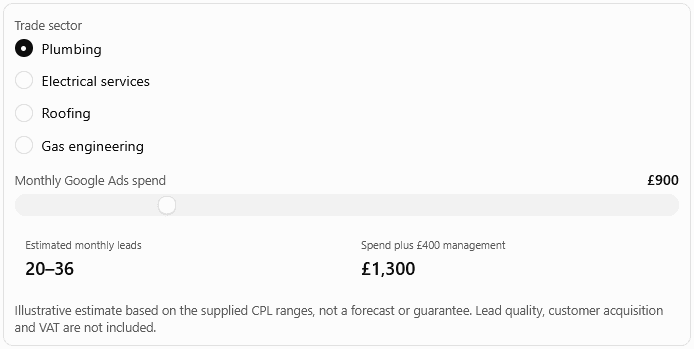 A business should ideally also measure the cost of acquiring a paying customer, rather than treating every enquiry as a completed sale.
4. Case Study: Google Ads for a Bristol Emergency Plumber
A Bristol emergency plumber needed more immediate enquiries and wanted to avoid waiting for organic search rankings to improve.
The business was a sole trader, and its website was not converting visitors effectively.
The campaign information supplied for this case study records a previous cost per lead of £68, despite also describing the business as having no prior Google Ads history. That starting-point discrepancy should be clarified before publication.
The Problem
The existing advertising approach was not producing enquiries at a sustainable cost.
The landing page also made it harder than necessary for people to contact the plumber.
What BAMSH Did
BAMSH focused on the parts of the campaign most likely to affect enquiry quality and wasted spend.
The work included:
-
Rebuilding the campaign structure
-
Reviewing and improving negative keywords
-
Rewriting advert copy around emergency plumbing searches
-
Improving the landing page’s calls to action
-
Aligning adverts more closely with urgent customer intent
Month 1 Results
 The estimated value of work generated from the advertising in month three was £8,200.
BAMSH’s management fee was £400 per month.
The brief describes this as approximately 20 times the management fee, but that is a revenue-to-management-fee comparison, not a true 20× return on total advertising investment.
The advertising spend, operating costs and profit would need to be included to calculate actual ROI.
What Can Other Tradespeople Learn?
The improvement did not come from increasing spending blindly.
It came from improving the relationship between the search, the advert and the landing page.
For businesses paying for irrelevant clicks or receiving enquiries for the wrong services, those fundamentals are often the right place to start.
5. How Quality Score Can Help Improve PPC Performance
Quality Score is a Google Ads diagnostic measure, scored from 1 to 10, that helps advertisers understand the relevance of their keywords, adverts and landing pages.
It considers three main areas:
-
Expected click-through rate: How likely somebody is to click the advert.
-
Advert relevance: How closely the advert relates to the searcher’s intent.
-
Landing page experience: Whether the destination page is relevant and useful.
A common mistake is to assume that improving Quality Score by a particular number automatically reduces CPC by a fixed percentage.
It does not work that way.
Quality Score is a diagnostic indicator rather than a direct input into Google’s ad auction.
However, the improvements that influence its components can also contribute to better advertising performance.
What Should You Improve First?
Imagine somebody searches for:
“Emergency plumber Bristol”
They click an advert about emergency plumbing.
But the landing page takes them to a generic homepage containing information about bathroom installations, heating maintenance and company history.
That is a poor match for the search.
A dedicated emergency plumbing page with clear availability information, service coverage and a prominent telephone number is more relevant.
That can improve the visitor’s experience and increase the likelihood of an enquiry.
For further practical advice, see our PPC optimisation tips for South West UK SMEs.
6. When BAMSH Recommends PPC Over SEO, and When We Recommend Both
Not every business should spend its entire marketing budget on Google Ads.
Equally, not every business can afford to wait for organic search visibility.
The right recommendation depends on how quickly you need customers, what your services are worth and what your website already achieves.
When PPC Is the Better Starting Point
We would generally prioritise PPC when:
-
You need enquiries quickly.
-
Your website is new and has little organic visibility.
-
You have spare capacity that needs filling.
-
You offer high-intent services such as emergency repairs.
-
You want to test demand for a new service.
-
You have a clear advertising budget and can measure enquiries.
For example, a new emergency plumbing business may need customers immediately.
A properly targeted PPC campaign can be a sensible way to reach people searching for urgent help.
When SEO Is the Better Priority
SEO may deserve more attention when:
-
You want to reduce long-term dependence on paid clicks.
-
Your website has technical or structural problems.
-
Customers research extensively before making a decision.
-
You need stronger organic visibility across multiple services.
-
You already have sufficient short-term enquiries.
-
Your available budget makes competitive PPC difficult to sustain.
SEO is not free, but organic clicks do not carry the same per-click advertising charge.
When We Recommend Both
For an established business with enough budget, combining PPC and SEO can make sense.
PPC can target immediate commercial demand while SEO develops wider organic visibility.
Google Ads data can also help identify which services and search terms produce valuable enquiries.
|
Business situation |
Recommended priority |
Why |
|---|---|---|
|
New emergency plumber needing work now |
PPC first |
Immediate search visibility |
|
Established roofer planning long-term growth |
SEO plus selective PPC |
Build organic visibility while capturing high-intent searches |
|
Electrician launching a new commercial service |
PPC test, supported by SEO |
Test demand before expanding content |
|
Business with a broken or poorly converting website |
Fix conversion problems first |
Paying for more clicks may waste money |
|
Growing SME with sufficient marketing budget |
PPC and SEO together |
Balance short-term demand with longer-term visibility |
BAMSH provides both Google Ads management and SEO services.
7. How PPC Gives Small Businesses Better Targeting and Budget Flexibility
A small business does not necessarily need to advertise to an entire city or region.
It can concentrate its budget on the services and locations that matter.
Location Targeting
A window cleaning company in Exeter does not need enquiries from London.
A Bristol electrician might want to target Bristol, Filton, Kingswood and other areas the company actually serves.
Review the location settings carefully, including whether adverts can reach people showing interest in an area rather than only those physically located there.
Advert Scheduling
If a company only answers calls during working hours, it may want to concentrate its advertising around those hours.
An emergency service may need a different approach.
The schedule should match the business’s ability to respond.
Negative Keywords
Negative keywords help prevent adverts appearing for irrelevant searches.
For example, a commercial roofing contractor may want to exclude searches relating to DIY roofing tutorials or roofing jobs.
The right exclusions depend on the business.
Search Intent
Not all searches have equal commercial value.
Compare:
“How to fix a leaking tap”
with:
“Emergency plumber Bristol call out”
The second search generally indicates a more immediate need for a service provider.
A campaign focused on urgent enquiries should reflect that difference.
Advert Assets
Sitelinks, call assets and location assets can provide additional useful information within adverts.
These can make it easier for relevant customers to reach the right page or contact the business.
However, adding assets does not guarantee higher rankings or cheaper clicks.
8. How Much Should a UK SME Spend on Google Ads?
There is no universal starting budget.
A business advertising low-cost services in a competitive market has different requirements from a company selling high-value commercial work.
Before choosing a budget, establish:
-
Your expected cost per lead
-
Your enquiry-to-customer conversion rate
-
Your average job value
-
Your gross profit per job
-
Your available capacity
-
Your management costs
A £300 advertising budget may be sufficient for a small initial test in some markets, but it may produce too little data in a highly competitive trade.
Likewise, spending £3,000 without proper tracking is not automatically a better strategy.
Start with a budget that gives you a reasonable opportunity to test meaningful search demand.
Then adjust based on actual results.
If you want help establishing the appropriate budget, review the BAMSH PPC management service or book a free 15-minute call.
9. What Can UK SMEs Learn From Larger PPC Campaigns?
Large companies often have much bigger advertising budgets than small businesses, but the underlying principles can still be useful.
For example, the original article referenced Xero’s paid-search transformation, which reportedly achieved 42% growth in paying subscribers from paid search while reducing cost per subscriber by 7%.
That is not a result a typical UK SME should expect to reproduce.
The useful lesson is that growth and efficiency need to be measured together.
If you double your advertising budget but the cost of acquiring each customer rises sharply, the extra revenue may not justify the spending.
For a small business, this means knowing:
-
What a lead costs
-
How many leads become customers
-
What those customers spend
-
How much profit remains
-
Whether the campaign can support more demand
The same principle applies whether your monthly advertising budget is £500 or £50,000.
10. Why Landing Pages Matter as Much as the Ads
A well-written advert can attract the right visitor.
But the landing page determines what happens next.
If somebody searches for “emergency boiler repair Bristol”, the page should make it immediately clear whether you provide that service, which areas you cover and how to contact you.
A strong PPC landing page normally needs:
-
A clear headline matching the searcher’s intent
-
Relevant service information
-
A visible telephone number or enquiry form
-
Genuine reviews or evidence of previous work
-
Accurate service-area information
-
Fast loading and mobile usability
-
A straightforward call to action
Sending every advert to the homepage is not always the best choice.
Where several services have different customer needs, dedicated landing pages can improve relevance and make tracking easier.
For more practical examples, see our complete guide to PPC in lead generation.
11. Which Google Ads Campaign Types Should SMEs Consider?
Google offers several advertising formats.
The right choice depends on what your business sells and how customers find it.
|
Campaign type |
Common use |
|---|---|
|
Search Ads |
Reaching people actively searching for services or products |
|
Shopping Ads |
Advertising physical products with images and prices |
|
Performance Max |
Running goal-based campaigns across eligible Google advertising channels |
|
Display Ads |
Visual advertising across Google’s Display Network |
|
Remarketing |
Reaching eligible previous visitors through supported campaigns |
For a local emergency tradesperson, Search Ads are often a sensible starting point because customers are already expressing an immediate need.
For an online retailer, Shopping Ads may be more appropriate.
Performance Max can be useful in certain circumstances, but it should not be chosen simply because it uses automation.
The campaign type should match the business objective, available conversion data and budget.
Read our guide to the types of Google Ads available to UK SMEs for a more detailed comparison.
Martyn’s View: Why PPC Works Best When You Understand the Numbers
Martyn’s existing perspective, retained and refined for this article.
Having worked with UK SMEs on digital marketing since 2012, one of the recurring problems I see is businesses spending money on advertising without understanding what the campaigns are actually producing.
The problem is not always the advertising budget.
Sometimes the campaign targets searches that are too broad. Sometimes the landing page does not answer what the customer needs to know. In other cases, the business is receiving enquiries but has no reliable way to establish which ones came from advertising.
Increasing the budget will not automatically solve those problems.
Before scaling a campaign, I want to understand what each enquiry costs, how many enquiries become paying customers and whether the resulting work is profitable.
That is what makes PPC useful for small businesses. You can make decisions based on actual campaign performance rather than assuming more traffic means more business.
The objective is not to buy the most clicks. It is to generate suitable enquiries at a cost the business can afford.
Martyn, BAMSH Digital Marketing
Ready to Generate More Enquiries From Google?
If your business needs more enquiries now, PPC may be a practical starting point.
BAMSH manages Google Ads campaigns for businesses in Bristol, the South West and across the UK.
Our management fees start from £400 per month excluding VAT, with your advertising spend paid directly to Google.
There are no long-term contracts, and the aim is to make the costs and performance understandable before you commit to increasing your budget.
You can review our Google Ads and PPC management service, compare our published pricing or book a free 15-minute call to discuss your business, budget and realistic options.
Frequently Asked Questions
What are the main benefits of PPC for SMEs?
PPC can provide fast visibility, precise targeting, measurable performance and control over advertising budgets. It allows businesses to reach people actively searching for relevant products or services. The value comes from generating profitable enquiries rather than simply attracting more clicks.
How much does Google Ads management cost for a small business in the UK?
BAMSH Google Ads management starts from £400 per month excluding VAT. Advertising spend is separate and paid directly to Google. The total investment depends on the market, campaign complexity and advertising budget.
How quickly can Google Ads generate enquiries?
Google Ads can begin showing adverts once a campaign is approved and active, potentially producing enquiries on the first day. However, there is no guarantee of immediate leads. Campaigns usually need monitoring and refinement as performance data becomes available.
How much does a Google Ads lead cost for a UK tradesperson?
The supplied planning ranges are £25–£45 for plumbing, £20–£40 for electrical services, £30–£55 for roofing and £28–£50 for gas engineering. These are indicative figures rather than verified UK-wide benchmarks. Actual costs depend on location, competition, targeting and landing page performance.
Is PPC better than SEO for a small business?
PPC can be more suitable when a business needs immediate search visibility or wants to test demand quickly. SEO is useful for building organic visibility over time. Many businesses benefit from combining both, provided their budget and commercial objectives justify the investment.
What is Quality Score in Google Ads?
Quality Score is a diagnostic measure from 1 to 10 that helps advertisers assess expected click-through rate, advert relevance and landing page experience. It is not a direct input into Google’s advertising auction. Improving the underlying quality of adverts and landing pages can nevertheless support better campaign performance.
Can a small business compete with larger advertisers?
Yes, particularly when it focuses on relevant searches, a defined service area and strong landing pages. Larger budgets can provide an advantage, but spending alone does not determine campaign performance. A smaller advertiser can still compete effectively for suitable searches.
How much should a small business spend on Google Ads?
The right budget depends on the sector, geographic area, expected cost per lead and number of enquiries required. BAMSH indicates that many local trades and small service businesses start with approximately £500–£1,000 per month in advertising spend, separate from management fees. More competitive markets may require substantially more.
Does BAMSH require a long-term PPC contract?
No. BAMSH’s published pricing describes rolling monthly services without long-term lock-in, with 30 days’ notice for cancellation. The advertising budget is paid directly to Google rather than through BAMSH.
How do I know whether my PPC campaign is profitable?
Track advertising spend, management fees, qualified enquiries, customers acquired and profit generated. A low cost per lead is useful, but it does not automatically mean the campaign is profitable. The key is whether the value of the customers acquired justifies the total investment.