
SEO results compound over time. Google Ads can generate leads from day one.
That’s the difference we explain to UK trade businesses when they’re deciding where to spend their marketing budget.
But after 14 years in digital marketing, BAMSH knows the decision isn’t always straightforward.
An emergency plumber in Bristol might need the phone ringing this week. A builder specialising in extensions may be more interested in attracting larger projects over the next 12 months. A roofing company might need both immediate repair enquiries and a steady pipeline of replacement work.
These businesses shouldn’t all follow the same marketing strategy.
We’ve seen how businesses can waste money by expecting SEO to deliver immediate enquiries or running Google Ads without understanding what happens after somebody clicks.
The important question isn’t whether organic or paid traffic is better.
It’s which channel can generate the right enquiries at a cost your business can afford.
In this guide, we’ll explain how BAMSH approaches that decision, compare estimated costs per lead across six UK trades, show what our services cost and outline a practical 12-month strategy for using SEO and Google Ads together.
Key Takeaways
-
Google Ads offers speed. Campaigns can begin attracting visitors shortly after launch, although enquiries aren’t guaranteed.
-
SEO builds long-term visibility. Relevant rankings can generate enquiries over time without paying Google for every click.
-
Emergency plumbers, electricians and gas engineers may benefit from starting with Google Ads while SEO develops.
-
Builders and renovation companies may benefit from prioritising SEO because customers often research larger projects before making contact.
-
BAMSH’s SEO and AEO services start from £799 per month, while Google Ads management starts from £400 per month, plus advertising spend.
-
A combined 12-month strategy can help businesses attract enquiries now while developing organic visibility for the future.
-
Cost per qualified lead, customers acquired and profitable jobs matter more than website traffic alone.
1. What Is the Difference Between Organic and Paid Traffic?
Organic traffic refers to visitors who reach your website through unpaid search results.
For example, somebody searches Google for “roof repairs Bristol”, finds a roofing company’s website in the normal results and clicks through.
The business doesn’t pay Google for that particular click.
However, appearing prominently may require ongoing SEO work, including improving service pages, fixing technical issues and strengthening local search visibility.
Paid traffic comes from advertising.
With Google Ads, the same roofing company can run adverts targeting people searching for roof repairs in its service area.
The business typically pays when somebody clicks the advert.
Paid advertising can provide faster visibility, but the campaign needs an ongoing budget.
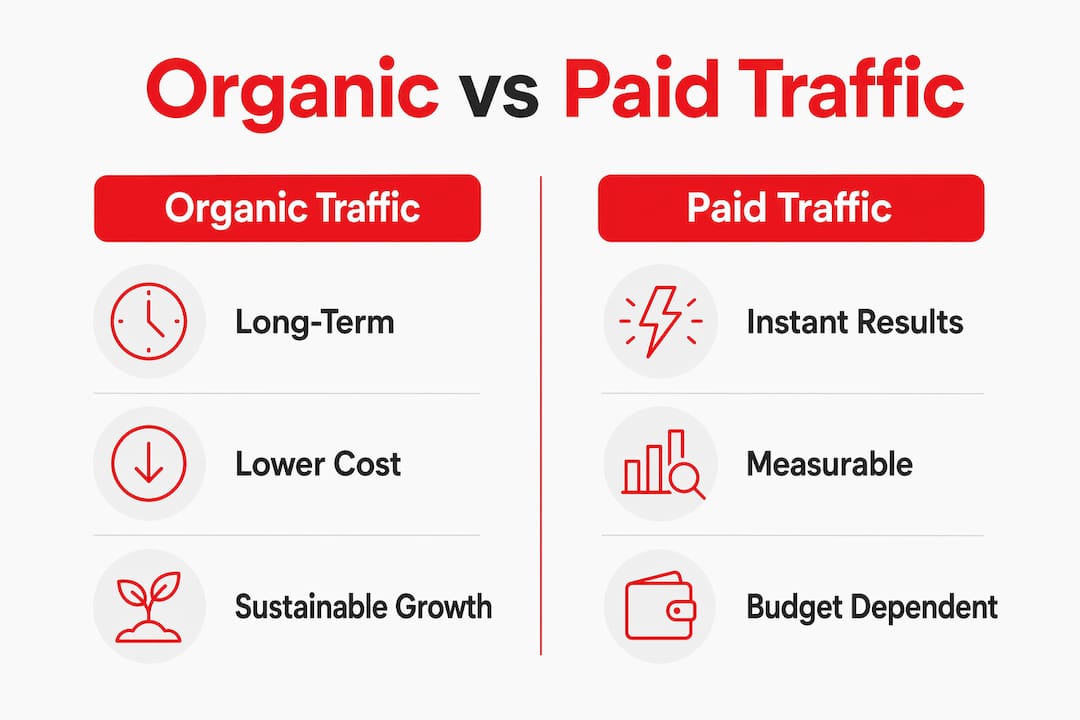
Organic vs Paid Traffic Compared
| Factor | SEO (Organic Traffic) | Google Ads (Paid Traffic) |
|---|---|---|
| Speed | Usually develops over several months | Traffic can begin shortly after launch |
| Main cost | SEO work and ongoing management | Advertising spend plus management fees |
| Cost per click | No direct charge from Google | Usually charged per click |
| Long-term value | Rankings can continue generating enquiries | Paid visibility depends on continued spending |
| Targeting | Based on search relevance and organic rankings | More direct control over keywords, locations and budgets |
| Best suited to | Building sustainable local visibility | Generating immediate search visibility |
| Main limitation | Results take time and aren’t guaranteed | Advertising costs continue while campaigns run |
Neither channel automatically produces customers.
A website still needs to explain the service clearly, establish trust and make it easy for visitors to enquire.
2. What BAMSH Has Learnt After 14 Years in Digital Marketing
One of the most important lessons from working with businesses over time is that SEO and Google Ads solve different problems.
SEO is about developing visibility.
Google Ads is about buying relevant search exposure when you need it.
The challenge is knowing when each approach makes commercial sense.
SEO Results Compound Over Time
A well-optimised service page can continue attracting visitors long after it’s first published.
As more useful pages begin ranking, a website can develop visibility across different services and locations.
For example, a roofing company might initially attract visitors searching for roof repairs.
Over time, improvements to its website could also help it appear for flat roofing, tiled roofing and roof replacement searches.
Each relevant page creates another opportunity to attract customers.
This is why we describe SEO as a compounding investment.
However, rankings aren’t permanent. Competitors improve their websites, search results change and existing pages need maintaining.
SEO requires ongoing attention.
Google Ads Can Generate Leads From Day One
Google Ads offers something SEO usually cannot: the opportunity to appear prominently for relevant searches shortly after launching a campaign.
A new plumbing business doesn’t necessarily have to wait months to appear in search results for its services.
It can use paid advertising to reach people searching within its target area.
But visibility isn’t the same as a guaranteed enquiry.
Poor targeting, irrelevant keywords or a weak landing page can quickly waste an advertising budget.
More Traffic Doesn’t Always Mean More Customers
A business can receive hundreds of website visitors without generating enough enquiries.
Before recommending more traffic, we consider what happens when somebody reaches the website.
Can they find the telephone number?
Is it clear which areas the business covers?
Are the services explained properly?
Does the website work well on mobile?
If those basics aren’t right, spending more money on either SEO or PPC may not solve the problem.
3. SEO vs PPC by Trade Type: Estimated Cost Per Lead
The type of trade makes a significant difference to the marketing strategy.
Someone dealing with a burst pipe usually wants help immediately.
A homeowner planning an extension may spend several weeks researching builders before requesting quotations.
Those different buying behaviours affect how businesses should approach SEO and Google Ads.
Estimated SEO vs Google Ads Cost Per Lead for UK Trades
| Trade Type | Typical SEO CPL (Est.) | Typical Google Ads CPL (Est.) | Best Starting Channel | Recommended Approach |
|---|---|---|---|---|
| Plumber / emergency | £8–£18 once ranking | £25–£45 | Google Ads for speed | Ads immediately, SEO in parallel |
| Electrician | £10–£20 | £20–£40 | Google Ads for speed | Ads immediately, SEO in parallel |
| Builder / renovations | £15–£30 | £35–£70 | SEO for higher-value jobs | SEO first, Ads for specific campaigns |
| Roofer | £12–£25 | £30–£55 | Google Ads + Maps | Ads and Google Business Profile optimisation immediately |
| Gas engineer / boiler | £10–£22 | £28–£50 | Google Ads for speed | Ads immediately, SEO in parallel |
| Landscaper / gardener | £8–£16 | £18–£35 | SEO + Maps | Local SEO and Maps, with Ads for seasonal campaigns |
Important: These are estimated planning ranges from BAMSH’s August 2026 content brief. They should not be presented as independently verified historical client averages or guaranteed results.
Actual cost per lead depends on competition, location, service type, website conversion rate and the way enquiries are measured.
SEO figures also assume useful rankings have already developed. A new SEO campaign may take several months before it produces enough enquiries for a meaningful CPL calculation.
What Does Cost Per Lead Mean?
Cost per lead, or CPL, measures how much a business spends to generate an enquiry.
For example, if a plumber spends £1,000 on marketing and receives 25 enquiries:
£1,000 ÷ 25 = £40 per lead.
However, an enquiry isn’t necessarily a paying customer.
A more useful assessment also considers how many enquiries turn into quotations, booked jobs and profitable work.
4. When BAMSH Recommends SEO, When We Recommend PPC, and When We Recommend Both
We don’t recommend the same channel to every business.
The right approach depends on urgency, competition, available budget and the type of work the business wants to attract.
When We Recommend SEO First
Example: An established builder wants more extension and renovation projects.
The company already receives work through referrals but wants a more consistent source of enquiries.
Its customers usually research contractors, compare previous projects and consider their options before making contact.
In this situation, SEO can provide a strong foundation.
We would focus on improving service pages, documenting genuine projects, strengthening local visibility and making it easier for customers to request quotations.
Google Ads could still be useful for specific campaigns, but it wouldn’t necessarily need to be the first investment.
Why SEO? The business has time to develop visibility, and customers typically spend longer researching higher-value projects.
When We Recommend Google Ads First
Example: A newly established emergency plumber needs enquiries immediately.
The business has a new website and limited organic rankings.
The owner has availability for urgent call-outs and needs to start attracting customers.
Waiting several months for SEO to develop may not be practical.
Google Ads offers a faster route to relevant search visibility.
We would focus on specific services, realistic geographic targeting, suitable landing pages and reliable enquiry tracking.
SEO could then be developed alongside the advertising campaign.
Why PPC? The business needs immediate visibility for services customers often search for urgently.
When We Recommend Both
Example: A roofing company wants repair enquiries now and more replacement projects next year.
Google Ads can target urgent repair searches.
SEO can develop visibility for roof replacement, flat roofing and other relevant services.
Google Business Profile optimisation can also support local discovery.
As organic enquiries increase, the company can review which advertising campaigns still provide good value.
Why both? The business has immediate demand and longer-term growth objectives.
Which Channel Should You Start With?
| Business Situation | Recommended Starting Point | Reason |
|---|---|---|
| New emergency plumbing business | Google Ads | Faster search visibility |
| Established builder targeting larger projects | SEO | Supports longer customer research journeys |
| Roofing company needing immediate and future enquiries | SEO + Google Ads + Maps | Covers different customer needs |
| Local gardener with a limited budget | SEO + Google Business Profile | Builds ongoing local visibility |
| Business launching a new service | Google Ads initially | Helps test demand |
| Business with plenty of traffic but few enquiries | Website conversion improvements | More traffic may not fix the problem |
| Growing trade business with a sustainable marketing budget | SEO + Google Ads | Balances short-term and long-term objectives |
5. The 12-Month SEO and PPC Strategy We Recommend
For trade businesses that can afford both channels, combining SEO and Google Ads can provide a practical balance between immediate enquiries and long-term growth.
The idea is straightforward.
Google Ads helps your business reach potential customers while SEO builds organic visibility.
As your website starts generating more enquiries through unpaid search results, you can review whether the same advertising budget is still necessary.
Based on BAMSH’s approach, we recommend reviewing the strategy in three stages rather than expecting SEO and PPC to deliver identical results from the beginning.
Months 1–3: Google Ads Generates Leads While SEO Builds
During the first three months, Google Ads can provide immediate search visibility.
A campaign can begin attracting relevant visitors shortly after launch, provided the adverts are approved and the targeting is suitable.
Meanwhile, SEO focuses on improving the website’s foundations.
This typically includes technical SEO improvements, keyword research, optimising important service pages, improving Google Business Profile information and ensuring the website works properly on mobile.
The goal: Generate early enquiries through Google Ads while building the foundations for organic search performance.
Months 4–6: SEO Starts Gaining Visibility and PPC Is Refined
By months four to six, some SEO improvements may begin producing better rankings and relevant organic traffic.
This is also when Google Ads campaigns should have enough initial data to identify which keywords, adverts and locations are generating suitable enquiries.
For example, a roofer might discover that Google Ads performs well for emergency repairs while organic service pages begin attracting people researching complete roof replacements.
Instead of treating the channels separately, paid campaign insights can help prioritise further SEO improvements.
The goal: Improve organic visibility while making Google Ads more cost-effective.
Months 7–12: Organic Enquiries Increase and PPC Budgets Can Be Reviewed
As the SEO campaign develops, the website may begin receiving more consistent enquiries through organic search.
At this stage, businesses can assess whether certain Google Ads campaigns still require the same budget.
For example, if a plumbing business starts receiving enough suitable enquiries organically for a particular service, it may decide to reduce advertising spend on that service.
Alternatively, it could redirect that budget towards a new location or a more profitable service.
The goal: Build a stronger organic lead source while keeping PPC focused on opportunities where it remains profitable.
12-Month SEO and PPC Timeline
| Timeline | SEO Development | Google Ads Strategy | Main Objective |
|---|---|---|---|
| Months 1–3 | Technical fixes, keyword research, service page optimisation and local SEO foundations | Launch campaigns to attract relevant enquiries | Generate early leads while SEO builds |
| Months 4–6 | Rankings and organic visibility may begin improving | Refine targeting, keywords, adverts and landing pages using campaign data | Improve lead quality and cost efficiency |
| Months 7–9 | Organic traffic and enquiries may become more consistent | Review advertising spend on services gaining organic visibility | Reduce unnecessary dependence on paid traffic |
| Months 10–12 | Strengthen successful pages and review long-term SEO performance | Maintain profitable campaigns or redirect budget to new opportunities | Develop a sustainable balance between SEO and PPC |
This timeline is an illustrative strategy, not a guarantee of rankings or enquiries within a particular month. Results depend on the website, competition and investment.
Should You Stop Google Ads Once SEO Starts Working?
Not necessarily.
If Google Ads continues generating profitable enquiries, switching it off could reduce your overall customer pipeline.
Instead, review the contribution of each channel.
You may find that SEO performs well for some services while Google Ads remains valuable for urgent searches, seasonal demand or new locations.
The aim is to make your marketing budget more effective, not eliminate paid advertising entirely.
6. How Much Does SEO Cost With BAMSH?
SEO requires an investment in website improvements, content, technical work and ongoing optimisation.
BAMSH publishes its starting prices so businesses can understand the likely investment before arranging a consultation.
BAMSH SEO Pricing
| Package | Published Monthly Price | Suitable For |
|---|---|---|
| Local Launch | £799–£1,200 | Local businesses and trades |
| Growth Accelerator | £1,500–£2,500 | Growing regional and multi-location businesses |
| National / Enterprise | £3,000–£6,000+ | Larger or more complex campaigns |
Prices exclude VAT. Confirm the latest package rates and inclusions before publishing.
BAMSH’s managed SEO services start from £799 per month.
What Does SEO Management Include?
Depending on the agreed package and scope, SEO work can include:
-
Website audits and keyword research.
-
Technical SEO improvements.
-
On-page optimisation.
-
Service page and content improvements.
-
Local SEO and Google Business Profile optimisation.
-
Appropriate link-building activity.
-
Answer Engine Optimisation (AEO).
-
Performance reporting.
The exact monthly deliverables depend on the package.
A local plumber targeting one town doesn’t necessarily need the same level of work as a business targeting several counties.
The right SEO investment should reflect the competition, services and locations involved.
Why SEO Costs Money When Organic Clicks Are Free
Google doesn’t charge businesses for clicks on their unpaid organic listings.
However, the work required to improve rankings involves research, technical expertise, content improvements and ongoing monitoring.
That is what the SEO management fee covers.
The objective is to develop search visibility that can continue generating relevant enquiries over time.
7. How Much Does Google Ads Cost With BAMSH?
Google Ads has two separate costs.
The first is the management fee paid to the agency.
The second is the advertising budget paid to Google.
These shouldn’t be confused.
BAMSH’s Google Ads and PPC management service starts from £400 per month, excluding VAT, plus the advertising spend.
Example Monthly Google Ads Costs
| Expense | Example Monthly Cost |
|---|---|
| BAMSH PPC management | £400 |
| Google Ads advertising budget | £500 |
| Combined monthly cost | £900 |
This is an illustrative starting example, not a fixed package price. VAT on management fees and any applicable advertising charges should be confirmed separately.
What Does PPC Management Include?
Depending on the agreed campaign scope, management can include:
-
Keyword research.
-
Campaign setup and advert creation.
-
Geographic targeting.
-
Bid and budget management.
-
Conversion tracking.
-
Ongoing campaign optimisation.
-
Performance reporting.
The advertising budget depends on the market.
A plumber targeting emergency call-outs in a competitive city may need a different budget from a specialist contractor targeting a smaller geographic area.
Does Paying More Guarantee More Leads?
No.
Increasing the budget can create more opportunities for adverts to appear, but it doesn’t guarantee suitable enquiries.
Campaign performance depends on competition, targeting, search intent, advert quality and website conversion rates.
A smaller, well-targeted campaign can sometimes produce better commercial results than a larger campaign attracting irrelevant clicks.
8. How Much Does It Cost to Run SEO and PPC Together?
A combined strategy needs a sustainable budget.
Using BAMSH’s starting prices, here’s an illustrative monthly breakdown.
Combined SEO and Google Ads Budget
| Service | Monthly Cost |
|---|---|
| SEO and AEO management | £799 |
| Google Ads management | £400 |
| Google Ads advertising budget | £500 |
| Combined monthly total | £1,699 |
The example excludes applicable VAT and assumes a £500 monthly advertising budget. Additional website development or other separately quoted work is not included.
This doesn’t mean every small trade business should spend £1,699 per month.
A sole trader with a limited budget may need to prioritise one channel initially.
An established roofing company with several employees and capacity for more work may be able to justify a larger investment.
The important thing is to understand what the business can afford and what results would make the spending worthwhile.
For the latest package details, see BAMSH’s published pricing.
9. How to Calculate the Real Cost Per Lead From SEO and PPC
One mistake businesses make when comparing organic and paid traffic is using different cost calculations.
For example, they might include the agency fee when calculating SEO costs but look only at Google Ads spend when calculating PPC costs.
That makes the comparison misleading.
Example: Google Ads Cost Per Lead
A plumbing company spends:
-
£800 on Google Ads.
-
£400 on campaign management.
-
Receives 30 enquiries.
The total marketing cost is £1,200.
£1,200 ÷ 30 enquiries = £40 per lead.
If the business looked only at its Google Ads spend, it would calculate approximately £26.67 per lead.
That would exclude the management cost.
Example: SEO Cost Per Lead
The same business spends £799 on SEO in a month and receives 50 organic enquiries.
£799 ÷ 50 enquiries = £15.98 per lead.
However, this calculation needs context.
The business may have invested in SEO for several months before those enquiries started arriving.
A fair comparison should consider the total investment over a suitable period, particularly during the early stages of an SEO campaign.
Both calculations are illustrative examples, not actual BAMSH client performance figures.
Cost Per Lead vs Cost Per Customer
Not every enquiry becomes a paying customer.
Imagine a roofing company receives 20 enquiries from Google Ads but only five turn into jobs.
Another campaign produces 12 enquiries, with eight becoming customers.
The second campaign may be more valuable despite generating fewer leads.
This is why we recommend tracking:
-
Qualified enquiries.
-
Quotations provided.
-
Jobs won.
-
Revenue generated.
-
Marketing costs.
-
Cost per acquired customer.
The aim is profitable work, not simply the cheapest enquiry.
10. How Google Ads Data Can Improve SEO
One advantage of running both channels is that Google Ads can provide useful information about what customers search for.
For example, a roofer may discover that adverts for flat roof repairs attract better-quality enquiries than broader roofing terms.
That information can help identify which services deserve stronger organic content.
The business might then improve its flat roofing service page, explain common repair problems and make it easier for customers to request a quotation.
SEO and PPC shouldn’t operate as completely separate activities.
Both should contribute towards the same commercial goals.
For further background, see our SEO versus PPC guide.
11. How AI Search Affects Organic and Paid Traffic in 2026
Google search results are changing.
AI Overviews and other answer engines can provide information directly within search results, sometimes reducing the need for users to visit a website.
This makes clear, accurate and useful website content increasingly important.
For UK trade businesses, that means explaining services properly, providing genuine experience, answering relevant customer questions and keeping business information consistent.
BAMSH incorporates Answer Engine Optimisation into its wider SEO approach to help businesses improve how their information can be understood by AI-powered search systems.
However, AI citations aren’t guaranteed, and appearing in an AI-generated answer doesn’t automatically produce an enquiry.
Google Ads remains a separate way to reach customers through paid search.
The principle is still the same.
Make it easy for suitable customers to find your business, understand what you offer and get in touch.
12. Common Mistakes Businesses Make With SEO and Google Ads
Expecting SEO to Deliver Immediate Results
SEO can take several months to develop meaningful visibility.
Businesses that urgently need enquiries should consider whether they can afford to wait.
Running Google Ads Without Conversion Tracking
If you don’t know which adverts produce enquiries, it’s difficult to understand whether the campaign is profitable.
Track meaningful actions, not just clicks.
Paying for Traffic Before Fixing the Website
A slow website, broken contact form or hidden telephone number can waste visitors from both channels.
Fixing these problems may improve results without increasing the marketing budget.
Treating Organic Traffic as Completely Free
Organic clicks don’t carry a direct advertising charge, but SEO still requires investment.
Choosing the Cheapest Lead Instead of the Best Lead
A low-cost enquiry isn’t valuable if the customer wants a service you don’t provide.
Lead quality matters.
Reducing PPC Spend Too Early
Improved rankings don’t automatically mean Google Ads is no longer useful.
Review actual enquiries and customers before changing budgets.
Ignoring What Happens After an Enquiry
A business can invest heavily in SEO and PPC but still lose work because nobody responds promptly.
Marketing doesn’t stop when somebody completes a contact form.
13. When Should a UK Trade Business Invest in SEO First?
SEO may be the stronger starting point when:
-
The business already has a steady flow of work.
-
Customers typically research services before buying.
-
The owner wants to develop long-term local visibility.
-
There is time to wait for organic performance to improve.
-
The business has useful projects, experience and service information to showcase.
For example, a landscaping company with an established portfolio may benefit from improving its visibility for garden design, patios and landscaping services across its local area.
It may not need to pay for advertising immediately.
14. When Should a UK Trade Business Invest in PPC First?
Google Ads may be the better starting point when:
-
The business needs enquiries quickly.
-
It has recently launched.
-
It is entering a new service area.
-
It wants to promote a specific service.
-
It has enough budget to test campaigns properly.
-
It can respond promptly to incoming enquiries.
For example, an emergency plumber may benefit from appearing in relevant paid searches while their organic rankings are still developing.
The key is to keep the campaign focused on services and locations that can generate profitable work.
15. When Should You Invest in Both?
A combined strategy can be appropriate when a business needs immediate enquiries but also wants to build long-term visibility.
Google Ads can help attract customers now.
SEO can develop a more sustainable source of relevant search traffic.
As performance improves, the balance between the two channels can change.
For example, a roofing company might continue using Google Ads for emergency repairs while relying increasingly on SEO for planned roof replacements.
A builder could use SEO for its main services while running targeted campaigns for a particular location.
There isn’t one fixed split that works for every business.
The decision should be based on actual performance and available budget.
16. How BAMSH Helps UK Trade Businesses Choose the Right Channel
After 14 years in digital marketing, our approach is to start with the business problem rather than recommend the same package to everybody.
A newly established plumber may need immediate enquiries.
A builder may want larger projects over the next year.
A roofing company may need a combination of urgent repair work and planned installations.
Those goals require different strategies.
BAMSH provides SEO, AEO and Google Ads management, with published starting prices and reporting to help businesses understand their marketing performance.
The aim is to identify which channel is suitable for the business today and how that strategy may need to change as the company grows.
Frequently Asked Questions
What is the main difference between organic and paid traffic?
Organic traffic comes from unpaid search results, while paid traffic comes from advertisements such as Google Ads. SEO aims to improve organic visibility over time, while PPC provides faster access to relevant search audiences. Organic clicks don’t have a direct advertising charge, but SEO work still costs money. Google Ads requires ongoing advertising spend and campaign management.
Is organic traffic better than paid traffic?
Neither is always better. Organic traffic can become a valuable long-term source of enquiries once useful rankings are established. Paid traffic can provide visibility more quickly and offers direct control over advertising budgets. The best choice depends on how urgently the business needs work, its budget and the value of each customer.
How long does organic traffic take to build?
SEO often takes several months to produce meaningful improvements, particularly in competitive markets. Some local businesses may see progress sooner, while new websites or difficult keywords can take longer. There is no guaranteed month when rankings or enquiries will increase. Performance should be reviewed using relevant search visibility, qualified leads and customer outcomes.
Can paid traffic improve my organic SEO strategy?
Yes. Google Ads can show which search terms, services and messages attract relevant enquiries. That information can help prioritise SEO improvements and identify useful content opportunities. Strong organic pages may also support PPC landing page performance. The two channels work best when they share consistent business goals.
How do I measure the success of organic vs paid traffic?
Measure qualified enquiries, customers acquired and total marketing costs. Use Google Analytics 4, Google Search Console, Google Ads and enquiry records where appropriate. Include management fees when calculating cost per lead. For SEO, review costs and results over a suitable longer period rather than relying on one month of performance.
Is SEO or Google Ads better for plumbers?
Google Ads can be useful for plumbers who need enquiries quickly, particularly for urgent services. SEO can then build longer-term local visibility. The best approach depends on the service area, competition and budget. Businesses should also ensure they can answer calls and respond promptly to enquiries.
Should builders invest in SEO or PPC?
Builders often benefit from SEO because customers researching extensions and renovations may take time to choose a contractor. Useful service pages, genuine project examples and local visibility can support that process. PPC may help promote specific services or reach new locations. The right mix depends on the type and value of projects the business wants.
Can I reduce Google Ads spending after six months of SEO?
Possibly, but not automatically. Six months of SEO doesn’t guarantee enough organic enquiries to replace paid advertising. Review rankings, qualified enquiries, jobs won and campaign profitability first. If organic performance has improved, you may be able to reduce or redirect some advertising spend.
How much does BAMSH charge for SEO and Google Ads?
BAMSH’s SEO and AEO services start from £799 per month, excluding VAT. PPC management starts from £400 per month, excluding VAT, with Google Ads spend paid separately. The final price depends on the agreed services and campaign requirements. Businesses should compare total costs rather than management fees alone.
Can a small trade business afford SEO and PPC together?
Some can, but it depends on available budget and expected job value. A combined strategy using BAMSH’s starting fees and an illustrative £500 advertising budget would cost £1,699 per month before applicable VAT. A smaller business may be better served by prioritising one channel initially. The decision should be based on sustainable spending and realistic commercial goals.
SEO or Google Ads? Start With the Work You Want to Win
SEO and Google Ads aren’t competing solutions that every business must choose between.
They work at different speeds and involve different costs.
Google Ads can help you reach potential customers quickly.
SEO can develop a more sustainable source of visibility and enquiries over time.
For many UK trade businesses, the strongest approach is to use paid advertising where speed matters while building organic visibility for the future.
But the right decision depends on your services, location, competition and available budget.
At BAMSH, we focus on finding the approach that makes commercial sense rather than recommending the same marketing package to every business.
If you’re unsure where to start, book a free 15-minute call to discuss your website, marketing budget and the type of work you want to attract.