

TL;DR:
- A sales pipeline visually tracks active deals through stages from first contact to closure, enabling real-time revenue control. Proper management, outcome-based stages, and regular reviews improve forecast accuracy and reduce stalled deals. Integrating AI signals and maintaining pipeline hygiene are essential for reliable, predictable sales growth.
A sales pipeline is defined as a visual, stage-by-stage representation of every active deal your sales team is currently working, showing exactly where each opportunity sits on its journey from first contact to closed business. Think of it as your real-time control panel for revenue. Without one, you are essentially guessing which deals will close, when they will close, and how much money is coming in. According to Apollo.io 2026 data, average B2B sales pipelines convert just 15 to 25% of opportunities into wins, while top performers exceed 40%. That gap is almost entirely explained by how well a team manages its pipeline.

What is a sales pipeline and why does it matter?
A sales pipeline is the seller’s real-time system for organising every active deal through defined stages, from prospecting all the way to post-sale handoff. The industry standard term is “sales pipeline,” and it sits firmly within the discipline of sales pipeline management. Where it differs from looser concepts like a “leads list” or a “to-do board” is precision. Each deal occupies a specific stage, and moving it forward requires meeting clear exit criteria.
The importance of a sales pipeline goes beyond organisation. It gives sales managers a reliable basis for revenue forecasting. It shows reps exactly what action to take next. It highlights where deals stall so you can intervene before they go cold. Apollo.io reports that poor pipeline management contributes to an 86% stall rate in buying, which means the majority of deals that enter a pipeline never reach a decision without active management.
For UK small and medium-sized businesses in particular, a well-run pipeline is the difference between predictable monthly revenue and a feast-or-famine sales cycle. Tools like Salesforce, HubSpot, and Pipedrive all provide CRM environments built around the pipeline concept, making it accessible even for teams without a dedicated sales operations function.
What are the typical stages of a sales pipeline?
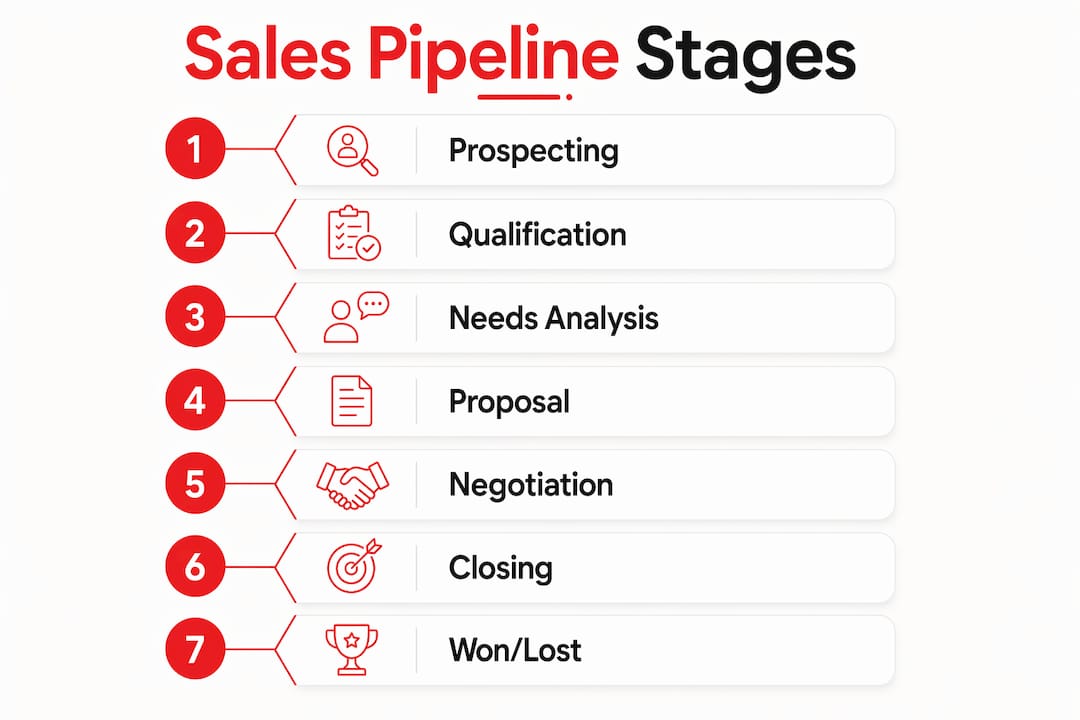
A typical B2B sales pipeline contains five to seven stages aligned with the buyer’s journey. Each stage has a specific purpose, and each requires defined exit criteria before a deal advances.
| Stage | Purpose | Example exit criterion |
|---|---|---|
| Prospecting | Identify potential buyers | Contact identified and verified |
| Qualification | Confirm fit and intent | Budget, authority, need, and timeline confirmed |
| Needs analysis | Understand specific requirements | Discovery call completed and notes documented |
| Proposal | Present your solution and pricing | Proposal sent and acknowledged |
| Negotiation | Agree terms | Revised terms accepted by both parties |
| Closing | Secure commitment | Contract signed |
| Post-sale handoff | Transition to delivery | Onboarding meeting booked |
Exit criteria are the rules that determine when a deal genuinely moves forward rather than simply sitting in a stage because a rep has not updated it. Without them, pipeline stages become vague labels rather than meaningful milestones. Gain.io’s best practices confirm that vague stage names like “Contact” or “Follow-up” reduce pipeline hygiene and harm forecasting accuracy. Outcome-based names such as “Discovery completed” or “Proposal reviewed” create objective, measurable checkpoints instead.
Conversion rates vary significantly between stages. Deals typically drop off most sharply between qualification and needs analysis, and again between proposal and negotiation. Over 30% of B2B deals require one to three months from initial contact to final signature, which means a pipeline without stage-level tracking quickly loses visibility over where time and effort are being spent.
Pro Tip: Review your stage names right now. If any of them describe a task rather than an outcome, rename them. “Proposal sent” is a task. “Proposal reviewed and questions answered” is an outcome. The second version tells you something real about deal progress.
How does a sales pipeline differ from a sales funnel?
The sales pipeline and the sales funnel are related but distinct concepts, and confusing them leads to poor strategy and muddled reporting. According to Outreach and Salesforce perspectives, the sales pipeline represents the seller’s view of active deals and revenue opportunities, while the sales funnel depicts the buyer’s journey with aggregate conversion metrics.
Here is the clearest way to think about it:
- Sales pipeline: Your view. Individual deals. Active management. Revenue forecasting. Seller-centric.
- Sales funnel: The buyer’s view. Aggregate data. Awareness to purchase. Marketing-centric.
The funnel answers questions like: how many visitors became leads, and how many leads became customers? It is a diagnostic tool for marketing effectiveness. The pipeline answers questions like: which deals are at risk this month, and what does my revenue look like for the next 90 days? It is an operational tool for sales management.
Both matter, and they work best together. Your funnel tells you whether you are generating enough of the right leads to feed your pipeline. Your pipeline tells you whether your sales team is converting those leads efficiently. If your funnel is healthy but your pipeline is not, the problem is in your sales process. If your pipeline looks strong but your funnel is weak, you will run out of new opportunities within a few months.
“The funnel shows you where leads come from. The pipeline shows you where deals go. You need both to run a predictable sales operation.” — Martyn Lenthall, Bamsh
For a deeper understanding of how the funnel works alongside your pipeline, the Bamsh guide on what is a sales funnel explains the buyer journey stages and how they connect to lead generation strategy.
Best practices for building and maintaining a strong sales pipeline
Building a pipeline is straightforward. Maintaining one that actually reflects reality is where most teams fall short. Here are the practices that separate high-performing sales teams from the rest.
-
Define outcome-based stage exit criteria from day one. Every stage needs a clear, measurable condition that must be met before a deal advances. This removes subjectivity and keeps your pipeline data trustworthy. Stage naming conventions using outcome-based milestones create objective criteria for deal progression and improve forecasting accuracy across the whole team.
-
Conduct weekly pipeline reviews. A pipeline review is not a status update meeting. It is a structured audit of every deal in the pipeline, asking: what has changed, what is the next step, and is this deal still genuinely active? Salesforce research confirms that pipeline hygiene, including auditing stalled deals and updating deal data, is essential to accurate revenue forecasting.
-
Integrate delivery feasibility and margin checks. Before advancing a deal to proposal or negotiation, confirm that your business can actually deliver profitably. Teamwork’s 2026 analysis shows that effective pipeline management requires integrating delivery feasibility and margin checks into stage exit criteria to avoid progressing unprofitable deals.
-
Use automation to track follow-ups. Missed follow-ups are one of the most common reasons deals stall. CRM automation in tools like Salesforce, HubSpot, or Pipedrive can trigger reminders, send follow-up sequences, and flag deals that have gone quiet. Bamsh’s guide on how to automate lead follow-up covers practical tactics for keeping deals moving without manual effort.
-
Use AI and buyer intent signals for deal health monitoring. AI-driven analytics integrated into pipelines provide early warnings of deal health issues, enabling proactive intervention before a deal goes cold. Platforms like Salesforce Einstein and HubSpot’s AI tools now surface these signals automatically.
Pro Tip: Set a hard rule: any deal with no activity in 21 days gets flagged for review. If there is no clear next step with a date attached, the deal is either stalled or dead. Treat it accordingly.
Common pitfalls and misconceptions about sales pipelines
Even experienced sales teams make these mistakes. Recognising them is the first step to fixing them.
-
Confusing pipeline volume with forecast revenue. A full pipeline feels reassuring, but it is not the same as committed revenue. Treating pipeline volume as a forecast leads to systemic over-commitment and inaccurate sales forecasts. Your pipeline shows all active deals. Your forecast shows only those with a realistic chance of closing within a defined period.
-
Using task-based stage names. Stages named “Called” or “Email sent” describe what a rep did, not where the deal stands. They make it impossible to assess deal health at a glance and create false confidence about progress.
-
Skipping delivery and margin checks. Advancing a deal to proposal without confirming you can deliver it profitably wastes everyone’s time. It also inflates your pipeline with deals that will either be lost at negotiation or become unprofitable if won.
-
Neglecting pipeline hygiene. Pipeline hygiene is as important as volume in ensuring that reported numbers translate into real revenue. A pipeline full of stale, inactive deals gives you a false picture of your sales health and leads to poor resource allocation.
-
Confusing pipeline with funnel. Using funnel metrics to manage individual deals, or pipeline data to assess marketing effectiveness, produces the wrong conclusions. Keep the two frameworks separate and use each for its intended purpose.
Key takeaways
A well-managed sales pipeline is the single most reliable tool for turning leads into predictable, measurable revenue.
| Point | Details |
|---|---|
| Define the pipeline clearly | A sales pipeline tracks individual active deals through defined stages from prospecting to close. |
| Use outcome-based stage names | Stages like “Discovery completed” create objective criteria and improve forecasting accuracy. |
| Separate pipeline from forecast | Pipeline volume shows all active deals; forecast shows only committed revenue within a timeframe. |
| Maintain pipeline hygiene | Audit stalled deals weekly and remove inactive opportunities to keep data reliable. |
| Pipeline and funnel serve different purposes | The pipeline manages active deals from the seller’s view; the funnel tracks aggregate buyer journey metrics. |
What I have learned about sales pipelines after years in the field
Let me be direct with you: most businesses I speak to have a CRM, but very few have a genuine pipeline. They have a list of contacts with statuses attached. That is not the same thing.
The shift happens when you start treating your pipeline as a financial instrument rather than a glorified spreadsheet. Every deal in your pipeline represents a probability-weighted revenue figure. When you manage it that way, your weekly pipeline review stops being an admin task and starts being one of the most valuable 30 minutes in your sales week.
The other thing I see consistently is teams that resist removing stalled deals because it makes the pipeline look smaller. That instinct is understandable, but it is exactly backwards. A smaller, accurate pipeline is worth ten times more than a bloated, fictional one. You cannot make good decisions about where to focus your effort if your data is polluted with deals that have been dead for three months.
The future of pipeline management is already here. AI tools that surface buyer intent signals, flag deals with no recent engagement, and predict close probability based on historical patterns are now standard features in platforms like Salesforce and HubSpot. Teams that use these signals proactively will consistently outperform those that rely on gut feel and manual updates.
Build your pipeline with clear stages, honest data, and a weekly review habit. Everything else follows from that.
— Martyn
How Bamsh can help you fill and manage your pipeline
A strong sales pipeline starts with a steady flow of qualified leads. If your pipeline is thin, the problem is often upstream: your website is not capturing enough of the right enquiries, or those enquiries are not being nurtured effectively before they reach your sales team. At Bamsh, we specialise in building the systems that fix both problems. From answer engine optimisation that gets your business found in Google and AI tools like ChatGPT and Gemini, to automated CRM and lead nurturing systems that keep prospects engaged until they are ready to buy. If you want a pipeline that is full of the right deals, let’s talk.
FAQ
What is a sales pipeline in simple terms?
A sales pipeline is a visual tool that shows every active sales deal your team is working on, organised by stage from first contact to closed business. It gives sales teams and managers a clear picture of where each opportunity stands and what needs to happen next.
How many stages should a sales pipeline have?
Most B2B sales pipelines have five to seven stages, typically covering prospecting, qualification, needs analysis, proposal, negotiation, closing, and post-sale handoff. The right number depends on your sales process, but each stage must have a defined exit criterion to be useful.
What is the difference between a sales pipeline and a sales funnel?
The sales pipeline tracks individual active deals from the seller’s perspective, focusing on deal management and revenue forecasting. The sales funnel depicts the buyer’s journey using aggregate conversion metrics, making it a marketing diagnostic tool rather than a sales management one.
Why do sales pipelines stall?
Deals stall most often because of unclear next steps, lack of follow-up, or missing exit criteria that allow inactive deals to sit in stages indefinitely. Poor pipeline management contributes to an 86% stall rate in buying, which is why weekly pipeline reviews and automation are so important.
How do I keep my sales pipeline accurate?
Conduct weekly pipeline reviews, remove deals with no activity in the past three weeks, and use outcome-based stage names with clear exit criteria. Pipeline hygiene is as important as pipeline volume for producing reliable revenue forecasts.