
TL;DR:
- Most UK SMEs miss revenue opportunities hidden in their existing sales process.
- Optimising each sales funnel stage by just 10% can significantly increase income without extra traffic.
- Integrating automation and ongoing analysis helps SMEs build effective, profitable sales funnels.
Most UK SMEs focus on one thing when growth stalls: getting more leads. More traffic, more ads, more followers. But here’s the uncomfortable truth. The revenue you’re missing is often already sitting in your existing process, quietly leaking away at each stage before it ever becomes a sale. Compounding 10% improvements at every sales funnel stage can multiply your revenue without a single extra penny spent on traffic. In this guide, you’ll learn exactly what a sales funnel is, how each stage works, and the practical steps to use it as a genuine growth lever for your business.
Table of Contents
- Demystifying the sales funnel: what it is and why it matters
- Breaking down the sales funnel: key stages explained
- How do sales funnels drive revenue for UK SMEs?
- Integrating sales funnels with your marketing process
- Why most SMEs waste funnel potential: a UK perspective
- Next steps: taking your sales funnel further
- Frequently asked questions
Key Takeaways
| Point | Details |
|---|---|
| Funnel stages matter | Understanding and improving each funnel stage is a direct way to drive SME revenue. |
| Small changes compound | A 10% improvement at every stage multiplies your total results—focus on optimisation, not just more leads. |
| Balance automation and human touch | Timely automation helps nurture leads, but personal connection closes more UK SME sales. |
| Map your customer journey | Identifying each step from awareness to loyalty makes it easier to fix leaks and boost conversions. |
Demystifying The Sales Funnel: What It Is and Why It Matters
A sales funnel is simply a model that maps the journey a potential customer takes from first hearing about your business to making a purchase and, ideally, becoming a loyal advocate. Think of it as a visual representation of your customer’s decision-making process. Wide at the top where many people enter, and narrower at the bottom where paying customers emerge.
For UK SMEs, the funnel is not some abstract marketing theory reserved for corporate giants. It is a practical framework that helps you understand where you are winning customers and, crucially, where you are losing them. Understanding the digital marketing funnel explained is the starting point for fixing the gaps that cost you money every single day.
Here is how the funnel stages map to the typical customer journey:
| Funnel stage | Customer mindset | Your goal |
|---|---|---|
| Awareness (TOFU) | “I have a problem” | Get noticed |
| Interest/Consideration (MOFU) | “What are my options?” | Build trust |
| Desire/Decision (BOFU) | “Which one is right for me?” | Differentiate and persuade |
| Action/Purchase | “I’m ready to buy” | Make it easy to say yes |
| Loyalty/Retention | “I’d recommend them” | Delight and retain |
As Monday.com’s sales funnel guide outlines, common funnel stages include Awareness, Interest and Consideration, Desire, Action, and Loyalty, each requiring a different approach and a different type of content or communication.
Here is what makes the sales funnel so powerful for a growing business:
- It shows you exactly where leads are dropping off
- It gives your marketing and sales teams a shared language
- It helps you prioritise where to invest time and money
- It turns guesswork into a system
“A sales funnel is not a marketing gimmick. It is the architecture of your customer relationship, and getting it right changes everything.”
The sales funnel is not a marketing fad. Businesses that actively manage it grow faster, convert better, and waste far less money on activity that does not produce results.
Breaking Down The Sales Funnel: Key Stages Explained
Understanding the big picture is useful, but breaking the sales funnel into distinct stages helps you spot bottlenecks and opportunities. Each stage has its own objectives, key metrics, and common pitfalls that UK SMEs regularly stumble into.
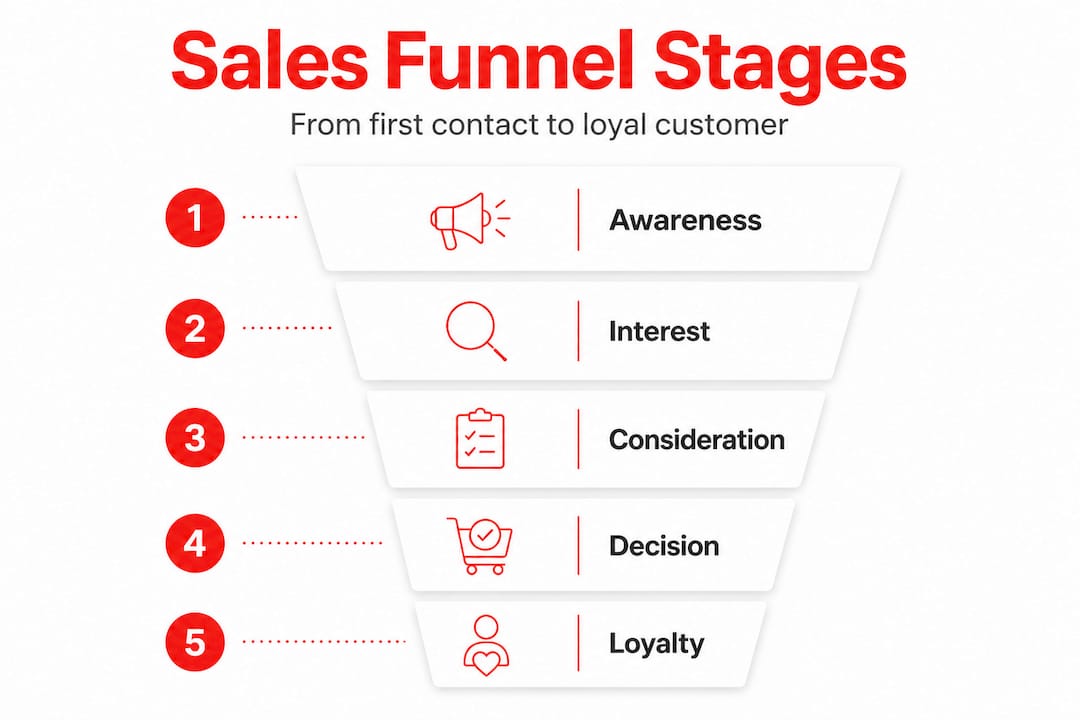
Here is a detailed breakdown of the funnel stages and what you should be doing at each one:
| Funnel stage | Key metric | Primary activity | Common SME mistake |
|---|---|---|---|
| Awareness (TOFU) | Website traffic, impressions | SEO, social media, paid ads | Targeting too broad an audience |
| Interest (MOFU) | Email open rates, time on site | Content marketing, email nurturing | No follow-up system in place |
| Desire (BOFU) | Lead quality, demo requests | Case studies, testimonials, offers | Failing to address objections |
| Action | Conversion rate | Clear CTA, frictionless checkout | Too many steps to purchase |
| Loyalty | Repeat purchase rate, NPS | Post-sale emails, loyalty incentives | Ignoring customers after the sale |
Let’s walk through each stage properly.
- Awareness (TOFU, or top of funnel): This is where your potential customer first discovers you. They might find you via Google, a social media post, a referral, or a paid advert. Your job here is not to sell. It is to make a strong first impression and give them a reason to learn more. Many UK SMEs make the mistake of targeting a far too broad audience, burning through ad budgets without attracting genuinely relevant prospects.
- Interest and consideration (MOFU, or middle of funnel): The prospect knows you exist and is now weighing their options. This is where most SMEs drop the ball. There is no nurturing sequence, no helpful content, and no follow-up. Prospects drift away simply because no one stayed in touch. This stage is where email campaigns, retargeting adverts, and useful resources like guides or webinars do the heavy lifting.
- Desire and decision (BOFU, or bottom of funnel): Your lead is seriously considering buying, but they have questions and doubts. What separates you from competitors? Why should they trust you? Case studies, reviews, demonstrations, and direct conversations become essential here. Check out this step-by-step funnel guide for practical tactics at this stage.
- Action and purchase: This is the moment of conversion. It sounds simple, but a clunky checkout process, a confusing proposal, or an unanswered question at this stage can kill the deal. Make the path to purchase as frictionless as possible.
- Loyalty and retention: The sale is not the end. A retained customer costs far less to serve than a new one costs to acquire. Post-purchase emails, loyalty programmes, and proactive service all turn one-time buyers into long-term advocates.
Pro Tip: Map your own customer journey against each sales funnel stage and ask honestly, “Where do we go silent?” That silence is where revenue disappears.
For a deeper look at building your own pipeline, the lead generation guide for UK SMEs covers the practical tactics stage by stage.
How Do Sales Funnels Drive Revenue for UK SMEs?
Once you know the stages, it is time to see why optimising each part of the funnel is crucial for your income, not just your marketing metrics. The maths here is genuinely eye-opening.
Imagine your sales funnel currently looks like this:
- 1,000 people visit your website each month
- 10% fill in an enquiry form (100 leads)
- 20% of those leads convert to a sale (20 customers)
- Average order value: £500
- Monthly revenue: £10,000
Now imagine you improve just two stages by 10% each. Your enquiry rate goes from 10% to 11%, and your conversion rate from 20% to 22%. That single change, with no extra traffic, produces around £12,100 in monthly revenue. A 21% increase in income from two small tweaks.
That is the compounding effect of funnel optimisation. And it is why the advice to prioritise TOFU/MOFU fixes before scaling ads is so valuable. Pouring more money into awareness when your middle and bottom stages are leaking is like filling a bucket with holes.
“Fix the leaks before you turn up the tap. More traffic into a broken funnel just means more wasted spend.”
Here are the practical areas where sales funnel improvements drive real revenue gains for UK businesses:
- MOFU nurturing: Setting up a simple five-email sequence after someone downloads a resource can double your lead-to-appointment rate. Many SMEs send one email and give up.
- BOFU social proof: Adding three genuine customer testimonials to your enquiry page often lifts conversions by a meaningful margin without any additional ad spend.
- Reducing friction at purchase: Removing unnecessary form fields or offering a clearer call to action frequently produces an immediate uplift in completed enquiries.
- Post-sale follow-up: A single well-timed check-in email after purchase increases repeat business and generates referrals, both of which cost virtually nothing to execute.
The businesses that generate consistent leads are not always the ones spending the most. They are the ones making the most of every lead that enters their sales funnel. Explore lead generation strategies for UK businesses if you want a broader view of how this fits into your marketing mix.

Pro Tip: Before increasing your ad budget, spend one week auditing what happens to leads after they first make contact. The answer is usually surprising, and often fixable within days.
Integrating Sales Funnels With Your Marketing Process
Having a theoretical sales funnel is not enough. Now, let us make it part of how you actually attract, nurture, and convert leads day to day.
For most UK SMEs, the challenge is not understanding the funnel in theory. It is embedding it into real processes without creating a mountain of extra work. The good news is that modern automation tools for lead nurturing make this far more achievable than it was even five years ago.
Here is how to weave sales funnel thinking into your marketing operations:
- Align your CRM with funnel stages: Label your contacts by stage so you always know who needs what kind of communication. Most CRM platforms, including HubSpot and many UK-friendly alternatives, allow this out of the box.
- Create stage-specific content: Do not send the same message to a cold prospect and a warm lead. TOFU content should educate, MOFU content should build trust, and BOFU content should nudge towards a decision.
- Automate the repetitive touchpoints: Follow-up emails, appointment reminders, and lead scoring can all be handled automatically, freeing you and your team to focus on the conversations that actually need a human.
- Keep sales and marketing talking: In many SMEs, marketing generates leads and then hands them over with no context. Make sure both teams agree on what a “qualified lead” looks like and how each stage is defined.
- Review funnel data monthly: Look at where leads are stalling and test one change at a time. Funnel improvement is an ongoing process, not a one-time project.
According to HubSpot’s Sales Strategy Report, the most effective approach is to integrate your funnel with your pipeline for proper alignment, using automation and AI tools for nurturing while preserving the personal touch that UK B2B buyers still value. In practice, this means using technology to stay consistent and using people to build relationships.
Understanding the benefits of automated lead nurturing is essential if you want your funnel to work around the clock, not just when your team is at their desks.
✅ Funnel integration checklist:
- [ ] CRM reflects your funnel stages
- [ ] Content exists for each stage
- [ ] Automated follow-up sequences are live
- [ ] Lead handover process is agreed between marketing and sales
- [ ] Monthly review of stage conversion rates is scheduled
Why Most SMEs Waste Funnel Potential: A UK Perspective
Working with small and medium-sized businesses across the UK for more than a decade, we have seen the same patterns repeat themselves. And let’s be honest: most SMEs are not losing because of bad products or poor customer service. They are losing because of funnel blindness.
The first big mistake is jumping straight to bottom-of-funnel tactics. Running discount promotions and sales pitches to people who have never heard of you, and wondering why the conversion rate is dismal. The funnel is not a shortcut. It is a sequence. Skipping steps does not save time; it wastes money.
The second is treating automation as a replacement for relationship-building. UK B2B buyers in particular still want to feel that they are dealing with a real business that understands their specific situation. Automation should handle the repetitive, time-sensitive touchpoints. Real people should handle the conversations that require judgement, empathy, and expertise.
The third, and perhaps the most costly, is ignoring the loyalty stage entirely. A business that focuses purely on acquisition and then forgets about its existing customers is running on a treadmill. Retention and referral are the most cost-effective growth levers available to any SME, yet they are consistently underinvested.
The businesses we see growing most steadily are the ones using an automated sales funnels guide as a foundation while layering in genuine human touchpoints at the moments that matter most. They are also the ones measuring their funnel stage by stage, not just counting total revenue at the end of the month. Fix the leaks. Nurture the middle. Delight after the sale. That is where the real growth is hiding.
Next Steps: Taking Your Sales Funnel Further
Ready to put these ideas into practice and start converting more of the leads you are already generating? The good news is that you do not need to rebuild everything at once. Start by identifying the one stage where leads are most likely to drop off, and focus there first.
At Bamsh Digital Marketing, we help UK SMEs build, automate, and optimise sales funnels that generate consistent, predictable revenue. From CRM setup and automated nurturing sequences to full-funnel digital strategy, everything we do is designed to make your pipeline work harder. Explore our sales funnels step-by-step guide for practical implementation advice, or dive into our lead generation strategies to see how awareness-stage activity connects to the rest of your funnel. We are here to help you grow with clarity, not confusion.
Frequently Asked Questions
What is the difference between a sales funnel and a marketing funnel?
A sales funnel focuses specifically on guiding prospects from enquiry to purchase, while a marketing funnel is broader and covers the full journey from awareness through to loyalty, including brand discovery and post-sale engagement.
Why is the middle of the funnel (MOFU) so important?
MOFU is where most leads are either nurtured towards a decision or quietly lost. Improving MOFU conversion means you generate more customers from the leads you already have, without spending more on traffic or advertising.
Can automation replace personal interaction in my sales funnel?
Automation handles speed and consistency brilliantly, but it cannot replace human judgement. Balancing AI with personal touch is especially important in UK B2B sales, where trust and relationship quality directly influence purchasing decisions.
What is the first step to improving my sales funnel?
Audit each stage and identify where the largest volume of leads is dropping off. Fixing TOFU/MOFU leaks first delivers the fastest return, since improvements compound across every stage that follows.
Recommended
- Build automated sales funnels: step-by-step guide for UK SMBs
- What Is a Digital Marketing Funnel – Driving SME Growth
- Lead Generation Explained: Complete Guide For UK SMEs – Bamsh Digital Marketing
- How Predictive Lead Scoring Transforms UK SMB Sales
- What is digital marketing? A guide for small business success
- How to Optimise Luxury Sales Funnel for Maximum ROI – Corrado Manenti