
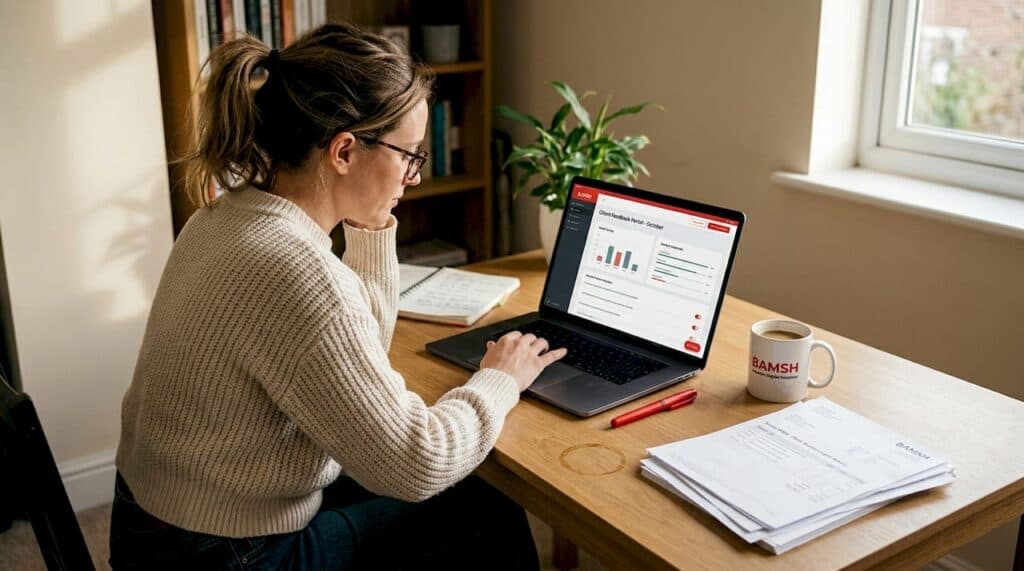
Tradesperson checking online Google reviews and customer feedback
You’ve finished a job, the customer is happy, and they’ve told you they’ll recommend you to their friends.
That’s good news. But there’s one thing you probably haven’t done.
Asked them to leave a Google review.
For plumbers, electricians, roofers, gas engineers and other UK tradespeople, that small missed opportunity can make a real difference to how customers find and choose your business.
Google reviews do two important jobs. They help potential customers decide whether they trust you, and they contribute to your business’s prominence in local search results.
If your competitors have 40 or 50 genuine reviews and you only have four, customers may feel more confident contacting them, even if you’ve been trading longer.
The good news is that getting more reviews doesn’t require an expensive marketing campaign.
You need a simple process, a direct review link and the confidence to ask every genuine customer for honest feedback.
This guide explains how to get more Google reviews as a tradesperson, how reviews influence your Google Maps ranking and how to build a stronger online reputation without buying reviews or breaking Google’s rules.
Key Takeaways
-
Google reviews can support your local search visibility and help customers choose your business.
-
There is no guaranteed number of reviews needed to appear in Google’s Map Pack. Around 25 genuine reviews can be a useful initial target in some markets, but local competition matters.
-
The easiest way to get more reviews is to send a short, personalised message after completing a job.
-
Ask all genuine customers for honest feedback, not just customers you expect to leave five stars.
-
Never buy reviews, offer rewards in exchange for Google reviews or attempt to suppress negative feedback.
-
BAMSH offers Google Business Profile management from £99 per month as a standalone service.
1. Why Google Reviews Matter for UK Tradespeople
Imagine somebody in Bristol needs an electrician.
They search Google for “electrician Bristol” and see three businesses in the local Map Pack.
One has 6 reviews and a 4.8-star rating.
Another has 47 reviews and a 4.9-star rating.
The third has 82 reviews and a 4.6-star rating.
Which business would they contact first?
There isn’t one answer for every customer, but review quantity, rating and the detail within the feedback can influence that decision.
For tradespeople, reviews provide something particularly valuable: evidence from people who have already trusted you to work on their property.
A customer considering a boiler repair, roof replacement or electrical installation wants reassurance that you will turn up, communicate clearly and complete the work properly.
Reviews help answer those questions before the customer calls.
Do Google Reviews Directly Affect Your Ranking?
Yes, reviews are one of the factors Google identifies when explaining how local search rankings work.
Google says local results are primarily based on:
-
Relevance: How well your business matches the search.
-
Distance: How close your business is to the location relevant to the search.
-
Prominence: How well-known and established your business appears.
Review count and positive ratings can contribute to prominence.
However, reviews are not the only factor. A business with fewer reviews may still rank above a competitor because of relevance, distance or other signals.
For more detail, read our guide to the role of reviews in local SEO.
2. How Many Google Reviews Does a Bristol Tradesperson Need to Rank in the Map Pack?
There is no fixed number of Google reviews required to rank in the Map Pack.
Google does not publish a minimum review threshold, and 25 reviews will not automatically get your business into the top three results.
However, for a Bristol tradesperson starting with very few reviews, reaching 25 genuine reviews can be a useful initial milestone.
The more important question is how your review profile compares with businesses already appearing for your main services.
For example, an electrician targeting “electrician Bristol” may face different competition from an electrician targeting “commercial electrician Filton”.
Likewise, the businesses appearing for “emergency plumber Bristol” may be different from those appearing for “bathroom installation Bristol”.
A Practical Review Benchmark
|
Current Google Reviews |
Recommended Next Step |
|---|---|
|
0–5 |
Start requesting reviews consistently after completed jobs |
|
6–15 |
Build a regular request process and aim for steady growth |
|
16–25 |
Compare your reviews, rating and recency with local competitors |
|
26–50 |
Continue collecting genuine feedback and improve your overall Google Business Profile |
|
50+ |
Maintain consistency, monitor feedback and focus on customer experience |
These are practical planning stages, not official Google ranking thresholds.
A business with 70 old reviews may still benefit from a more consistent flow of recent customer feedback.
A business with 20 detailed, genuine reviews may already have a competitive profile in a less crowded local market.
How to Check Your Competition
Search Google for your main service and location.
For example:
-
Plumber Bristol
-
Gas engineer Bristol
-
Electrician Bath
-
Roofer Weston-super-Mare
-
Emergency locksmith South Gloucestershire
Look at the businesses appearing in the Map Pack and compare their review counts, ratings, recent feedback and business profiles.
Remember that local results vary by search location, so a single search is only a snapshot.
You can also use our Google Business Profile tips for better local results to identify other areas worth improving.
3. Case Study: From 4 Reviews to 43 and What Happened to the Map Pack Ranking
A Bristol gas engineer had been trading for nine years and had built a strong reputation through recommendations and repeat customers.
However, the business had only four Google reviews.
Despite being established locally, the engineer was not appearing in the Map Pack for the target search “gas engineer Bristol”.
Competitors with similar services and more than 30 reviews were appearing more prominently.
What BAMSH Did
BAMSH introduced a straightforward review request process.
Every customer received a text message approximately 24 hours after the job was completed.
The message contained a direct Google review link, reducing the effort needed to leave feedback.
The process did not depend on offering discounts, prizes or rewards.
It simply made asking for an honest review part of the normal customer follow-up.
The Results After 90 Days
|
Performance Metric |
Before |
After 90 Days |
|---|---|---|
|
Google Reviews |
4 |
43 |
|
Average Google Rating |
Not specified |
4.9 stars |
|
Map Pack Ranking |
Outside top 10 |
Position 2 |
|
Target Keyword |
Gas engineer Bristol |
Gas engineer Bristol |
|
Calls From Google Maps |
Baseline |
67% increase in the 90 days following the ranking improvement |
Results supplied in the BAMSH August 2026 content improvement brief. Individual outcomes vary.
These results show what can happen when an established business begins actively collecting feedback from genuine customers.
However, they do not prove that reviews alone caused the ranking improvement. Local positions can also change because of location, competition, profile optimisation and other factors.
The lesson: You may already have satisfied customers willing to recommend you. The missing part could simply be a consistent way to ask them.
4. The Easiest Way to Ask for a Review Without Feeling Awkward
This is where many tradespeople struggle.
You’ve finished the job. The customer has paid. Everything has gone well.
But asking for a review can feel uncomfortable, especially if you don’t want to appear pushy.
The easiest approach is to make the request short, polite and routine.
You don’t need a long explanation.
You don’t need to ask for five stars.
And you don’t need to persuade the customer to say anything specific.
Copy-and-Paste Google Review Text Message
Hi [Customer Name], thanks again for choosing us for your [job/service]. If you have a minute, we’d really appreciate an honest Google review about your experience.
Here’s the link: [Google Review Link]
Thanks again,
[Your Name / Business Name]
This works because it is personal, clear and easy to act on.
The customer knows who sent it, why they’re receiving it and where to leave feedback.
A Shorter Version for Busy Tradespeople
Hi [Name], thanks for having us round today. If you have a spare minute, would you mind leaving us an honest Google review? It really helps our small business.
[Google Review Link]
Thanks, [Your Name]
When Should You Send the Message?
For many trade businesses, sending it around 24 hours after completing the job is a sensible starting point.
The work is still fresh in the customer’s mind, but they have had a little time to settle back into their routine.
For larger projects, you may prefer to wait until the customer has had a proper handover.
The important thing is consistency.
Ask genuine customers through the same normal process, regardless of whether you expect their feedback to be positive or negative.
5. How to Create a Google Review Link for Your Business
Before asking customers for reviews, make sure you have a direct link.
You can obtain this through your Google Business Profile.
-
Sign in to the Google account managing your Business Profile.
-
Find your business profile in Google Search.
-
Select the option to read or request reviews.
-
Copy the available review link.
-
Save it somewhere easy to access, such as your phone notes or customer follow-up template.
Test the link before sending it to customers.
The fewer steps a customer needs to take, the easier it is for them to leave feedback.
Other Ways to Share Your Review Link
You can also include it in your invoice email, job completion message or email signature.
A QR code on a printed invoice or business card can be useful when customers prefer to scan rather than type.
However, avoid asking customers to leave reviews on a shared business device. Reviews should reflect their genuine experience and be submitted through their own accounts.
For more ideas on improving local visibility, read our guide to boosting your business online.
6. What You Need Before Requesting More Google Reviews
Getting more reviews is easier when your Google Business Profile is already in good shape.
Before starting a review campaign, check the basics.
|
Google Business Profile Element |
What to Check |
|---|---|
|
Business Name |
Matches your real trading name |
|
Primary Category |
Reflects your main service |
|
Telephone Number |
Correct and answered during advertised hours |
|
Opening Hours |
Accurate, including relevant special hours |
|
Service Areas |
Reflect where you genuinely work |
|
Website |
Links to the correct business website |
|
Photos |
Show genuine work, staff, vehicles or premises |
|
Review Link |
Works properly and opens the review process |
For service-area tradespeople, be careful about displaying a residential address if customers do not visit you there. Google’s Business Profile rules may require the address to be hidden.
You can find additional advice in our local SEO best practices for UK businesses.
7. How to Build a Review Request Process That Actually Works
You don’t need expensive software to start collecting more reviews.
For a sole trader, a phone reminder and a saved text message may be enough.
For a larger company, the process can become part of your job management system.
Step 1: Complete the Job
Finish the work, explain what has been done and provide any necessary paperwork or aftercare instructions.
Step 2: Record the Customer’s Contact Details
Use contact information collected appropriately for the job and handle follow-up communications in line with applicable UK privacy and electronic marketing rules.
Step 3: Send the Review Request
Send a polite message with your direct Google review link.
Do not ask the customer to leave a particular star rating.
Step 4: Keep a Simple Record
Record whether a request was sent so customers do not receive duplicate messages.
Step 5: Monitor New Reviews
Check your profile regularly and respond where appropriate.
Step 6: Review the Process Monthly
Compare the number of requests sent with the number of new reviews received.
You may discover that sending requests the next morning works better than waiting several days.
The objective is not to pressure customers.
It is to make review requests a normal, consistent part of running your trade business.
For related advice, see our practical guide to boosting business visibility.
8. Should You Ask for Reviews by Text, Email or in Person?
Different methods suit different businesses.
|
Method |
Best Suited To |
Main Advantage |
|---|---|---|
|
Text Message |
Plumbers, electricians, roofers, gas engineers |
Quick and easy to open on a phone |
|
|
Larger projects and commercial work |
Suitable for including with handover information |
|
Verbal Request |
Customer-facing jobs |
Personal and natural |
|
Invoice Link |
Businesses with standard invoicing |
Easy to incorporate into existing paperwork |
|
QR Code |
Printed cards or handover packs |
Convenient for customers using smartphones |
There is no reliable universal response rate for each method.
Your own results will depend on customer relationships, timing, how easy the request is to complete and the type of work you carry out.
For most tradespeople, a short text message with a direct Google review link is a practical place to start.
9. How to Respond to Positive and Negative Google Reviews
Getting more reviews is only half the job.
How you respond can influence what potential customers think about your business.
Google encourages businesses to respond to customer feedback because it shows that they value their customers’ experiences.
How to Respond to a Positive Review
Keep your reply natural and specific.
If a customer praises your punctuality or the quality of your work, acknowledge it.
For example:
Thanks for taking the time to leave us a review, James. We’re pleased you’re happy with the boiler repair and appreciate you choosing us. Thanks again for your support!
Avoid posting the same generic response under every review.
A brief, genuine reply is usually more useful than a long paragraph filled with keywords.
How to Respond to a Negative Review
Negative reviews can be frustrating, especially when you believe the feedback is unfair.
However, responding defensively can make the situation worse.
Instead, acknowledge the concern and offer a practical way to resolve it.
Hi [Name], thank you for your feedback. We’re sorry to hear that your experience didn’t meet expectations. We’d appreciate the opportunity to look into this properly. Please contact us directly so we can discuss what happened and work towards a resolution.
Don’t disclose private customer information or argue about the details of a job publicly.
A professional response can reassure prospective customers that you take concerns seriously.
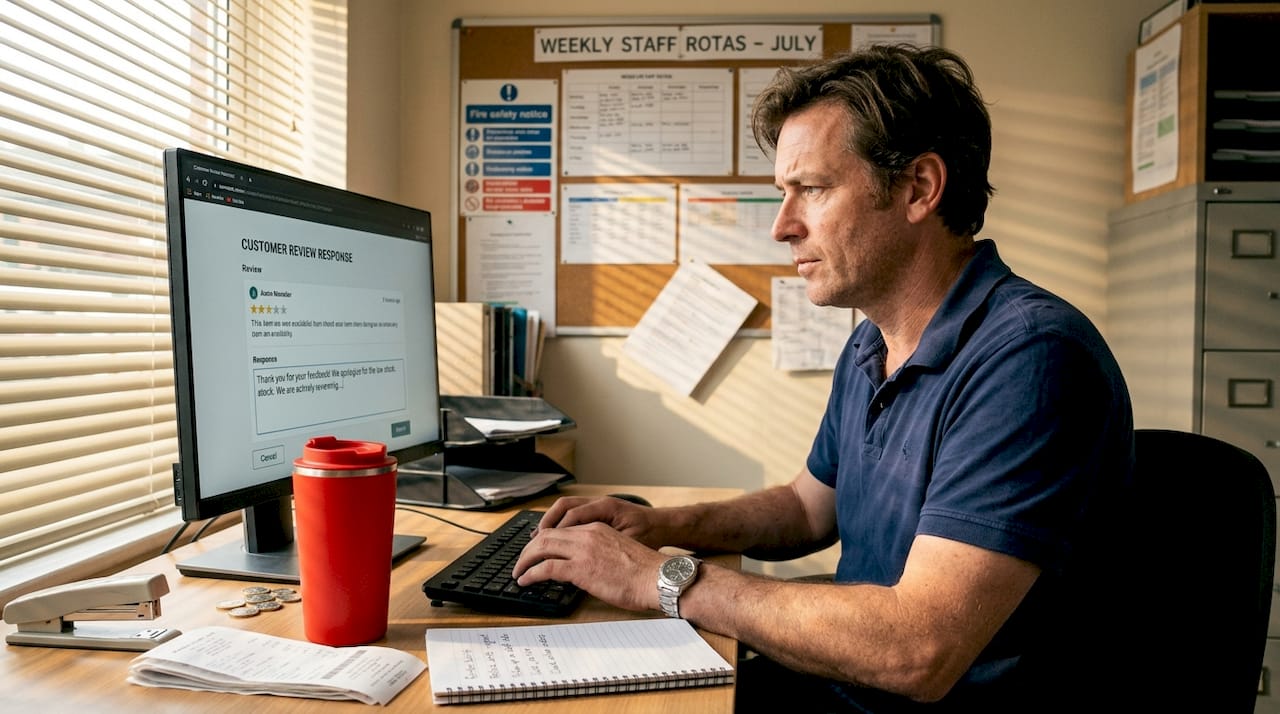
Business owner responding to online customer reviews
10. Can You Buy Google Reviews or Offer Customers Discounts?
No. Buying Google reviews or offering incentives in exchange for them violates Google’s policies.
This includes offering money, discounts, free services or other benefits in return for reviews.
Google also prohibits selectively requesting positive reviews while discouraging negative feedback.
|
Review Activity |
Recommended Approach |
|---|---|
|
Asking genuine customers for honest feedback |
Allowed |
|
Sending customers a direct review link |
Allowed |
|
Offering a discount for a five-star review |
Not allowed |
|
Buying reviews from an online provider |
Not allowed |
|
Asking only customers likely to leave positive reviews |
Not allowed |
|
Asking customers to remove negative reviews in exchange for a reward |
Not allowed |
|
Reporting reviews that violate Google’s policies |
Allowed |
For UK businesses, fake and misleading reviews can also raise consumer protection issues.
The safest approach is straightforward: ask genuine customers for genuine feedback without attempting to influence what they say.
This is also an important part of reputation management for UK SMEs.
11. How to Track Whether Your Google Reviews Are Improving Your Business
Increasing your review count is useful, but you should also measure whether your local visibility and customer enquiries are improving.
Review your performance monthly.
|
Metric |
What It Tells You |
|---|---|
|
Total Google Reviews |
How much customer feedback you’ve accumulated |
|
Average Star Rating |
Overall customer satisfaction reflected in reviews |
|
New Reviews Per Month |
Whether your request process is working consistently |
|
Review Response Rate |
Whether customer feedback is being acknowledged |
|
Google Maps Visibility |
How your business appears for relevant local searches |
|
Calls From Google Business Profile |
Whether customers are contacting you through your listing |
|
Website Clicks |
Whether people are visiting your website from your profile |
Don’t Measure Review Numbers in Isolation
Suppose your business grows from 15 to 35 reviews.
That is positive progress.
But if your telephone number is incorrect, your business category is unsuitable or your website doesn’t explain your services properly, those additional reviews may not translate into more enquiries.
Reviews work best alongside an accurate, well-maintained Google Business Profile and a useful website.
For further guidance, read our article on boosting online visibility for UK businesses.
12. Why Consistency Matters More Than One Big Review Campaign
One of the biggest mistakes tradespeople make is collecting a handful of reviews and then forgetting about them.
They might ask ten customers in one week, receive several reviews and then stop asking for another six months.
A more practical approach is to build review requests into the normal workflow.
Every completed job creates an opportunity to invite genuine feedback.
Over time, that can help you maintain a more current and useful review profile.
It also means you don’t have to keep remembering to launch a new review campaign.
The goal is not to collect as many reviews as possible in one week. It is to create a reliable process that continues throughout the year.
For more local marketing ideas, see our guide to improving local leads through Google.
13. How BAMSH Helps Tradespeople Get More From Google Business Profile
You might be excellent at your trade but have very little time to manage your Google Business Profile.
Between quoting jobs, travelling, completing work and dealing with customers, replying to reviews and updating your listing can easily fall down the priority list.
BAMSH offers ongoing Google Business Profile management for tradespeople and other UK businesses.
The service includes profile optimisation, category and service updates, review management strategy, customer review responses, posts, photographs and performance monitoring.
BAMSH Google Business Profile Management Pricing
|
Service Details |
Pricing |
|---|---|
|
Monthly Management Fee |
£99/month |
|
One-Off Setup Fee |
£249 |
|
Contract Terms |
Rolling monthly |
|
Included Within BAMSH SEO Packages |
At no extra cost |
|
VAT |
All prices exclude VAT |
Pricing published by BAMSH. Setup and monthly management fees exclude VAT.
If you’re not appearing in the Google Map Pack, or your competitors have significantly stronger review profiles, we can help you identify what needs attention.
You can view our Google Business Profile management service or book a free 15-minute call to discuss your current profile and what a realistic improvement plan might look like.
Frequently Asked Questions About Google Reviews for Tradespeople
How do I get more Google reviews as a tradesperson?
The simplest method is to ask genuine customers for honest feedback after completing a job. Send a short text message containing your direct Google review link and thank them for choosing your business. Make the process consistent rather than relying on customers to remember to leave reviews themselves.
How many Google reviews do I need to rank in the Map Pack?
There is no minimum number of reviews required to appear in Google’s Map Pack. Around 25 genuine reviews can be a useful initial target for some local tradespeople, but competition varies by service and location. Google also considers relevance, distance and other prominence signals.
Do Google reviews directly affect local SEO rankings?
Yes. Google confirms that more reviews and positive ratings can help a business’s local ranking. However, reviews are only one part of local SEO, and collecting more reviews does not guarantee a particular ranking position.
When is the best time to ask a customer for a Google review?
For many tradespeople, around 24 hours after completing a job is a practical starting point. The customer can still remember the work clearly, and the request feels like a natural follow-up. The ideal timing may vary depending on the type of service or project.
Can I offer a discount in exchange for a Google review?
No. Google’s policies prohibit offering discounts, payments, free services or other incentives in exchange for reviews. You should ask customers for honest feedback without attempting to influence their rating or comments.
Should I reply to every Google review?
Responding to reviews is good practice because it shows customers that you value their feedback. Thank customers for positive reviews and address negative feedback calmly and professionally. Avoid sharing private information or using repetitive, automated-looking responses.
Can I remove a negative Google review?
You can report a review if you believe it violates Google’s policies, such as fake engagement, harassment or irrelevant content. However, a genuine negative review cannot normally be removed simply because you disagree with it. In those situations, a professional response is usually the better approach.
How long does it take for more Google reviews to improve rankings?
There is no guaranteed timeframe. Review growth may contribute to local visibility, but ranking changes depend on competition, search location and other factors. Track your review growth alongside Google Business Profile performance rather than assuming a particular number of reviews will produce immediate results.
Is Google Business Profile management worth paying for?
It can be worthwhile for tradespeople who rely on local enquiries but lack the time to maintain their profile consistently. The value depends on the quality of the work, local competition and whether the improvements lead to relevant customer enquiries. BAMSH offers standalone management from £99 per month, with a £249 setup fee, excluding VAT.
Recommended
- Google Business Profile tips for better local results
- How to Improve Online Visibility: UK SME Guide 2026 – Bamsh Digital Marketing
- Boost online visibility: actionable guide for UK businesses
- How to Boost Local Business Online for Better Results
- Proven strategies to increase brand visibility for SMBs – Palmador Blog
- Ervaringen / Reviews – Zakelijkeverzekering