

Many local businesses in Bristol and Cardiff find that standing out online feels like a never-ending challenge. Effective digital marketing is vital because your visibility directly influences the flow of new leads and customer trust. This guide presents practical steps rooted in measurable goal-setting, current audit frameworks, and proven local optimisation techniques, offering actionable strategies to grow your presence and attract the right clients consistently.
Table of Contents
- Step 1: Assess Current Visibility And Set Measurable Goals
- Step 2: Optimise Website And Google Business Profile For Local Reach
- Step 3: Launch Targeted SEO, PPC And Social Advertising Campaigns
- Step 4: Implement Automated Lead Nurturing And AI Receptionist Tools
- Step 5: Verify Results And Refine Visibility Strategies
Business Visibility Quick Summary
| Key Insight | Explanation |
|---|---|
| 1. Conduct a visibility audit | Assess your current online presence to set realistic and measurable goals for visibility improvement. |
| 2. Optimise local online presence | Enhance your website and Google Business Profile to attract and engage local customers effectively. |
| 3. Implement targeted marketing campaigns | Develop precise SEO, PPC, and social advertising strategies that resonate with your ideal customer base. |
| 4. Utilise automated lead nurturing | Adopt AI tools for efficient lead qualification and customer engagement while preserving a personal touch. |
| 5. Regularly review and adjust strategies | Continuously monitor performance metrics to refine strategies based on what works best for your business growth. |
Step 1: Assess Current Business Visibility and Set Measurable Goals
Before you can improve your business’s digital presence, you need a clear snapshot of where you currently stand. This step is about understanding your existing visibility landscape and creating strategic, actionable goals that will drive meaningful growth.
Start by conducting a comprehensive current visibility audit. This means examining your online footprint across multiple channels. Performance measure frameworks suggest using structured approaches to track your marketing effectiveness. Your audit should include:
- Google search rankings for key terms
- Social media engagement metrics
- Website traffic volume and quality
- Number of qualified leads generated monthly
- Conversion rates across digital platforms
Once you’ve gathered this data, it’s time to set SMART goals – Specific, Measurable, Achievable, Relevant, and Time-bound. These aren’t just corporate buzzwords; they’re your roadmap to strategic visibility.
Your visibility goals should directly connect to your bottom-line business objectives, not just vanity metrics.
For instance, instead of a vague goal like “increase online presence,” aim for something precise: “Improve organic search rankings for three primary service keywords by two positions within the next quarter.”
Pro tip: When setting visibility goals, always anchor them to specific business outcomes that generate tangible revenue impact.
Step 2: Optimise Website and Google Business Profile for Local Reach
Local digital visibility isn’t just about being online – it’s about strategically positioning your business where potential customers are actively searching. Optimising your website and Google Business Profile are critical steps in attracting local clientele and standing out in your regional market.
Begin by ensuring your website is fully mobile-responsive and locally optimised. This means creating content that speaks directly to your local audience, incorporating region-specific keywords, and ensuring fast loading speeds across all devices. Your website should clearly communicate:
- Your precise business location
- Local contact information
- Service areas covered
- Localised service descriptions
- Customer testimonials from nearby clients
For your Google Business Profile, completeness is key. Upload high-quality images of your business, ensure all contact details are accurate, and regularly update your listing with posts, offers, and current information. This isn’t just about visibility – it’s about creating a comprehensive digital storefront that builds trust with potential customers.
Local customers trust businesses that demonstrate a genuine connection to their community.
Encourage satisfied local customers to leave authentic reviews on your Google Business Profile. These social proof elements significantly boost your credibility and search rankings, making your business more discoverable to potential clients in your area.

Pro tip: Treat your Google Business Profile like a living, breathing marketing asset – update it weekly and respond to every single review, both positive and negative.
Step 3: Launch Targeted SEO, PPC and Social Advertising Campaigns
Your digital marketing strategy demands precision – a multi-channel approach that strategically positions your business across search, social, and advertising platforms. This step is about creating targeted campaigns that speak directly to your ideal customers and drive meaningful engagement.
Start by understanding the strategic landscape of digital advertising, which requires careful planning and targeted execution. Your campaign strategy should encompass:
- Keyword research for precise audience targeting
- Compelling ad copy that resonates with your market
- Tailored landing pages with clear conversion paths
- Budget allocation across different advertising channels
- Continuous performance monitoring and adjustment
For SEO, focus on creating high-quality, locally relevant content that answers your customers’ most pressing questions. This means developing website pages, blog posts, and resources that demonstrate genuine expertise in your field. Your PPC campaigns should complement this organic approach, using targeted ads to capture immediate search intent.
The most effective digital campaigns create a seamless experience across multiple marketing channels.
With social advertising, precision is key. Target your ads based on detailed demographic information, interests, and behaviours that align closely with your ideal customer profile. Use platform-specific features like Facebook’s detailed targeting options or LinkedIn’s professional targeting to narrow your audience.
Pro tip: Always allocate 10-15% of your initial campaign budget for testing and experimentation, allowing you to quickly identify and double down on the most effective strategies.
Step 4: Implement Automated Lead Nurturing and AI Receptionist Tools
Transforming your customer engagement requires smart, strategic automation that feels personal and responsive. Implementing automated lead nurturing and AI receptionist tools will help you capture, qualify, and convert leads while providing round-the-clock customer support.
Begin by understanding the strategic implementation of AI tools that can revolutionise your customer interaction processes. Your automation strategy should focus on:
- Capturing lead contact information automatically
- Segmenting leads based on behaviour and interest
- Creating personalised communication workflows
- Setting up intelligent response triggers
- Tracking and scoring lead engagement
Intelligent lead nurturing means developing a system that communicates with potential customers at the right time, with the right message. Your AI tools should be able to:
Here’s a comparison of traditional versus automated lead nurturing approaches:
| Approach | Response Time | Personalisation Level | Scalability |
|---|---|---|---|
| Traditional Manual | Often slow, business hours only | Inconsistent; depends on staff | Limited, staff-dependent |
| Automated with AI | Instant, available 24/7 | Highly tailored based on data | Scales easily, minimal human input |
- Instantly respond to initial inquiries
- Provide relevant information based on user interactions
- Schedule follow-up communications
- Escalate complex queries to human team members
Effective automation doesn’t replace human connection – it enhances and accelerates it.
Integrate your AI receptionist with your existing CRM system to ensure seamless data flow and comprehensive lead tracking. This allows your team to focus on high-value interactions while the AI handles initial screening and basic customer support.
Pro tip: Configure your AI tools with a 70-30 rule: 70% automated efficiency, 30% human touch to maintain genuine customer relationships.
Step 5: Verify Results and Refine Visibility Strategies
The journey of digital marketing is never truly complete – it’s a continuous cycle of measurement, analysis, and strategic refinement. This step is about transforming raw data into actionable insights that will drive your business’s ongoing visibility and growth.
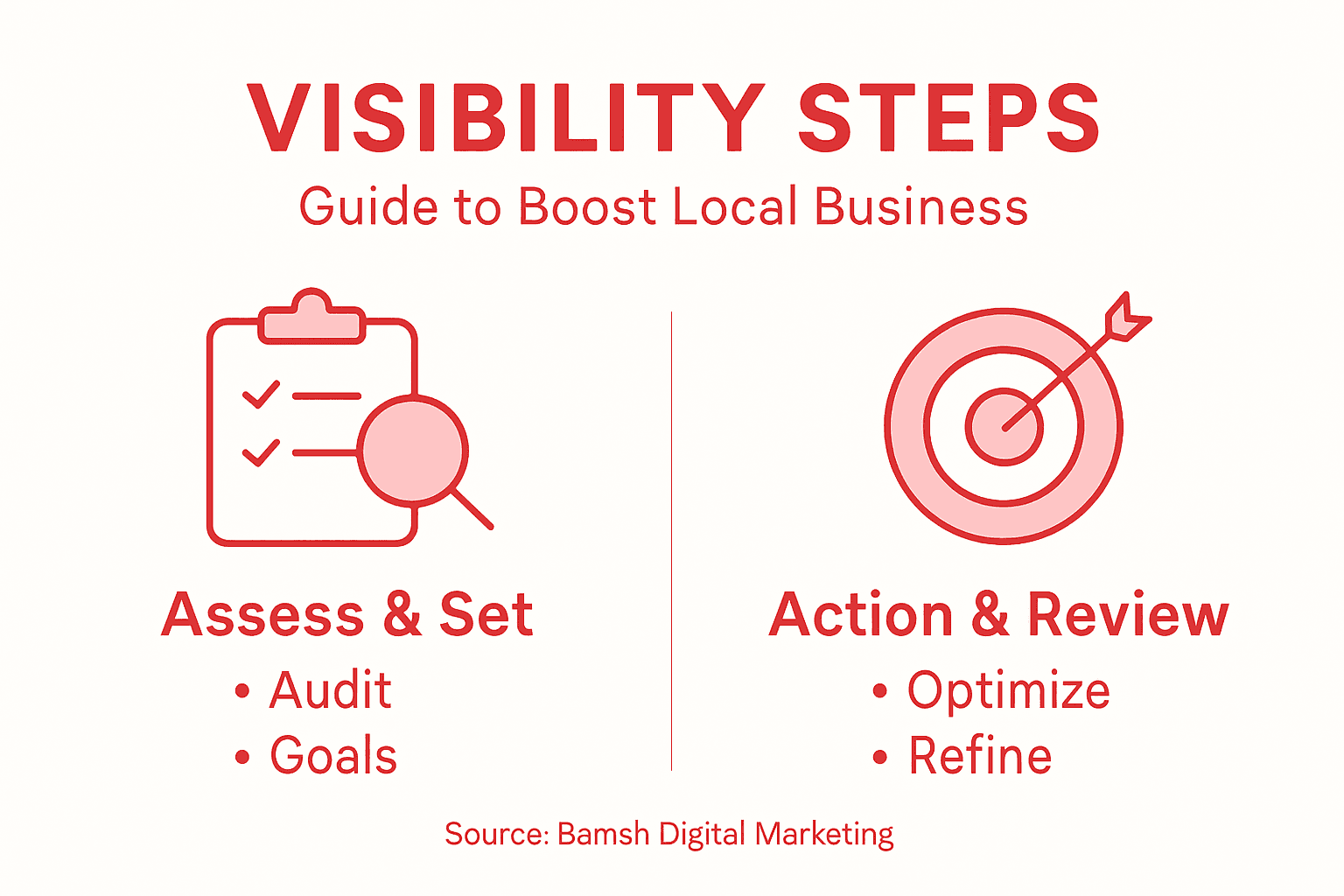
Begin by implementing comprehensive performance tracking across all your digital channels. Your verification process should meticulously examine:
Below is a summary of key performance metrics to track for digital visibility refinement:
| Metric | Why It Matters | How to Interpret |
|---|---|---|
| Conversion Rate | Indicates effectiveness of campaigns | Higher values mean better targeting |
| Source of Traffic | Reveals most valuable channels | Focus on top-performing sources |
| Cost per Lead | Measures efficiency of spend | Lower costs reflect improved ROI |
| Customer Retention | Shows long-term engagement | Higher retention boosts growth |
- Conversion rates from different marketing channels
- Website traffic volume and source
- Engagement metrics on social platforms
- Cost per lead across advertising campaigns
- Search engine ranking improvements
Data-driven decision making means looking beyond surface-level metrics. Dive deep into the quality of interactions, not just quantity. Are your leads becoming customers? Are they returning? Are they recommending your business?
Success in digital marketing isn’t about perfect strategies, but about continuous learning and adaptation.
Establish a quarterly review cycle where you critically assess your visibility strategies. This isn’t just about celebrating wins, but understanding where and why certain approaches worked or didn’t work. Compare your current performance against your initial goals, and be prepared to pivot quickly.
Pro tip: Create a “insights dashboard” that consolidates key metrics from all platforms, making it easier to spot trends and make rapid, informed strategic adjustments.
Unlock Your Business Potential with Expert Digital Visibility Solutions
If you are struggling with improving your business visibility despite following all the right steps like assessing your current presence or launching targeted campaigns then Bamsh Digital Marketing can help you bridge that gap effectively. This article highlighted critical challenges such as setting measurable goals, optimising your Google Business Profile, launching strategic SEO and PPC campaigns, and implementing AI-powered automated lead nurturing. These are exactly the areas where our award-winning team specialises, delivering clear, honest strategies that turn digital visibility into tangible business growth.
At Bamsh Digital Marketing, we understand your need for a transparent, jargon-free approach that ensures your ideal customers find you, choose you, and keep coming back. From expert Digital Marketing Bristol – Bamsh Digital Marketing services to our comprehensive solutions like Google Business Profile management and AI enhanced lead nurturing automation, each service is designed to build your local and online authority with measurable results. Don’t wait for another opportunity to slip away, explore our Special Offers – Bamsh Digital Marketing and get started today with a strategy tailored to your business goals. Take the next step now by visiting Bamsh Digital Marketing and see how we can help you convert visibility into real growth.
Frequently Asked Questions About Business Visibility
How can I assess my current business visibility?
To assess your current business visibility, conduct a comprehensive visibility audit. Gather data on your Google search rankings, social media engagement, website traffic, and conversion rates to create a clear picture of your online presence.
What are SMART goals, and how do I set them for visibility improvement?
SMART goals are Specific, Measurable, Achievable, Relevant, and Time-bound objectives. For instance, set a goal to “Improve organic search rankings for three primary service keywords by two positions within the next quarter” to ensure a focused approach.
How do I optimise my website for local reach?
To optimise your website for local reach, ensure it is mobile-responsive and includes localised content. This should include your business location, service areas, and customer testimonials to enhance your connection with local clientele.
What should I include in my Google Business Profile?
Your Google Business Profile should include high-quality images, accurate contact details, and relevant updates. Regularly post offers and respond to all reviews to create a trustworthy and engaging presence for potential customers.
How can I effectively track the results of my visibility strategies?
To track the results of your visibility strategies, implement comprehensive performance tracking across all digital channels. Focus on key metrics such as conversion rates, traffic sources, and customer retention to evaluate your success and adjust your approach accordingly.
What is automated lead nurturing, and how can it benefit my business?
Automated lead nurturing involves using tools to capture and segment leads while providing personalised communication at scale. By implementing this, you can respond to inquiries instantly and engage leads more effectively, improving conversion rates by streamlining your follow-up processes.