

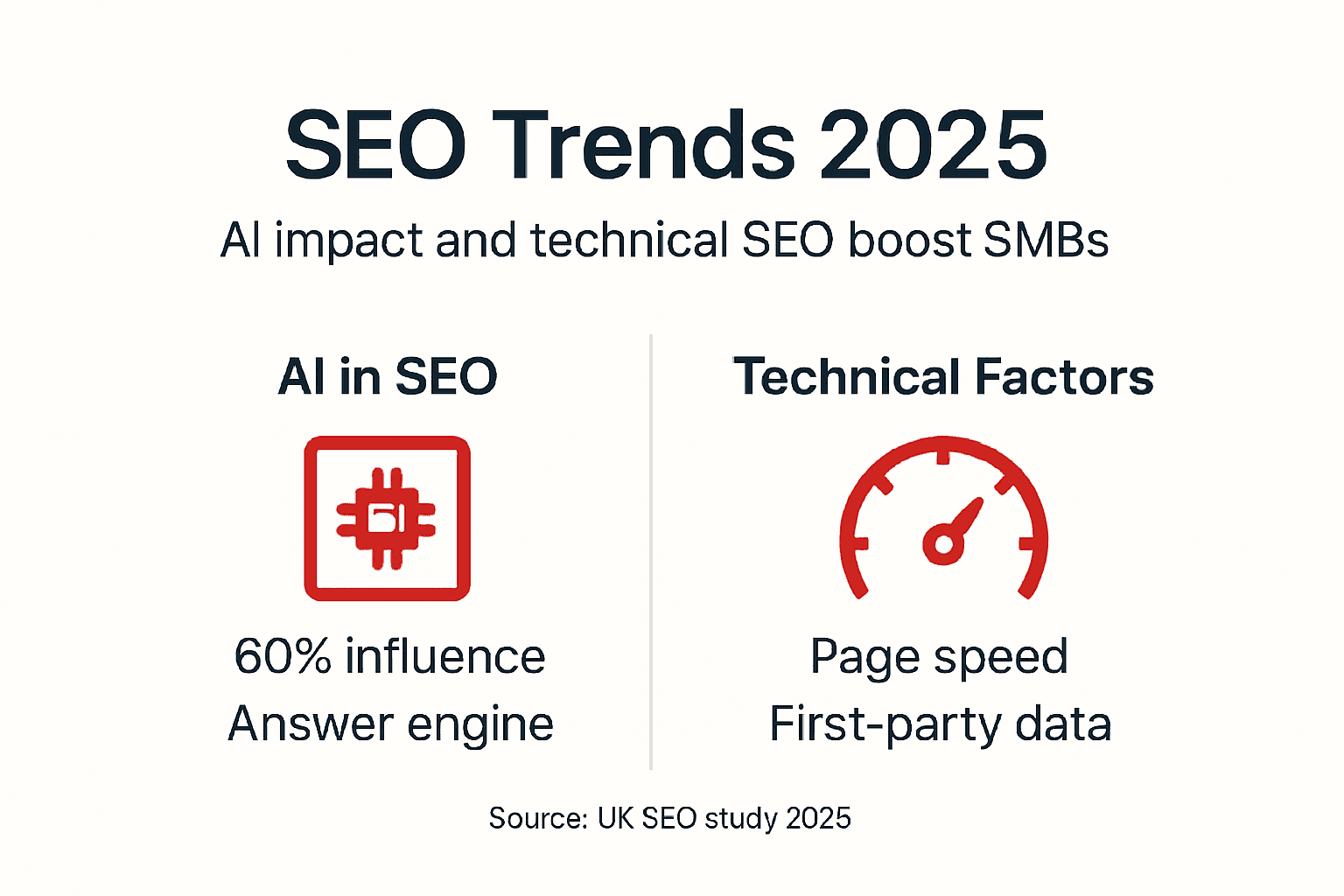
By the end of 2025, AI technologies will influence over 60% of search results, fundamentally changing how UK small and medium-sized businesses must approach search engine optimisation. Traditional SEO tactics like keyword stuffing and excessive backlink building no longer deliver results. Instead, you need to focus on Answer Engine Optimisation, local visibility, privacy-compliant strategies, and technical health to capture customers actively searching for your products and services.
Table of Contents
- Understanding AI’s Role In SEO In 2025
- The Rise Of Local SEO For UK Businesses
- Privacy And Data Regulations Impact On SEO
- Prioritising Technical SEO Health And Speed
- Common Misconceptions About SEO In 2025
- Boost Your SEO Success In 2025 With Bamsh Digital Marketing
- Frequently Asked Questions About SEO Trends In 2025
Key takeaways
| Point | Details |
|---|---|
| AI dominates search results | AI influences over 60% of search results, requiring Answer Engine Optimisation instead of traditional keyword tactics. |
| Local SEO drives foot traffic | 73% of UK consumers visit businesses within 5 miles after a local search, making Google Business Profile optimisation essential. |
| Privacy laws reshape data use | 67% increase in first-party data usage reflects shift from cookie tracking to privacy-compliant SEO strategies. |
| Technical SEO boosts conversions | Improved page speed increases conversions by 20% and strengthens rankings across all devices. |
| Outdated tactics harm rankings | Keyword stuffing and backlink over-reliance now trigger penalties instead of improving visibility. |
Understanding AI’s role in SEO in 2025
Artificial intelligence has fundamentally transformed how search engines process queries and deliver results. Tools like ChatGPT, Google Gemini, and Microsoft Copilot now generate direct answers before traditional search results even appear. This shift means your content must satisfy AI algorithms that prioritise semantic relevance over exact keyword matches.
Answer Engine Optimisation focuses on creating content that AI tools can easily extract and present as answers to user queries. Instead of targeting specific keywords dozens of times, you structure information to address questions comprehensively and clearly. This approach can boost organic traffic by up to 30% because AI tools cite sources that provide the most relevant, well-organised information.
For UK SMBs, this presents both challenge and opportunity. You compete not just for page rankings but for featured snippets, AI-generated summaries, and voice search results. The businesses that win this competition create content answering real customer questions in natural, conversational language.
Key AI tools now assist with:
- Content creation that matches semantic search patterns
- Technical SEO audits identifying crawl issues and speed problems
- Competitor analysis revealing content gaps you can exploit
- Keyword research focusing on question-based queries
Pro Tip: Structure your service pages and blog articles around specific customer questions. Use headings formatted as questions, then provide clear, concise answers in the following paragraphs. This format helps AI tools extract and cite your content as authoritative sources.
The rise of local SEO for UK businesses
Local search has become the primary discovery method for customers seeking nearby services. When someone searches for a plumber, restaurant, or solicitor, Google prioritises businesses within their immediate area. 73% of UK consumers visit businesses within 5 miles after conducting a local search, making geographic visibility critical for physical locations.
Your Google Business Profile serves as your digital shopfront. Optimised profiles gain 50% more engagement through clicks, calls, and direction requests compared to incomplete listings. This free tool from Google displays your business information, photos, reviews, and opening hours directly in search results and Google Maps.
Implementing local SEO best practices requires consistent effort across multiple channels:
- Claim and verify your Google Business Profile with accurate business details
- Collect genuine customer reviews and respond to all feedback
- Use location-specific keywords naturally in your website content
- Ensure your site loads quickly on mobile devices
- Build citations on UK business directories with matching NAP information
Optimising your Google Business Profile involves regular updates, high-quality photos, and prompt responses to customer questions. Businesses that post weekly updates and respond to reviews within 24 hours consistently outperform competitors in local search rankings.

| Strategy | Standard SEO benefit | Local SEO benefit |
|---|---|---|
| Google Business Profile | Not applicable | 50% more customer engagement |
| Local keywords | Broad traffic | 73% convert to in-person visits |
| Customer reviews | Trust signals | Direct ranking factor for local pack |
| Mobile optimisation | Important for all users | Critical as 80% of local searches occur on mobile |
Pro Tip: Encourage satisfied customers to leave reviews by sending a simple follow-up message with a direct link to your Google Business Profile review page. Even small improvements in review quantity and quality significantly boost local visibility.
Privacy and data regulations impact on SEO
UK data protection laws have fundamentally changed how businesses track and target customers online. GDPR restrictions and evolving cookie policies limit third-party tracking, forcing a strategic shift towards first-party data collection and user-centric content strategies.
The 67% increase in SEO campaigns using first-party data reflects this regulatory environment. First-party data comes directly from your customers through newsletter signups, purchase history, and direct interactions. This information provides deeper insights whilst maintaining full compliance with privacy regulations.
For SEO practitioners, this shift means several practical changes:
- Focus on creating valuable content that encourages voluntary email subscriptions
- Build customer relationships through transparent data collection practices
- Rely less on third-party cookies for audience targeting and retargeting
- Implement consent management platforms that respect user privacy choices
Businesses that ignore privacy impacts on SEO risk substantial penalties and damaged customer trust. The Information Commissioner’s Office actively enforces GDPR compliance, issuing fines for violations. Beyond legal consequences, customers increasingly avoid businesses with opaque data practices.
Your SEO strategy must prioritise earning customer trust through transparency. Clearly explain what data you collect, why you need it, and how it benefits the customer. This approach builds loyal audiences who willingly share information, creating a sustainable competitive advantage as third-party tracking becomes increasingly restricted.
Prioritising technical SEO health and speed
Technical SEO forms the foundation supporting all your content and link-building efforts. Without a technically sound website, even brilliant content struggles to rank well or convert visitors into customers. Improved page speed increases conversions by 20% whilst simultaneously boosting search rankings.
Google evaluates your site’s technical health through Core Web Vitals, mobile usability, crawlability, and security. Sites that score poorly in these areas face ranking penalties regardless of content quality. Regular technical audits identify and fix issues before they damage your visibility.
Key technical factors affecting your SEO performance:
- Page loading speed on both desktop and mobile devices
- Mobile responsiveness ensuring proper display on all screen sizes
- Secure HTTPS connection protecting user data
- XML sitemap helping search engines discover all your pages
- Clean URL structure making pages easy to understand and index
- Proper heading hierarchy organising content logically
Technical SEO tools help SMBs identify problems without requiring extensive technical expertise. These platforms scan your website, highlight issues, and provide clear instructions for fixes. Many problems can be resolved quickly once identified.
| Metric | Before technical improvements | After technical improvements |
|---|---|---|
| Average page load time | 4.2 seconds | 1.8 seconds |
| Mobile usability score | 67/100 | 94/100 |
| Pages indexed by Google | 142 pages | 203 pages |
| Conversion rate | 2.1% | 2.5% |
Pro Tip: Run a free technical SEO audit monthly using tools that check page speed, mobile friendliness, and crawl errors. Address the highest-priority issues first, focusing on problems affecting multiple pages rather than isolated incidents.
Common misconceptions about SEO in 2025
Many UK SMBs still operate under outdated SEO assumptions that waste budget and damage rankings. Understanding what no longer works helps you focus resources on strategies that actually deliver results.
Myth: Backlinks still dominate rankings. Reality: Whilst quality backlinks remain valuable, content relevance and user experience now carry more weight in ranking algorithms. Google prioritises sites that comprehensively answer user queries with well-structured, accessible content.
Myth: Keyword stuffing improves rankings. Reality: Excessive keyword repetition triggers penalties rather than boosting visibility. Modern algorithms detect unnatural keyword density and demote pages attempting this tactic. Natural language covering topics thoroughly outperforms keyword-focused content.
Myth: AI replaces human SEO experts. Reality: AI tools complement human strategy but cannot replace the creativity, business understanding, and strategic thinking required for effective SEO. AI excels at data analysis and content generation but needs human guidance to align with business goals.
Myth: More content always means better rankings. Reality: Quality trumps quantity in 2025. Publishing thin, repetitive content dilutes your site’s authority. Focus on creating comprehensive resources that thoroughly address specific topics rather than churning out numerous shallow articles.
Common mistakes to avoid:
- Buying backlinks from link farms or low-quality directories
- Duplicating content across multiple pages
- Ignoring mobile users despite 80% of searches occurring on smartphones
- Neglecting local SEO whilst competing nationally
- Focusing solely on rankings instead of conversion rates
Understanding these SEO misconceptions helps you avoid wasting resources on tactics that no longer work. The businesses succeeding in 2025 focus on user experience, comprehensive content, technical excellence, and authentic engagement rather than manipulation and shortcuts.
Boost your SEO success in 2025 with Bamsh digital marketing
Navigating 2025’s complex SEO landscape requires expertise, tools, and consistent effort that many SMBs struggle to maintain in-house. Professional answer engine optimisation services help you capture AI-driven search traffic by structuring your content for featured snippets and AI tool citations.
Our Google Business Profile management service optimises your local presence, generating more calls, direction requests, and foot traffic from nearby customers actively searching for your services. We handle review responses, post creation, and profile updates so you can focus on serving customers.
For businesses preferring to manage their own SEO, our DIY SEO tools for SMBs provide the technical audits, keyword research, and actionable recommendations you need to improve rankings independently. Get expert guidance without the ongoing agency fees.
Frequently asked questions about SEO trends in 2025
What is answer engine optimisation and why is it important in 2025?
Answer Engine Optimisation structures your content to appear in AI-generated responses from tools like ChatGPT and Google Gemini. It matters because these AI systems now influence how most users discover information and businesses online.
How can UK SMBs effectively improve their local SEO?
Claim your Google Business Profile, collect genuine customer reviews, use location-specific keywords naturally, and ensure your website displays properly on mobile devices. Regular profile updates and prompt review responses significantly boost local visibility.
What privacy changes should affect my SEO strategy?
Focus on collecting first-party data through newsletter signups and customer accounts rather than relying on third-party cookies. Build trust through transparent data practices and create valuable content that encourages voluntary information sharing.
Are backlinks still important for SEO success?
Quality backlinks remain valuable but no longer dominate rankings. Google now prioritises content relevance, user experience, and comprehensive topic coverage. Focus on earning natural links through excellent content rather than buying links or participating in link schemes.
How do AI SEO tools complement manual SEO work?
AI tools excel at data analysis, technical audits, and identifying patterns across large datasets. They save time on research and routine tasks but require human strategy to align recommendations with business goals and create content that genuinely connects with your audience.