
TL;DR:
- Chatbots are AI agents that automate customer interactions, support internal workflows, and boost sales efficiency. They reduce response times, operate 24/7, and handle repetitive tasks, allowing human staff to focus on complex work. Proper deployment involves ongoing optimisation, system integration, and transparent communication to build user trust.
Chatbots are AI-powered conversational agents that automate customer interactions, internal workflows, and sales processes to reduce costs and improve service quality. The role of chatbots in business has expanded well beyond simple FAQ responses. Today, they handle everything from live customer support to HR enquiries and lead qualification. Zendesk reports that 80% of digital customer service interactions will be AI-handled by 2029. That figure signals a fundamental shift in how businesses communicate, not just a technology trend. This guide explains what chatbots actually do, where they deliver real value, and how to deploy them without losing customer trust.
How chatbots improve customer service efficiency
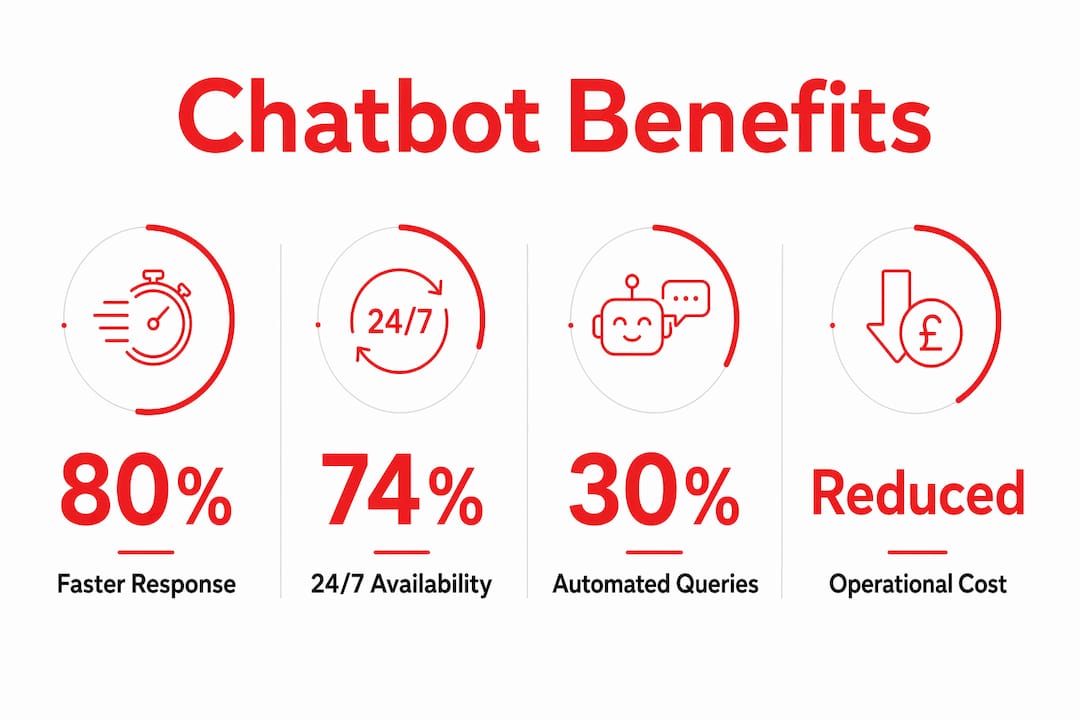
Speed is the most immediate benefit of chatbots in customer service. AI-powered chatbots reduce response times by up to 80% and cut support costs by 30–50%. That means a customer who previously waited 24 hours for an email reply now gets an answer in seconds.

Availability matters just as much as speed. 74% of customers expect instant 24/7 service, driven by the normalisation of AI across digital platforms. A business that only operates Monday to Friday, 9 to 5, is already behind customer expectations. Chatbots close that gap without adding headcount.
The quality of resolution is where most chatbot deployments either succeed or fail. Zendesk executives define true resolution as an outcome agreed upon by the customer, the business, and the agent. A chatbot that deflects rather than resolves does not meet that standard. Finnair’s AI assistant, Sisu, is a strong example of getting this right. Sisu handles common travel queries but passes conversations to human agents with a full transcript, so customers never have to repeat themselves.
There are two broad types of chatbots worth understanding:
- Rule-based chatbots follow decision trees. They are fast to deploy and reliable for simple, predictable queries such as opening hours or order status.
- AI-powered chatbots use natural language processing to understand intent. They handle more complex conversations, learn from interactions, and integrate with CRM systems to personalise responses.
- AI agents go further still. They connect to core business systems and execute multi-step tasks autonomously, such as processing a refund or rescheduling a booking.
Choosing the right type depends on the complexity of your customer queries and the depth of system integration you need.
Pro Tip: Set clear escalation triggers from day one. Define which query types always route to a human agent, and make that handoff instant. Customers forgive a chatbot’s limitations far more readily when a real person picks up the conversation without friction.
What can chatbots automate beyond customer service?
Chatbots deliver significant value inside the business, not just on the customer-facing side. Internal automation is one of the fastest-growing use cases in 2026, particularly in HR and IT functions.
- IT helpdesk support. Chatbots handle password resets, software access requests, and common technical queries without involving a human technician. This frees IT teams to focus on complex infrastructure work.
- HR enquiries. Employees ask repetitive questions about payroll dates, holiday entitlement, and onboarding processes. A chatbot answers these instantly, at any hour, without burdening the HR team.
- Internal knowledge retrieval. Large organisations hold enormous amounts of policy documentation. A chatbot connected to that knowledge base gives staff accurate answers in seconds rather than searching through shared drives.
- Meeting scheduling and task routing. Chatbots integrated with calendar tools and project management platforms can book meetings, assign tasks, and send reminders automatically.
Rasa research shows that chatbots tackle 30% or more of repetitive internal queries, freeing staff for work that genuinely requires human judgement. That efficiency gain compounds quickly across a team of 50 or 500 people.
The cost case is straightforward. Fewer repetitive queries reaching human staff means lower operational costs and faster response times for employees. Consistent service delivery across locations and time zones becomes achievable without additional resource. For businesses with distributed teams or multiple sites, that consistency is particularly valuable.
What makes a chatbot actually work? Trust and integration
Technical accuracy is the single most important factor in chatbot success. Research published in Nature confirms that accuracy and transparency build user trust more effectively than conversational style or human-like tone. A chatbot that gives a wrong answer confidently destroys brand credibility faster than a slow human response ever would.
Standard chatbots vs. AI agents
| Feature | Standard chatbot | AI agent |
|---|---|---|
| Primary function | Retrieves information | Executes multi-step workflows |
| System integration | Limited or none | CRM, ERP, billing, ticketing |
| Autonomy | Follows scripts | Acts independently within defined rules |
| Best use case | FAQs, simple queries | Bookings, refunds, order management |
AI agents wired to core systems such as CRM, ERP, and billing platforms can complete tasks end to end. A standard chatbot tells a customer their order is delayed. An AI agent reschedules the delivery, sends a confirmation, and updates the CRM record, all without human input.
IBM describes the most effective enterprise chatbots as a conversational layer over existing workflows. The chatbot does not replace your CRM or your ticketing system. It sits on top of them, giving users a single, natural interface to access everything. That approach reduces complexity rather than adding to it.
Data security and transparency are non-negotiable. Customers need to know when they are speaking to a bot, what data is being collected, and how it is used. Hiding that information erodes trust quickly. Providing it upfront, clearly and simply, does the opposite.
Pro Tip: Audit your chatbot’s failure rate monthly. Track every conversation where the bot could not resolve the query. Those failure points are your product roadmap. Fix the most common ones first, and your resolution rate will climb steadily.
How do chatbots support sales and marketing?
Chatbots are one of the most effective tools for lead qualification and nurturing. They engage website visitors the moment they land on a page, ask qualifying questions, and route high-intent prospects directly to a sales representative. That process happens instantly, at any time of day, without a salesperson lifting a finger.
The impact on the sales funnel is measurable. Chatbots respond to enquiries immediately, which matters because lead conversion rates drop sharply the longer a prospect waits. An automated response within seconds keeps the conversation alive. A follow-up email sent 12 hours later often does not.
✅ Best practices for chatbot deployment in sales and marketing:
- Define your qualification criteria first. Know exactly what questions separate a hot lead from a browser before you build the chatbot flow.
- Personalise responses using CRM data. A returning customer should never be asked for information you already hold.
- Use chatbots to deliver content. Send a relevant case study, pricing guide, or product comparison based on what the visitor is browsing.
- Integrate with your email marketing platform. Capture consent during the chatbot conversation and trigger nurture sequences automatically.
- Test and iterate. Run A/B tests on opening messages and qualification questions. Small changes in wording produce significant differences in engagement.
For businesses using social media AI chatbots, the same principles apply across Facebook Messenger, Instagram DMs, and WhatsApp. A prospect who messages your Facebook page at 11pm gets an instant, relevant response rather than waiting until the next morning.
The marketing automation benefits extend to campaign personalisation. Chatbots can segment visitors by behaviour, location, or purchase history and deliver tailored messages accordingly. That level of personalisation was previously only achievable with large marketing teams. Chatbot technology makes it available to businesses of any size. For a deeper look at how UK businesses are applying these tools, the guide on AI in marketing and sales covers the full picture.
Key takeaways
Chatbots deliver measurable business value when they are accurate, well-integrated, and designed with a clear human escalation path.
| Point | Details |
|---|---|
| Speed and availability | Chatbots reduce response times by up to 80% and meet the 24/7 service expectations of modern customers. |
| Internal automation | Bots handle 30% or more of repetitive HR and IT queries, freeing staff for higher-value work. |
| Trust depends on accuracy | Technical reliability and transparency build user trust more than conversational style alone. |
| AI agents outperform basic bots | Agents integrated with CRM and ERP systems complete full workflows, not just retrieve information. |
| Sales impact is immediate | Instant lead qualification and personalised responses keep prospects engaged and improve conversion rates. |
Why I think most businesses are deploying chatbots the wrong way
Most businesses I speak with treat chatbot deployment as a one-time project. They build the bot, launch it, and move on. That is the wrong approach, and it explains why so many chatbots frustrate customers rather than helping them.
The businesses getting real results treat their chatbot as a live product. They review failure logs, update responses, and expand capabilities based on actual customer behaviour. They also resist the temptation to make the bot do everything from day one. Starting with two or three high-volume use cases and doing those brilliantly is far more effective than building a complex system that handles dozens of scenarios poorly.
The human escalation question is where I see the most damage done. A chatbot that traps a customer in a loop, with no clear route to a real person, does not just fail that customer. It damages the brand. Finnair’s Sisu model, where the bot hands off with a full transcript, is the standard every business should aim for. It respects the customer’s time and the agent’s intelligence.
My honest view is that chatbots are not a cost-cutting tool. They are a service quality tool that happens to reduce costs when deployed well. Businesses that approach them purely as a way to reduce headcount tend to build systems that deflect rather than resolve. That distinction matters enormously to the customers on the other end of the conversation.
— Martyn
How Bamsh can help you get chatbots right
Getting chatbot strategy right requires more than picking a platform. It requires understanding your customer journey, your existing systems, and where automation genuinely adds value versus where it creates friction. Bamsh works with UK businesses to build AI-powered customer service and lead generation systems that are practical, measurable, and designed to grow with your business. If you want to understand how chatbots fit into a broader digital strategy, the guide on maximising online leads with AEO is a strong starting point. For businesses ready to talk specifics, Bamsh offers a straightforward consultation with no obligation and no jargon.
FAQ
What is the main role of chatbots in business?
Chatbots automate customer interactions, internal queries, and sales processes to reduce costs and improve response times. Their primary value is handling high-volume, repetitive tasks so human teams can focus on complex work.
How do chatbots improve customer service?
Chatbots reduce response times by up to 80% and provide 24/7 availability, meeting the instant service expectations that 74% of customers now hold. The key is accurate responses and a clear path to a human agent when needed.
What is the difference between a chatbot and an AI agent?
A standard chatbot retrieves information and follows scripts. An AI agent connects to systems such as CRM and ERP platforms and completes multi-step tasks autonomously, such as processing refunds or rescheduling bookings.
Can chatbots help with sales and lead generation?
Yes. Chatbots qualify leads instantly by asking targeted questions and routing high-intent prospects to sales teams. Immediate responses prevent the drop-off in conversion rates that occurs when prospects wait hours for a reply.
How long does it take to see ROI from chatbot automation?
ROI on chatbot automation is typically achieved within 18 months, driven by reduced support costs and improved lead conversion rates. Businesses that start with focused, high-volume use cases tend to reach that point faster.