
TL;DR:
- Social proof influences consumer decisions by showcasing genuine feedback, boosting trust and conversions.
- Legislation in the UK now strictly bans fake reviews and incentivized disclosures, emphasizing authenticity.
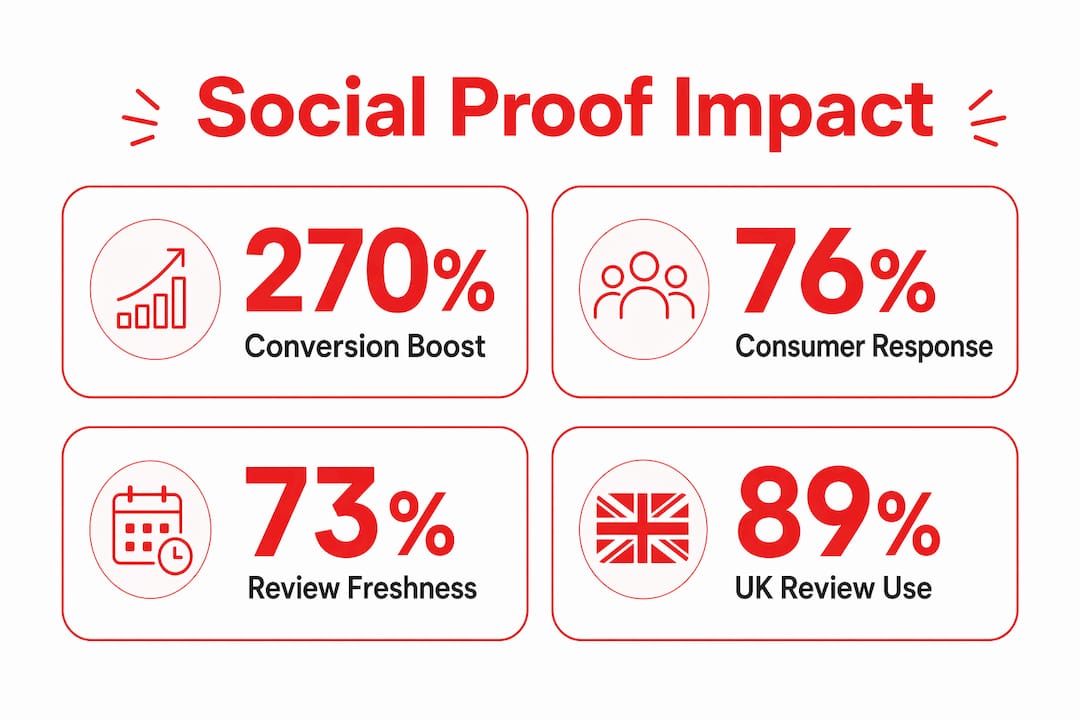
Social proof is defined as the psychological mechanism by which people look to the actions and opinions of others to guide their own decisions. In business, it functions as the most powerful trust signal you can deploy. 89% of UK consumers consult online reviews before buying, and that behaviour influences roughly £23 billion of annual UK consumer spending. That figure alone tells you how much revenue hinges on what other people say about you. The role of social proof in business is not a nice-to-have. It is a commercial necessity, and in 2026, it comes with legal obligations you cannot afford to ignore.
How does social proof build trust and influence consumer behaviour?
Social proof works by reducing the perceived risk a buyer feels before committing. When a potential customer sees that others like them have already made a purchase and been satisfied, the mental effort required to say “yes” drops significantly. This is especially true in the UK, where cultural scepticism of self-promotion runs deep. British buyers are far more likely to trust a stranger’s review than a brand’s own claims.
The main types of social proof relevant to business are:
- Customer reviews and star ratings on platforms such as Google Business Profile and Trustpilot
- Written testimonials placed on your website, ideally with a name, photo, and job title
- Video testimonials, which convert at a higher rate than text alone
- User-generated content, such as photos or posts shared by real customers on social media
- Trust badges and accreditations, such as industry body memberships or award logos
- Case studies, which are particularly persuasive for high-consideration B2B purchases because they combine measurable results with client context
The numbers back this up. Genuine testimonials can increase conversion rates by up to 270% for higher-priced products. That is not a marginal gain. It is the difference between a website that generates enquiries and one that does not.
Responding to reviews matters just as much as collecting them. 76% of UK consumers say that a business responding to reviews significantly increases their trust. Engagement signals that you care about outcomes, not just sales.

Pro Tip: Do not wait for customers to leave reviews spontaneously. Build a simple follow-up process that asks every customer for feedback within 48 hours of their purchase or project completion. Consistency beats occasional bursts.
What are the legal rules for social proof in UK marketing?
The legal landscape for social proof changed significantly with the Digital Markets, Competition and Consumers Act 2024. This legislation bans fake reviews and undisclosed incentivised reviews outright, with penalties reaching up to 10% of global annual turnover. The Competition and Markets Authority enforces these rules, and enforcement is active.
The following practices are now prohibited:
- Publishing fake reviews written by people who have not used your product or service
- Commissioning fake reviews from third parties, including review farms
- Offering incentives for reviews without clear disclosure, such as discounts or gifts in exchange for a positive write-up
- Suppressing or hiding negative reviews to create a misleadingly positive picture
- Misrepresenting review scores or cherry-picking data to inflate perceived ratings
Transparency and authenticity are not only ethical choices. They are commercially beneficial in the UK market, where consumers are increasingly sophisticated and regulators are increasingly active. A business that builds its reputation on genuine feedback will always outperform one that games the system, because trust compounds over time.
To stay compliant, ask every customer for a review regardless of how you think they will respond. Use a structured process, disclose any incentive clearly if you offer one, and respond professionally to every review, positive or negative. You can find practical guidance on improving online reviews that covers compliant collection methods in detail.
Best practices for using social proof to grow your brand and sales
The most effective social proof is specific, relevant, and recent. A testimonial that says “Great service, highly recommend” does almost nothing. A testimonial that says “We reduced our monthly admin time by six hours after switching” does a great deal. The difference is specificity.
Demographic relevance is equally important. Buyers want validation from people like themselves. A testimonial from a 52-year-old solicitor in Manchester carries far more weight with a similar buyer than one from an anonymous “satisfied customer.” Always include the reviewer’s name, location, and role where possible.
Format variety also drives results. The table below shows how different social proof formats perform across key objectives:
| Format | Best used for | Key benefit |
|---|---|---|
| Written testimonials | Website landing pages | Builds credibility quickly |
| Video testimonials | Product pages, social ads | Higher engagement and conversion |
| Star ratings | Search results, product listings | Instant trust signal at first glance |
| Trust badges | Checkout pages | Reduces abandonment at point of purchase |
| Case studies | B2B sales pages | Demonstrates measurable, real-world results |
Review freshness is a factor most businesses overlook. 73% of consumers only consider reviews from the last month to be relevant. A page full of glowing reviews from three years ago will not reassure a buyer in 2026. Set up a system that generates new reviews continuously, not just during a one-off campaign.
Negative reviews, handled well, can actually strengthen trust. Consumers read low-star reviews first to see how a business responds. A calm, professional reply to a complaint builds more credibility than a flawless five-star profile, which many buyers now view with suspicion. Responding to reviews can increase consumer trust by 30%. That is a meaningful return for a five-minute task.
Pro Tip: Place your strongest testimonial or case study above the fold on your key landing pages. Most visitors never scroll to the bottom, so your best social proof needs to be visible immediately.
What mistakes should you avoid with social proof?
The biggest mistake is over-curating. Businesses that only display five-star reviews, or that remove any mention of a complaint, create a profile that feels artificial. Buyers notice. Consumer sophistication in reading reviews has grown sharply, and a suspiciously perfect rating often triggers doubt rather than confidence.
Common pitfalls to avoid:
- Collecting reviews in bursts rather than continuously, which creates obvious gaps in your review history
- Ignoring negative reviews instead of responding, which signals indifference to customer experience
- Using generic testimonials without names, photos, or context, which carry little persuasive weight
- Relying on a single format, such as text reviews only, when video and trust badges significantly extend reach
- Incentivising reviews without disclosure, which now carries legal risk under the 2024 Act
- Letting your review profile go stale, given that most buyers discount reviews older than one month
Fake or insincere social proof causes lasting damage. Once a business is publicly associated with manipulated reviews, the reputational cost is difficult to recover from. The short-term gain of a boosted rating is never worth the long-term loss of credibility. Building a reputation management system grounded in genuine feedback is the only approach that compounds positively over time.
Key takeaways
Social proof is the single most cost-effective trust signal available to UK businesses, and its impact on conversion, reputation, and revenue is measurable, consistent, and legally regulated.
| Point | Details |
|---|---|
| Reviews drive significant revenue | 89% of UK consumers consult reviews, influencing £23 billion of annual spending. |
| Genuine testimonials convert | Authentic testimonials can lift conversion rates by up to 270% on higher-priced products. |
| Legal compliance is non-negotiable | The Digital Markets, Competition and Consumers Act 2024 bans fake reviews with penalties up to 10% of global turnover. |
| Freshness and relevance matter | 73% of consumers only trust reviews from the last month, so continuous collection is required. |
| Responding builds trust | Replying to reviews increases consumer trust by 30% and signals that you value customer outcomes. |
Why I think most businesses are still getting social proof wrong
After working with dozens of UK businesses since 2012, I have seen the same pattern repeat itself. A business owner spends months building a product or service they are genuinely proud of, then leaves the reputation side entirely to chance. They collect a handful of reviews in the first year, stop asking, and wonder why their conversion rate plateaus.
The businesses that grow consistently are the ones that treat social proof as a system, not an afterthought. They ask every customer, not just the happy ones. They respond to every review, not just the negative ones. They update their testimonials regularly and place them where buyers actually look.
What surprises me most is how few businesses use case studies for B2B sales. A well-written case study with real numbers, a named client, and a direct quote is the closest thing to a sales conversation you can have at scale. Yet most businesses either skip them entirely or produce something so vague it could apply to anyone.
The other thing I would push back on is the idea that negative reviews are a problem to be managed. They are actually an opportunity. A thoughtful, professional response to a complaint tells prospective buyers far more about your values than ten generic five-star reviews ever could. Buyers are not looking for perfection. They are looking for honesty.
— Martyn
How Bamsh helps you turn reviews into real business growth
Social proof only works when it is visible, credible, and consistent. Bamsh helps UK businesses build review systems that generate genuine feedback continuously, respond to every review professionally, and present that trust to buyers at exactly the right moment. Our Answer Engine Optimisation service ensures your reviews and testimonials appear not just in Google search results but in AI tools like ChatGPT, Gemini, and Copilot, where more buyers are now researching before they buy. If you want your social proof to work harder and reach further, Bamsh has the systems to make that happen. Get in touch to see how we can put your reputation to work.
FAQ
What is social proof in business?
Social proof is the use of third-party validation, such as reviews, testimonials, and ratings, to build trust with potential customers. It works by demonstrating that others have already chosen and benefited from your product or service.
How does social proof affect sales?
Genuine testimonials can increase conversion rates by up to 270% for higher-priced products, and trust badges can increase conversions by 42%. Social proof reduces buyer hesitation by shifting the decision from “should I trust this brand?” to “others like me already have.”
Is it legal to incentivise reviews in the UK?
Offering incentives for reviews is permitted only if the incentive is clearly disclosed. The Digital Markets, Competition and Consumers Act 2024 bans undisclosed incentivised reviews and fake reviews, with penalties up to 10% of global turnover.
How often should I collect new reviews?
Continuously. 73% of consumers only consider reviews from the last month relevant, so a one-off review campaign will quickly lose its impact. Build a process that requests feedback from every customer as standard.
Do negative reviews hurt my business?
Not if you respond to them well. Consumers read low-star reviews first to assess how a business handles problems. A professional, empathetic response can build more trust than a perfect five-star profile, which many buyers now view with scepticism.