

TL;DR:
- Your online reputation reflects your business’s public image across digital platforms. Managing it proactively enhances growth, trust, and customer engagement, while neglecting it can lead to lost customers.
Your online reputation is the public image your business holds across every digital platform where customers, prospects, and the wider world can see and judge you. Online reputation management, the recognised industry term for this practice, covers everything from Google reviews and social media comments to news articles and search results. Get it right, and it becomes one of your most powerful growth tools. Get it wrong, and it quietly costs you customers every single day. This guide gives you a clear, practical understanding of what online reputation is, why it matters, and exactly what you can do about it.
What is online reputation explained in simple terms?
Online reputation is the sum of every impression your business makes across the internet. It is shaped by multiple online channels working together: reviews, social media, search results, and press coverage. No single channel defines it. All of them combine to form what a potential customer believes about you before they ever pick up the phone or visit your website.
Think of it this way. A prospect in Bristol searches for a local plumber. They see your Google Business Profile, read three reviews, glance at your social media, and make a decision in under two minutes. That decision is driven almost entirely by your online reputation. You were not in the room, but your reputation spoke for you.
The standard industry term for managing this is online reputation management, often abbreviated to ORM. ORM is not just about fixing bad reviews. It is a continuous process of monitoring, responding, and improving how your business appears across every digital touchpoint.
What components make up an online reputation?
Your online reputation is built from several distinct layers. Understanding each one helps you know where to focus your efforts.
- Customer reviews and ratings. Platforms like Google, Trustpilot, and Facebook collect public feedback that directly shapes buyer decisions. Consumers rely on reviews as a primary factor when choosing between businesses. A steady stream of genuine, positive reviews builds credibility faster than any paid advert.
- Social media presence and engagement. How you show up on Facebook, Instagram, LinkedIn, and X (formerly Twitter) tells customers a great deal about your business culture. Consistent, responsive social media signals that real people are behind the brand.
- Search engine results. When someone Googles your business name, the first page of results is your reputation in print. News articles, directory listings, forum mentions, and your own website all contribute to that picture.
- Public relations and media coverage. A positive feature in a local publication or trade journal adds authority. Negative press, even if outdated, can linger in search results for years.
- Employee and stakeholder communications. Reviews on platforms like Glassdoor and public comments from team members shape how customers perceive your internal culture. A business that treats its staff well tends to treat its customers well too.
Each of these components feeds into the overall picture. Neglecting even one of them creates gaps that competitors will fill.
How does online reputation impact business success?

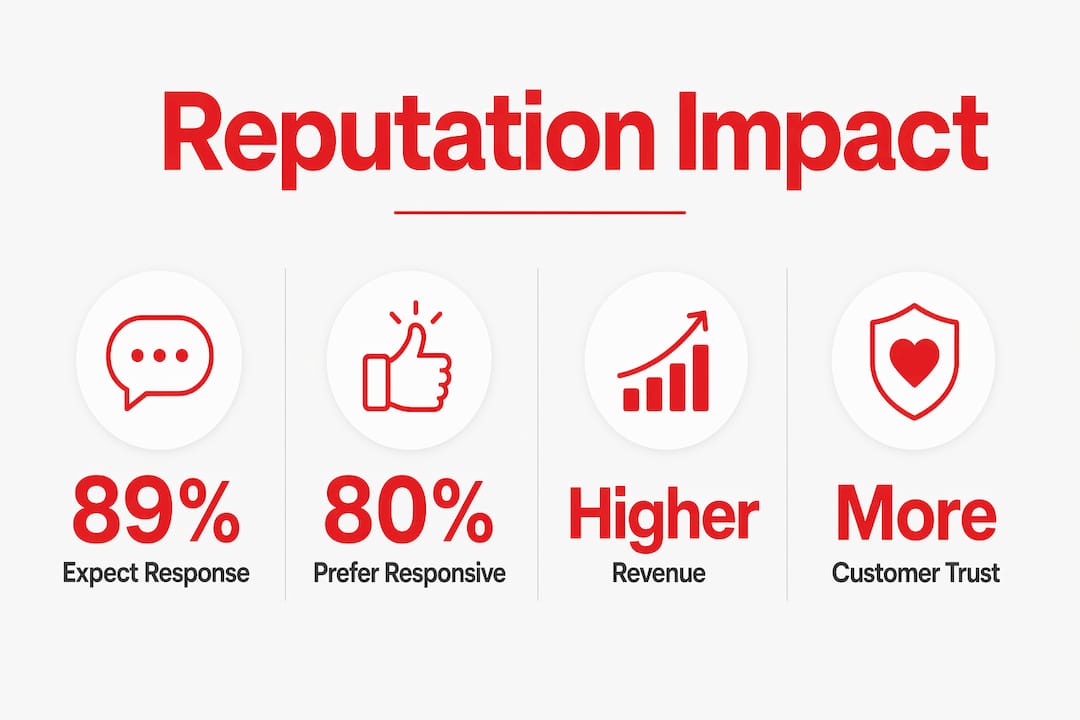
Online reputation has a direct and measurable effect on revenue. 89% of consumers expect a response to their reviews, and 42% will actively avoid businesses that ignore them. That is nearly half of your potential customers walking away because of silence.
The flip side is equally powerful. 80% of consumers are more likely to use a business that responds to every review. Responding is not just good manners. It is a conversion tool.
A strong online reputation also creates competitive advantage. When two businesses offer similar services at similar prices, the one with better reviews and more visible engagement wins. Customers use reputation as a shortcut for trust, particularly when they cannot assess quality in advance.
Poor reputation carries operational costs that go beyond lost sales. Persistent negative feedback in reviews often points to underlying operational failures, not just communication problems. If customers repeatedly mention slow response times or unclear pricing, that is a process issue, not a PR issue. Treating it as a marketing problem and ignoring the root cause means the negative reviews keep coming.
Reputation also connects directly to your marketing effectiveness. A business with strong reviews gets more clicks from Google Ads, more conversions from its website, and more referrals from existing customers. Your reputation amplifies every other marketing investment you make. For a deeper look at why this matters specifically for UK businesses, the Bamsh guide on reputation management for UK SMEs is worth reading.
How can businesses effectively monitor and manage their online reputation?
Managing your online reputation is not a one-off task. It is a weekly discipline. Here is a practical framework to follow.
- Set up monitoring alerts. Use Google Alerts for your business name, key staff names, and your main products or services. This gives you real-time notifications whenever your business is mentioned online. Social listening tools that track mentions across platforms add another layer of visibility.
- Respond to every review within 24 hours. The Federation of Small Businesses recommends replying to all reviews, positive and negative, ideally within 24 hours. Speed signals that you take customer feedback seriously.
- Use empathetic, transparent language in every response. Tone matters as much as timing in effective online communication. A defensive or dismissive reply to a negative review does more damage than the original complaint. Acknowledge the issue, apologise where appropriate, and offer a resolution.
- Treat negative feedback as operational intelligence. Negative feedback presents an opportunity for growth. When the same complaint appears repeatedly, fix the underlying process. Then let future responses reflect that change.
- Ask satisfied customers for reviews. Most happy customers do not leave reviews unless prompted. A simple follow-up message after a completed job or purchase, asking for honest feedback, significantly increases your review volume.
- Audit your search results monthly. Search your business name in an incognito browser window. Note what appears on the first page. If anything negative or outdated ranks highly, address it through content creation or a direct request for removal where applicable.
Pro Tip: When responding to a negative review, always take the conversation offline as quickly as possible. Acknowledge the issue publicly, then invite the customer to contact you directly. This shows other readers you care, without turning a complaint into a public debate.
For practical guidance on improving your online reviews, Bamsh has a dedicated resource that walks through the process step by step.
What tools and approaches support ongoing reputation management?
Reputation management works best when it is built into your regular marketing workflow, not treated as a crisis response.
| Tool category | Primary function | Best suited for |
|---|---|---|
| Alert systems | Monitor brand mentions across the web | Businesses of all sizes needing basic coverage |
| Analytics dashboards | Track review volume, ratings, and sentiment trends | Businesses wanting data to guide decisions |
| Social listening platforms | Monitor social media conversations and hashtags | Businesses with active social media presence |
| Review management platforms | Centralise reviews from multiple sources | Businesses managing reviews across several platforms |
The most effective approach integrates reputation management with your wider digital marketing activity. Your Google Business Profile, for example, is both a reputation asset and a local search ranking factor. Optimising your Google Business Profile directly improves how you appear in local search results and gives customers a clear, trustworthy first impression.
Assign clear ownership within your team. Someone needs to be responsible for monitoring and responding to reviews each week. Without a named owner, it falls through the cracks. For smaller businesses, this is often the owner or a marketing manager. For larger teams, a dedicated customer experience role makes sense.
Prompt response to online feedback enhances customer trust and demonstrates active management. Customers notice when a business engages consistently. They also notice when it does not.
Pro Tip: Build a simple response template library for common review scenarios: a five-star thank you, a response to a delivery complaint, a reply to a pricing query. Templates save time and keep your tone consistent, but always personalise the first line so responses feel genuine.
Why I think most UK businesses are managing reputation backwards
Most business owners I speak with treat reputation management as something they do when things go wrong. A bad review appears, panic sets in, and they scramble to respond. That reactive approach is the most expensive way to manage your reputation.
The businesses I have seen grow fastest treat reputation as a proactive, weekly function. They ask for reviews consistently. They respond to every piece of feedback, good and bad. They use what customers tell them to actually improve their operations. That last part is the one most people skip.
Managing online reviews is a strategic growth function, not merely damage control. I have watched businesses with a four-star average outperform competitors with five stars, simply because they engaged more visibly and more honestly. Customers do not expect perfection. They expect accountability.
The other thing I see overlooked constantly is the connection between reputation and marketing spend. If your Google Ads are driving traffic to a listing with twelve reviews and a three-star average, you are paying to send people somewhere they will not trust. Fix the reputation first. Then the paid traffic converts properly. Reputation is not separate from your marketing. It is the foundation everything else sits on.
— Martyn
How Bamsh can support your reputation and visibility online
Your online reputation does not exist in isolation. It connects directly to how visible you are in search, how well your Google Business Profile performs, and how effectively your wider digital marketing converts interest into enquiries. Bamsh works with UK businesses to build that visibility from the ground up, with clear reporting and no jargon. Whether you want to improve your local search presence, generate more reviews, or make sure your Google Business Profile is working as hard as it should, Bamsh has the expertise to help. If you want to see how your online presence stacks up, a free 15-minute consultation is the fastest way to get a straight answer.
FAQ
What is online reputation in simple terms?
Online reputation is the overall impression your business creates across digital platforms, including reviews, social media, and search results. It is what potential customers believe about you before they make contact.
Why does online reputation matter for small businesses?
42% of consumers will avoid a business that does not respond to reviews. For small businesses competing locally, reputation is often the deciding factor between winning and losing a customer.
How quickly should I respond to online reviews?
The Federation of Small Businesses recommends responding to all reviews, positive and negative, within 24 hours. Faster responses signal active management and build customer confidence.
Can negative reviews actually help my business?
Yes. Handling negative feedback with transparency and empathy can build customer loyalty more effectively than a perfect rating. Customers trust businesses that acknowledge problems and fix them.
What is the difference between online reputation and brand image?
Brand image is the identity you deliberately create through marketing. Online reputation is what customers actually say and believe about you, shaped by their real experiences. The two should align, but reputation is always the more credible signal.
Key takeaways
Online reputation is the most credible signal a potential customer has about your business, and managing it proactively is the single most cost-effective way to improve conversion rates and customer trust.
| Point | Details |
|---|---|
| Reputation is multi-channel | Reviews, social media, search results, and press coverage all combine to shape public perception. |
| Response speed builds trust | Replying to every review within 24 hours signals active management and increases conversion likelihood. |
| Negative feedback is operational data | Repeated complaints point to process failures that need fixing, not just better PR responses. |
| Proactive management outperforms reactive | Businesses that request reviews consistently and engage regularly outperform those that only respond to crises. |
| Reputation amplifies marketing spend | Strong reviews and visible engagement improve the return on every paid marketing channel you use. |