
TL;DR:
- Social listening analyzes why online conversations happen and guides strategic business decisions.
- Most businesses misuse it by focusing only on mentions, neglecting deeper narrative insights.
Social listening is defined as the practice of tracking online conversations about your brand, industry, or competitors, then analysing those conversations to guide business decisions. It goes well beyond counting mentions. The industry term you will also encounter is “social intelligence,” which sits at the top of a three-layer hierarchy: monitoring, listening, and intelligence. Each layer builds on the last. Marketing professionals and business owners who understand all three gain a genuine edge. This guide explains what social listening is, how it differs from social media monitoring, how the process works, and how you can put it to use right now.
What is social listening and why does it matter?
Social listening is the strategic practice of interpreting why online conversations happen, not just recording that they did. Social listening interprets why conversations happen and what should happen next, which is what separates it from simple monitoring. That distinction matters because volume alone tells you nothing useful. A spike in brand mentions could mean a viral campaign or a brewing crisis. Without interpretation, you cannot tell the difference.

The techniques at the heart of social listening include sentiment analysis, thematic analysis, and narrative intelligence. Sentiment analysis scores the emotional tone of posts and comments. Narrative intelligence goes deeper, mapping the belief structures and stories that shape how communities talk about a topic. Together, these techniques turn raw social data into something a marketing director or business owner can act on.
The importance of social listening shows up across every department. Marketing teams use it to refine messaging. Product teams use it to spot unmet needs. Customer service teams use it to catch complaints before they escalate. When insights flow across the business rather than sitting in one team’s inbox, the value multiplies.
How does social listening differ from social media monitoring?
The two terms are often used interchangeably, but they describe different activities with different goals. Understanding the gap helps you use both well.
Social media monitoring is reactive. It tracks what is being said, how often, and by whom in real time. The goal is to catch mentions, flag comments, and respond quickly. Think of it as the early warning system.
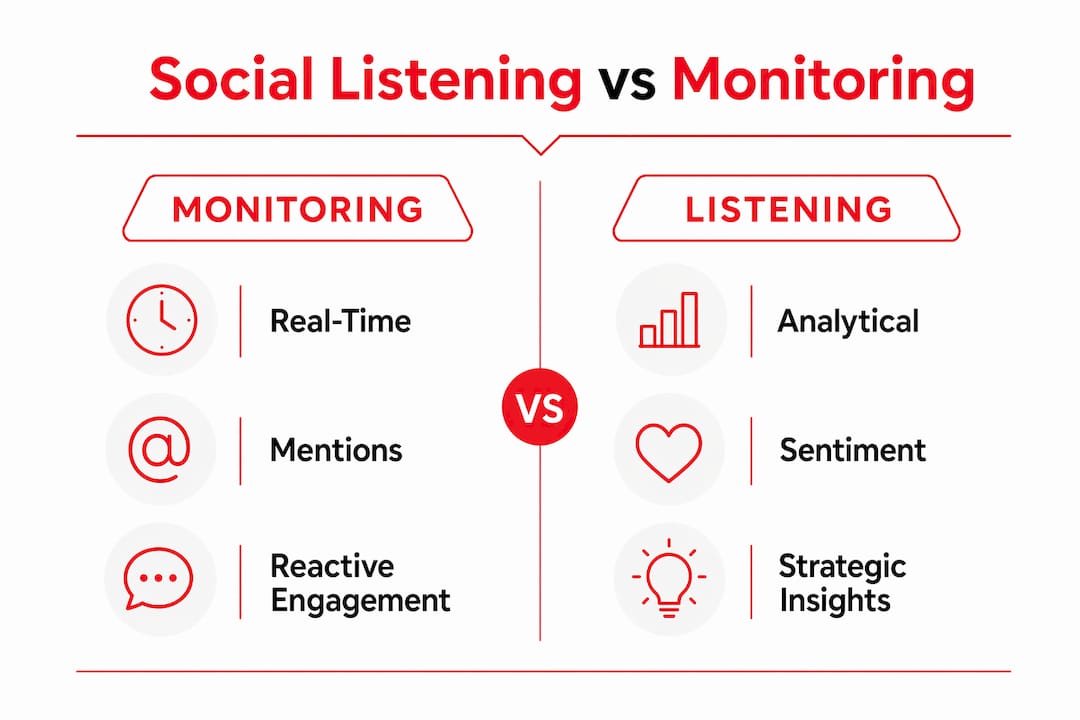
Social listening is analytical. Social intelligence creates a hierarchy where monitoring enables reactive engagement, listening explains trends, and intelligence supports cross-functional decisions. That layered view is the key. Listening asks the harder questions: Why is this conversation happening? What does it reveal about customer belief? What should we do differently?
| Aspect | Social media monitoring | Social listening |
|---|---|---|
| Primary focus | Mentions, volume, and response | Trends, sentiment, and narrative |
| Time horizon | Real-time and reactive | Medium to long-term and strategic |
| Key output | Alerts and replies | Insights and recommendations |
| Who uses it | Community managers | Marketing strategists and leadership |
| Typical tools | Notification dashboards | AI analytics platforms |
The two approaches are complementary, not competing. Monitoring feeds the raw data. Listening makes sense of it. Running one without the other leaves gaps in your picture.
What are the four stages of the social listening process?
Social listening involves four main stages: monitoring, analysis, insights extraction, and action. Each stage has a distinct role, and skipping one weakens the whole process.
-
Monitoring. You set up keyword tracking across social platforms, forums, review sites, and news sources. This stage captures the raw data: mentions of your brand name, product names, relevant hashtags, and industry terms. The wider your coverage, the more complete your picture.
-
Analysis. Raw data becomes meaningful here. Sentiment analysis scores each mention as positive, negative, or neutral. Thematic analysis groups mentions by topic. You start to see patterns: which product feature draws complaints, which campaign phrase resonates, which competitor is gaining ground in conversation.
-
Insights extraction. This is where you move from “what is happening” to “what it means.” You identify the narratives driving conversation, the communities leading them, and the moments that shifted sentiment. Narrative analysis is required here to avoid misleading conclusions from spikes in conversation volume. A spike caused by a meme is very different from a spike caused by a product defect.
-
Action. Insights without action are just reports. This stage means feeding findings into campaign briefs, product roadmaps, customer service scripts, and crisis response plans. The goal is a direct line from social conversation to business decision.
Pro Tip: Automated sentiment tools sometimes misread sarcasm, slang, and industry jargon. Always schedule a manual audit of flagged content before presenting findings to leadership. One misclassified viral post can send strategy in the wrong direction.
What tools and technologies support social listening in 2026?
The technology behind social listening has advanced considerably. Modern platforms do not just track Twitter or Instagram. Enterprise platforms now cover over 150 million websites and 30+ social channels across 239 countries, with AI providing advanced analytics including sentiment scoring and share of voice. That scale of coverage means you can track conversations happening in niche forums, podcasts, and regional news sites, not just mainstream social feeds.
✅ What current social listening platforms can do for you:
- Sentiment scoring across millions of posts in near real time, giving you a live read on brand health
- Share of voice measurement, showing how much of the industry conversation your brand owns compared to the category overall
- Narrative intelligence, which maps the stories and belief structures shaping how audiences talk about your sector
- Trend detection, surfacing emerging topics before they peak so you can respond or capitalise early
- Crisis alerts, flagging sudden spikes in negative sentiment so your team can act before a story spreads
AI advancements in 2026 enable proactive detection of misinformation and emerging risks, moving beyond manual prompting to provide self-driving insights. That shift is significant. Previously, a marketing team had to know what to search for. Now, platforms surface risks and opportunities without being asked.
Pro Tip: Match your tool to your business size. A small business owner does not need an enterprise platform covering 239 countries. Start with a tool that covers your core channels and language, then expand as your listening programme matures.
Choosing the right social media advertising tools alongside your listening platform creates a feedback loop: listening informs your ad targeting, and ad performance data feeds back into your listening analysis.
How can you use social listening insights to improve marketing and engagement?
This is where social listening pays for itself. The insights you gather are only as valuable as the decisions they drive. Here is how marketing professionals and business owners put them to work.
✅ Practical applications that deliver real results:
- Refine your messaging. If your audience consistently uses different language to describe your product than you do in your ads, change your copy. Social listening reveals the exact words your customers use, which are the words that convert.
- Feed product development. Pain points raised repeatedly in online conversations are product briefs waiting to be written. Maximum value from social listening is achieved when insights feed directly into product, marketing, and support functions rather than remaining isolated in one team.
- Spot emerging trends early. A topic gaining traction in niche communities today will hit mainstream media in weeks. Brands that respond early own the narrative. Those that wait play catch-up.
- Manage reputation proactively. Advanced AI enables proactive detection of misinformation and emerging risks, which improves crisis management. Catching a false claim about your brand early, before it spreads, is far cheaper than damage control after the fact.
- Improve customer service. Complaints aired on social platforms often go unresolved because they are not directed at the brand’s official account. Listening catches those conversations and gives your support team a chance to respond.
- Benchmark against the category. Share of voice data tells you whether your brand is growing or shrinking in the conversation relative to the overall market. That is a leading indicator of market share shifts.
Integrating social listening insights across departments enhances business impact instead of siloing data within marketing teams. The businesses that get the most from social listening treat it as a shared intelligence resource, not a marketing department tool.
Understanding how AI transforms customer engagement helps you connect listening insights directly to the systems that act on them, from CRM automation to personalised ad campaigns.
Key takeaways
Social listening is the practice of analysing online conversations to understand the why behind public sentiment, and that analytical depth is what separates it from basic social media monitoring.
| Point | Details |
|---|---|
| Definition is precise | Social listening analyses why conversations happen, not just how many mentions occur. |
| Monitoring and listening differ | Monitoring is reactive; listening is strategic. Use both together for the full picture. |
| Four stages guide the process | Monitor, analyse, extract insights, and act. Skipping any stage weakens the output. |
| AI expands coverage and speed | Modern platforms cover 150 million+ websites and detect risks without manual prompting. |
| Cross-department use multiplies value | Insights shared with product, support, and leadership teams drive far greater business impact. |
Why I think most businesses are using social listening wrong
Most marketing teams I speak with treat social listening as a monitoring upgrade. They set up keyword alerts, check the dashboard once a week, and call it done. That approach captures maybe 20% of the available value.
The real power is in narrative analysis. When treating social listening as just volume tracking, you miss the analytical value of understanding narratives and belief structures in communities. I have seen brands panic over a spike in mentions that turned out to be fans celebrating a product anniversary. I have also seen brands ignore a slow build of negative sentiment because the volume looked manageable. Volume without context is noise.
My honest advice: schedule a monthly narrative review, not just a metrics report. Ask your team to answer three questions. What story is the market telling about us right now? Has that story shifted from last month? What decision does that shift require? Those three questions turn a data exercise into a strategy session.
Automated sentiment analysis sometimes misreads sarcasm or jargon, and manual auditing is necessary to maintain accuracy. Build that audit into your process from day one. The brands that get this right are the ones that combine AI speed with human judgement, not the ones that hand everything to the algorithm and walk away.
— Martyn
How Bamsh can help you act on what you hear
Social listening tells you what your market wants. Bamsh helps you show up when they go looking for it. Once you know which topics, pain points, and questions your audience cares about, the next step is making sure your brand appears in the right places at the right moment. Bamsh’s DIY SEO tool helps you translate listening insights into content and keyword strategies that improve your search visibility. For faster results, Bamsh’s PPC management service puts your brand in front of buyers who are already searching for what you offer. Both services are built for UK small and medium businesses that want clear results without the jargon.
FAQ
What is the definition of social listening?
Social listening is the practice of tracking online conversations about a brand, industry, or topic, then analysing them to understand sentiment, trends, and narratives that inform business strategy.
How is social listening different from social media monitoring?
Social media monitoring tracks what is being said and how often, in real time. Social listening interprets why those conversations are happening and what the business should do in response.
What are the main benefits of social listening?
The main benefits include understanding customer sentiment, spotting emerging trends early, improving product development, managing reputation, and feeding insights across marketing, product, and support teams.
What tools support social listening in 2026?
Enterprise platforms now cover over 150 million websites and 30+ social channels, using AI to deliver sentiment scores, share of voice data, and proactive risk alerts without manual prompting.
How do I start using social listening as a small business?
Start by tracking your brand name, key product terms, and two or three competitor category terms on a platform suited to your budget. Review findings monthly and focus on narrative shifts, not just mention volume.