

Many UK business owners hesitate to invest in paid social advertising, believing it’s too expensive or complicated for small budgets. The truth is different. Many UK SMEs now allocate growing parts of their marketing budgets to paid social campaigns, proving it’s accessible, scalable, and delivers measurable results fast. This guide explains why paid social should be part of your 2026 marketing strategy and how it drives brand visibility and lead generation efficiently.
Table of Contents
- Introduction To Paid Social Advertising For UK SMEs
- How Paid Social Boosts Brand Visibility Effectively
- Driving Efficient Lead Generation With Paid Social
- Common Misconceptions About Paid Social Advertising
- Comparison: Paid Social Versus Other Digital Advertising Channels
- How Paid Social Improves Cost Efficiency And Return On Investment
- Integrating Paid Social With Broader Digital Marketing Strategies
- Conclusion: Making Paid Social Work For Your UK Business
- Boost Your Paid Social Success With Expert Support
Key takeaways
| Point | Details |
|---|---|
| Paid social delivers faster, targeted results versus organic social | Advanced targeting enables you to reach ideal prospects quickly, generating leads 50% faster than Google PPC for UK SMEs. |
| Measurable ROI helps optimise budgets and reduce wasted spend | Built-in analytics track impressions, clicks, and conversions, allowing you to adjust campaigns in real time for better returns. |
| Paid social works well alongside PPC and SEO for better reach | Combining channels amplifies brand visibility and increases lead conversion rates across the entire customer journey. |
| Misconceptions about cost and complexity often limit adoption | UK SMEs can start effective campaigns with as little as £5 per day using user-friendly platform interfaces. |
Introduction to paid social advertising for UK SMEs
Paid social advertising means promoting your content on platforms like Facebook, Instagram, and LinkedIn by paying to show targeted messages to specific audiences. Unlike organic posts that rely on follower engagement, paid social puts your brand in front of people who match your ideal customer profile, even if they’ve never heard of you before.
Brand visibility and lead generation are critical for small and medium businesses competing in crowded UK markets. Paid social solves both challenges by delivering immediate reach and measurable results. Many UK SMEs now allocate growing parts of their marketing budgets to paid social campaigns, recognising its ability to generate qualified leads quickly.
Current UK trends show SMEs increasingly favour digital channels that offer transparency and control. Paid social fits this demand perfectly. Platforms provide detailed analytics, flexible budgets, and the ability to pause or adjust campaigns instantly.
Key social platforms used by UK SMEs include:
- Facebook and Instagram for broad consumer reach and visual storytelling
- LinkedIn for B2B targeting and professional services
- TikTok for younger demographics and creative brand building
Paid social fits within your overall marketing mix by filling gaps left by slower channels. While SEO builds long-term authority and PPC captures high-intent searches, paid social creates awareness and nurtures prospects across the entire funnel. Understanding social media advertising steps UK businesses can clarify implementation, and exploring types of online advertising UK businesses helps you see where paid social fits strategically.
How paid social boosts brand visibility effectively
Paid social excels at brand visibility because it combines precise targeting with optimised ad placements. You can define audiences by demographics, interests, behaviours, and even life events, ensuring your message reaches people most likely to care about your offer.
Ad placements are optimised automatically by platform algorithms. They test different formats, times, and placements to maximise engagement. This means your budget works harder without manual tweaking.
UK SMEs see an average 37% boost in brand awareness within six months using paid social campaigns. This measurable brand lift comes from repeated exposure to your message across feeds, stories, and videos. When prospects see your brand multiple times, recognition and trust grow.

Creative formats tailored to audience preferences drive this effect. Video ads capture attention quickly, carousel ads showcase multiple products, and lead forms simplify conversions. Testing different formats reveals what resonates best with your audience.
Real UK SME data highlights consistent results. Businesses running targeted campaigns report improved recall, higher website traffic, and increased enquiries. The key is consistency and clear messaging that aligns with customer needs. Learning more about paid social ads UK business strategies can deepen your understanding of effective brand visibility tactics.
Brand visibility isn’t vanity. It’s the foundation for lead generation and customer trust, which we’ll explore next.
Driving efficient lead generation with paid social
Lead generation is where paid social proves its business value. Advanced targeting options let you reach prospects at the exact moment they’re considering solutions like yours. You can target competitors’ followers, people who visited your website, or cold audiences matching your customer profile.
Paid social ads generate leads 50% faster than Google PPC campaigns for UK SMEs. This speed advantage comes from proactive audience targeting rather than waiting for search queries. You go to prospects instead of hoping they find you.
Consider a UK SME offering accounting services. By targeting business owners aged 30 to 50 in specific postcodes who follow business finance pages, they generated 120 qualified leads in 60 days with a £600 budget. Each lead cost £5, and 18% converted to paying clients within three months.
Success requires clear objectives and audience segmentation. Define what a qualified lead looks like for your business. Segment audiences by stage: cold prospects need educational content, warm leads need case studies, and hot prospects need offers.
Follow these steps to maximise lead quality:
- Start with a small test budget to validate audience targeting and messaging.
- Use lead forms directly on the platform to reduce friction and capture contact details.
- Retarget engaged users who didn’t convert on the first visit.
- Integrate leads into your CRM for immediate follow-up and nurturing.
- Analyse cost per lead weekly and adjust targeting to improve efficiency.
Pro Tip: Start with small budgets and scale as data proves effectiveness. Testing prevents wasted spend and helps you identify winning combinations before committing larger budgets.
Paid social’s lead generation power is amplified when combined with CRM automation. Captured leads can trigger email sequences, SMS follow-ups, and personalised offers automatically. Exploring paid advertising benefits lead generation success reveals how integration multiplies results.
Common misconceptions about paid social advertising
Several myths prevent UK SMEs from trying paid social. Let’s address the most common ones with facts.
Myth: Paid social is too expensive for small budgets. Reality: Many UK SMEs can start effective paid social campaigns with as little as £5 per day. Platforms like Facebook and Instagram allow daily budget caps, giving you total control over spend. Starting small lets you test messaging and targeting before scaling.
Myth: Paid social requires expert knowledge to start. Reality: Platforms offer user-friendly interfaces with guided campaign setup. Facebook Ads Manager walks you through audience selection, budget setting, and creative upload step by step. Tutorials and support resources are abundant, making it accessible even for beginners.
Myth: ROI is uncertain and difficult to measure. Reality: Every major platform provides built-in analytics showing impressions, clicks, conversions, and cost per result. You can track exactly how many leads came from each campaign and calculate ROI down to the penny. This transparency helps justify spend and optimise performance.
“The barrier to entry is lower than most business owners think. With clear goals and basic platform knowledge, SMEs can achieve strong returns without hiring agencies initially.”
Myth: Organic social is enough if you post consistently. Reality: Organic reach has declined dramatically across all platforms. Algorithms prioritise paid content and personal connections, meaning business posts reach only 2% to 5% of followers. Paid promotion is now essential to reach your full audience.
Myth: Paid social only works for B2C companies. Reality: LinkedIn and Facebook offer robust B2B targeting options, including job titles, company size, and industries. Many B2B SMEs generate qualified leads cost-effectively through paid social.
Addressing these misconceptions opens the door to strategic testing. Reading paid advertising tips small business owners UK provides practical guidance for overcoming hesitation and launching campaigns confidently.
Comparison: paid social versus other digital advertising channels
Choosing the right channel depends on your goals, timeline, and resources. This comparison clarifies where paid social excels and where other channels may be better suited.
| Channel | Lead Generation Speed | Brand Funnel Positioning | Cost Efficiency | Campaign Complexity |
|---|---|---|---|---|
| Paid Social | Fast (days to weeks) | Awareness & consideration | High with targeting | Moderate |
| Google PPC | Very fast (hours to days) | Bottom funnel (high intent) | Variable, competitive | Moderate to high |
| SEO | Slow (months to years) | All stages over time | Very high long-term | High initially |
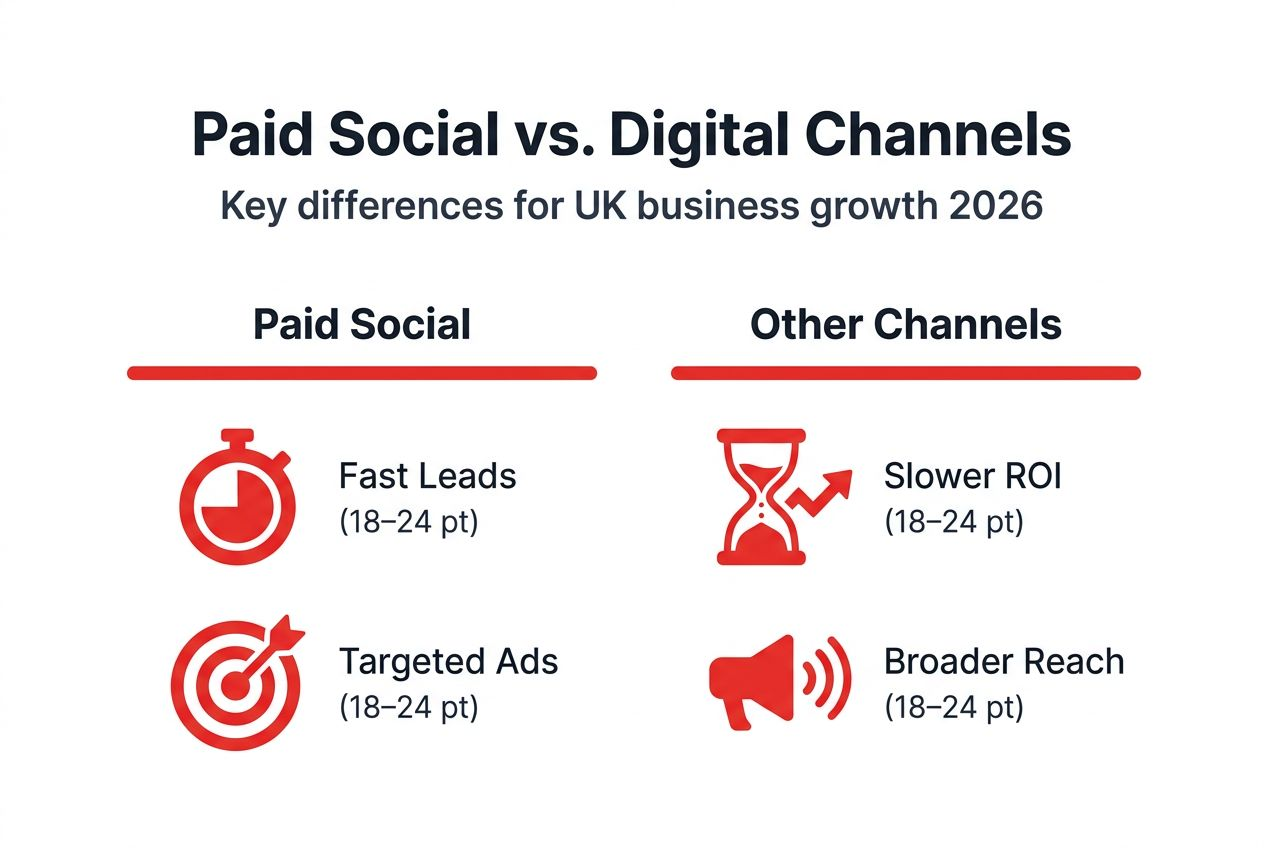
Lead generation speed differs significantly. Paid social offers highly precise targeting and real-time optimisation compared with Google PPC and SEO, delivering qualified leads faster than SEO but at a slightly slower pace than PPC. However, paid social prospects are often earlier in the buying journey, requiring nurturing.
Brand funnel positioning advantages of paid social shine at awareness and consideration stages. You introduce your brand to cold audiences and educate them on problems and solutions. PPC captures prospects already searching for solutions, while SEO builds authority across all stages over time.
Cost efficiency and scalability vary by channel:
- Paid social scales easily with budget increases and offers low entry costs.
- PPC costs fluctuate based on keyword competition, making some industries expensive.
- SEO requires upfront investment but delivers compounding returns without ongoing ad spend.
Complexity of campaign management is moderate for paid social. Platforms simplify setup, but optimisation requires ongoing testing and analysis. PPC demands keyword research and bid management, while SEO involves technical fixes and content creation.
Situational recommendations for combining channels:
- Use paid social for brand awareness and capturing leads early in the funnel.
- Deploy PPC to capture high-intent searches and immediate conversions.
- Build SEO for sustainable, long-term traffic and authority.
Most successful UK SMEs run integrated campaigns using all three channels strategically. Understanding SEO versus PPC dynamics and exploring SEO vs PPC UK lead generation helps you allocate budgets wisely across channels for maximum impact.
How paid social improves cost efficiency and return on investment
Paid social’s algorithmic optimisation and targeting capabilities reduce wasted spend and boost ROI systematically. Platforms use machine learning to deliver ads to users most likely to engage, click, or convert based on past behaviour.
Algorithm-driven ad delivery optimises audience targeting in real time. As campaigns run, algorithms analyse which demographics, interests, and behaviours produce the best results. Budgets automatically shift towards high-performing segments, reducing cost per acquisition over time.
Continuous optimisation in paid social lowers cost per acquisition and improves campaign effectiveness. This ongoing improvement happens without manual intervention, though regular monitoring accelerates results.
Reducing cost per acquisition through iterative improvements requires active engagement with analytics. Track which ad creatives, audiences, and placements drive conversions at the lowest cost. Pause underperforming variants and double down on winners.
Importance of monitoring analytics for campaign tuning cannot be overstated. Weekly reviews reveal trends, identify issues early, and inform strategic adjustments. Metrics to watch include:
- Click-through rate indicating ad relevance and creative effectiveness
- Conversion rate showing landing page and offer quality
- Cost per lead tracking budget efficiency and audience targeting accuracy
- Return on ad spend measuring overall campaign profitability
Benefits of scalable budgets matching business growth include flexibility and control. Start small during testing phases, scale successful campaigns during peak seasons, and reduce spend during slower periods without penalties or commitments.
Pro Tip: Use platform insights to reallocate spend mid-campaign. If Facebook outperforms Instagram, shift budget accordingly within days to maximise ROI without waiting for campaign end dates.
Scalability is a major advantage. A campaign generating leads at £5 each with a £300 monthly budget can scale to £3,000 monthly while maintaining similar costs, producing ten times more leads. This predictability helps forecast growth and plan capacity.
Paid social’s financial efficiency makes it accessible for UK SMEs at any growth stage. Learning more through paid social ads UK business resources can reveal advanced optimisation techniques for further improving ROI.
Integrating paid social with broader digital marketing strategies
Paid social delivers the best results when integrated with other channels like SEO, PPC, and CRM tools. This multichannel approach amplifies reach, nurtures leads more effectively, and increases conversions across the entire customer journey.
Synergy effects of combining paid social with SEO and PPC create comprehensive coverage. Paid social builds awareness and captures leads early in the funnel. SEO provides educational content that nurtures consideration. PPC captures high-intent searches when prospects are ready to buy. Together, these channels guide prospects from discovery to conversion seamlessly.
Multichannel integration increases lead conversion rates and overall marketing effectiveness. When prospects see consistent messaging across social ads, search results, and retargeting campaigns, trust builds faster and conversions increase.
CRM automation to nurture leads generated via social ads closes the loop. When someone submits a lead form on Facebook, your CRM can trigger an immediate email, schedule a follow-up call, and add them to a nurturing sequence automatically. This reduces response time and prevents leads from going cold.
Practical tips for coordinating messaging across channels:
- Use consistent brand voice, visuals, and value propositions across all platforms.
- Retarget website visitors from SEO and PPC campaigns with social ads to reinforce messaging.
- Share educational content created for SEO through paid social to extend reach.
- Track customer journeys across channels to understand which touchpoints drive conversions.
How integration improves overall marketing ROI becomes clear when measuring holistic performance. A prospect might discover your brand through a paid social ad, research your services via organic search, and convert through a PPC ad days later. Attribution across channels reveals the true value of each touchpoint.
Examples of successful multichannel campaigns for SMEs include a UK plumbing company that used paid social for awareness, SEO for local search visibility, and PPC for emergency callouts. Their integrated approach doubled leads within six months while reducing overall cost per acquisition by 30%.
Exploring PPC role lead generation guide and lead nurturing business customers strategies helps you understand how channels complement each other for maximum impact. Understanding broader digital marketing fashion trends can also provide inspiration for creative integrated campaigns.
Conclusion: making paid social work for your UK business
Paid social advertising offers UK SMEs a fast, measurable way to boost brand visibility and generate qualified leads without breaking the bank. By combining precise targeting, scalable budgets, and real-time optimisation, it outpaces organic social and complements SEO and PPC effectively.
Set clear objectives before launching campaigns. Define your target audience, desired actions, and budget limits. Start small to test messaging and targeting, then scale successful campaigns as data proves effectiveness.
Choosing the right agency or platform support accelerates success. Experienced partners help you avoid common mistakes, optimise faster, and achieve better returns. However, basic campaigns can be managed in-house using platform tools and resources.
Include paid social in your marketing mix for growth in 2026. It’s no longer optional for businesses serious about competing online. The accessibility, transparency, and results make it one of the highest-value channels available.
Actionable tips for planning initial campaigns:
- Allocate a test budget of £150 to £300 for your first 30 days.
- Define one clear goal such as lead generation or website traffic.
- Create three ad variants to test different messages and visuals.
- Monitor performance weekly and adjust targeting based on results.
- Integrate leads into your CRM for immediate follow-up.
Exploring resources like paid social ads UK business provides deeper insights into campaign strategy and execution for sustained growth.
Boost your paid social success with expert support
Bamsh Digital Marketing specialises in paid social advertising and PPC management for UK SMEs, helping businesses like yours achieve measurable growth without wasted spend. We design campaigns that target your ideal customers, generate qualified leads, and scale as your business grows.
Our team manages every aspect of your paid social ads UK business campaigns, from audience research and creative development to ongoing optimisation and transparent reporting. You’ll always know where your budget goes and what results it delivers.
We focus on scalable, budget-conscious strategies tailored to your goals. Whether you’re starting with £5 per day or scaling to thousands monthly, we ensure every pound works hard for your business. Our PPC management UK businesses services complement paid social perfectly, creating integrated campaigns that cover awareness, consideration, and conversion.
Ready to boost your brand visibility and generate more leads in 2026? Contact Bamsh today for a personalised digital marketing plan that combines pay per click PPC and paid social strategies designed for your success.
FAQ
What is paid social advertising?
Paid social advertising means paying to promote content on social platforms to targeted users to increase reach and engagement. It uses precise targeting and bid-based systems to show adverts to specified audience segments, ensuring your message reaches people most likely to care about your offer.
How much does paid social advertising cost for small businesses?
Many UK SMEs can start paid social campaigns with as little as £5 per day. Costs vary based on targeting, objectives, and competition but can be scaled to match your budget. Daily caps give you total control over spend, allowing you to test and grow gradually.
Can I measure the return on investment from paid social adverts?
Paid social platforms offer built-in analytics to track impressions, clicks, and conversions in real time. ROI measurement helps optimise campaigns and justify marketing spend by showing exactly which adverts and audiences deliver the best results at the lowest cost.
Is paid social advertising difficult to manage without expert help?
Platforms have user-friendly interfaces, and various resources help beginners start campaigns confidently. While expert help can improve results through advanced optimisation and strategy, small businesses can run basic campaigns themselves using guided setup tools and platform tutorials.