

Measuring marketing ROI remains one of the toughest challenges for UK small and medium businesses in 2026. With customers interacting across multiple channels, from AI chatbots to phone calls to social media, pinpointing which efforts actually drive revenue feels impossible. You invest in SEO, run paid ads, post on social platforms, yet struggle to prove what works. This guide delivers practical, step-by-step strategies to track your marketing ROI accurately across all touchpoints, helping you make smarter decisions and maximise every pound spent on marketing.
Table of Contents
- Understanding Marketing ROI And Its Challenges In 2026
- Preparing To Track Your Marketing ROI: What You Need
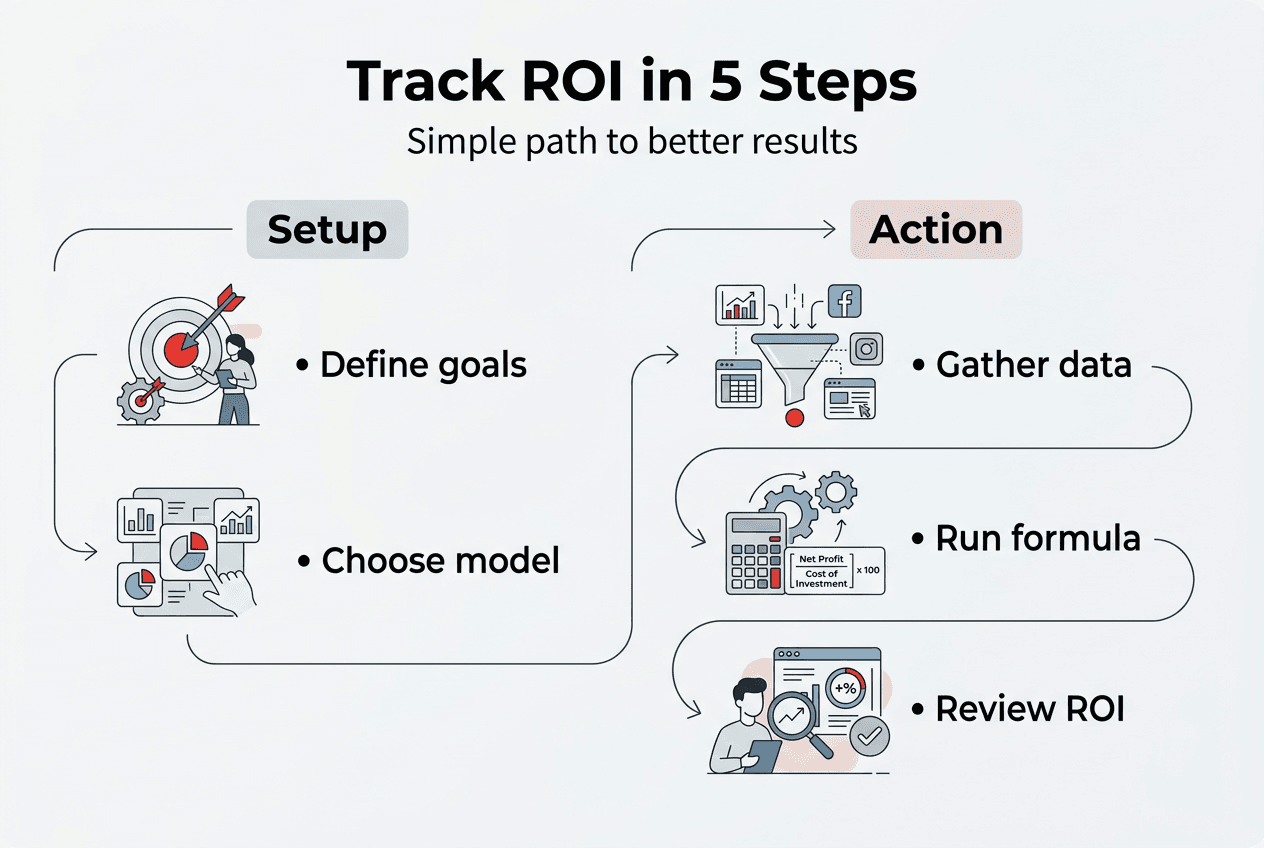
- Step-By-Step Process To Track And Measure Marketing ROI Accurately
- Common Mistakes To Avoid And Troubleshooting Tips
- Verifying Results And Using Insights To Improve Marketing ROI
- Boost Your Marketing With Expert Digital Services
- FAQ
Key takeaways
| Point | Details |
|---|---|
| ROI requires integrated data | Combine online analytics with offline interactions like calls and visits for complete visibility |
| Attribution models matter | Choose multi-touch or time-decay models instead of last-click to capture the full customer journey |
| Regular reviews drive improvement | Update tracking methods quarterly to accommodate new channels and evolving customer behaviour |
| Data quality determines accuracy | Ensure consistent integration across CRM, analytics, and tracking tools for reliable ROI calculations |
Understanding marketing ROI and its challenges in 2026
Marketing ROI measures the revenue generated from your marketing activities compared to what you spent. For UK SMBs, understanding this metric separates profitable campaigns from money pits. Every pound matters when you’re competing against larger brands with deeper pockets.
Today’s customer journeys involve far more complexity than a simple Google search leading to a purchase. Someone might discover you through an Instagram advert, research on your website, call your office with questions, revisit via a retargeting campaign, then finally convert weeks later. Customer journeys in 2026 aren’t linear, they’re symphonies of interactions across platforms.
UK businesses face specific hurdles tracking ROI accurately:
- Integrating AI-driven interactions with traditional digital channels creates data silos
- Offline touchpoints like phone enquiries often go unmeasured
- Most analytics platforms default to last-click attribution, ignoring earlier crucial touchpoints
- Privacy regulations limit tracking capabilities across devices
The problem intensifies when you run multi-channel marketing campaigns. A potential customer might engage with your brand seven or eight times before buying. If you only credit the final click, you’re making decisions based on incomplete information. You might kill a Facebook campaign that actually introduced hundreds of prospects to your brand, simply because it rarely gets the final click.
“In 2026, the question isn’t just ‘did we get a sale?’ but ‘which specific interaction across AI, offline calls, and digital touchpoints actually contributed to revenue?’”
Moving beyond simplistic attribution models becomes essential. You need systems that recognise every meaningful interaction, whether it happens on your website, through an AI chat, or during a phone conversation with your sales team. Only then can you accurately assess which marketing investments deserve more budget and which need rethinking.
Preparing to track your marketing ROI: what you need
Before diving into ROI tracking, you need the right foundation. Attempting to measure marketing performance without proper preparation wastes time and produces unreliable data.
Start by mapping every channel and touchpoint where customers interact with your business. This includes obvious digital channels like your website, Google Ads, and social media, but also offline elements such as phone calls, physical locations, and even AI-powered chat systems. Missing channels means missing attribution data.
Next, gather the essential tracking tools:
- A robust CRM system to capture and store customer interaction data
- Call tracking software that attributes phone enquiries to specific marketing sources
- Web analytics platforms like Google Analytics for digital behaviour tracking
- Marketing automation tools that monitor email and nurture campaign performance
- Dashboard software to consolidate data from multiple sources
Your tracking infrastructure must connect these tools. Data-driven marketing depends on integration. When your CRM doesn’t talk to your analytics platform, you lose the thread connecting awareness to conversion.
Set clear, measurable objectives before tracking anything. Vague goals like “increase brand awareness” don’t translate to ROI calculations. Instead, define specific outcomes such as “generate 50 qualified leads per month” or “achieve £5 revenue for every £1 spent on PPC.” These concrete targets make ROI measurement meaningful.
Data quality determines everything. Inconsistent naming conventions, duplicate records, and incomplete customer profiles corrupt your ROI calculations. Establish data entry standards and audit your systems regularly. An SEO audit report approach works for data quality too, systematically checking for issues and fixing them.
Pro Tip: Schedule monthly data quality checks where you verify that tracking codes fire correctly, CRM integrations sync properly, and phone numbers route through call tracking. Catching technical failures early prevents months of lost attribution data.
Consider how specific interactions across AI, offline calls, and digital touchpoints contribute to revenue. Your preparation phase should account for every possible customer interaction method, ensuring nothing falls through the cracks when you start measuring.
Step-by-step process to track and measure marketing ROI accurately
With preparation complete, follow this systematic approach to track marketing ROI effectively.
Step 1: Define conversion actions clearly
Decide which customer actions count as valuable conversions. For some businesses, this means completed purchases. For others, it includes form submissions, phone calls lasting over two minutes, or appointment bookings. Be specific about what qualifies.
Step 2: Select the right attribution model
Your attribution model determines how credit gets distributed across touchpoints. The table below compares common models:
| Attribution model | How it works | Best for |
|---|---|---|
| Last-click | Credits only the final interaction before conversion | Simple, short sales cycles with single touchpoint journeys |
| First-click | Credits only the initial interaction that introduced the customer | Understanding which channels drive awareness effectively |
| Linear | Distributes credit equally across all touchpoints | Valuing every interaction in multi-step journeys |
| Time-decay | Gives more credit to interactions closer to conversion | Recognising that recent touches matter more |
| Position-based | Credits first and last interactions more heavily | Balancing awareness and conversion contributions |
Most UK SMBs benefit from multi-touch models that acknowledge multiple interactions across AI, offline calls, and digital touchpoints. Your customer journey complexity should guide this choice.
Step 3: Collect and integrate comprehensive data
Gather interaction data from every source. Your analytics platform tracks website visits and digital conversions. Call tracking software logs phone enquiries and attributes them to marketing sources. Your CRM records sales conversations and deal values. AI chat systems capture automated interactions.
Integration matters enormously here. When a prospect clicks your Google Ad, visits your site, chats with your AI assistant, then calls your office, you need one unified record connecting these events to the eventual sale.

Step 4: Calculate ROI using consistent formulas
The basic ROI formula is straightforward: (Revenue from Marketing – Marketing Cost) / Marketing Cost × 100. A campaign costing £1,000 that generates £5,000 in revenue delivers 400% ROI.
Apply this consistently across channels. Track retargeting strategies’ ROI separately from cold acquisition campaigns. Break down results by channel, campaign, and even individual adverts when possible.
Step 5: Analyse and optimise based on findings
Use your ROI data to make informed decisions. Channels delivering strong returns deserve more budget. Underperforming campaigns need adjustment or elimination. Look beyond simple ROI numbers to understand why certain approaches work better.
Pro Tip: Create a monthly ROI scorecard comparing all active channels. Include not just ROI percentages but also total revenue contributed, cost per acquisition, and customer lifetime value. This comprehensive view prevents you from over-investing in channels with high ROI but low volume.
Remember that measuring website ROI extends beyond immediate conversions. Some marketing activities build long-term value that doesn’t show up in monthly reports. Balance short-term ROI optimisation with strategic brand building.
Common mistakes to avoid and troubleshooting tips
Even with solid preparation, UK SMBs frequently stumble when tracking marketing ROI. Recognising these pitfalls helps you avoid them.
Ignoring offline data ranks among the most damaging mistakes. Phone calls often represent your highest-value enquiries, yet many businesses never connect them to marketing sources. Someone might click your PPC advert, grab your number, and call directly. Without call tracking, you credit nothing for that conversion, potentially cutting a profitable channel.
Relying solely on last-click attribution severely distorts reality. Customer journeys aren’t linear, they involve multiple research phases. Your SEO content might introduce prospects, social media builds trust, then a branded search converts them. Last-click attribution credits only that final branded search, suggesting you should cut SEO and social despite their crucial roles.
Poor data integration creates incomplete pictures. When your CRM doesn’t sync with analytics, you can’t connect website behaviour to closed deals. You see leads but can’t trace them back to specific marketing sources. This forces guesswork instead of data-driven decisions.
Additional common errors include:
- Failing to account for customer lifetime value, only measuring first purchase
- Not tracking assisted conversions that contribute without getting final credit
- Comparing channels with different sales cycle lengths unfairly
- Ignoring seasonality when evaluating campaign performance
- Setting unrealistic timeframes for ROI assessment
Troubleshooting tip: When ROI numbers seem off, verify your tracking setup first. Check that conversion tracking fires correctly, attribution windows match your sales cycle, and data flows between systems properly. Test by creating a conversion yourself and following it through your entire tracking infrastructure.
Regularly reviewing and adjusting tracking methods prevents staleness. Marketing channels evolve constantly. New platforms emerge, customer behaviour shifts, privacy regulations change. Your 2025 tracking setup might miss crucial 2026 interactions. Quarterly audits catch these gaps before they corrupt months of data.
Avoid the temptation to constantly change attribution models seeking better numbers. Pick one model, stick with it for at least six months, and focus on improving actual performance rather than gaming the measurement system. Consistency enables meaningful period-over-period comparisons.
For complex digital marketing calculations, consider professional guidance. Attempting sophisticated multi-touch attribution without proper expertise often produces misleading results that drive poor decisions.
Verifying results and using insights to improve marketing ROI
Tracking ROI means nothing if you don’t verify accuracy and apply insights strategically.
Cross-check your ROI calculations against multiple data sources. Your analytics platform might show 100 conversions whilst your CRM records 95 sales. Investigate discrepancies rather than ignoring them. Common causes include tracking code failures, duplicate records, or definition mismatches between systems.
Validation methods include:
- Comparing total marketing spend against total attributed revenue across all channels
- Reconciling CRM deal values with analytics conversion values
- Spot-checking individual customer journeys from first touch to purchase
- Running test conversions through your tracking infrastructure
Dashboards and reporting tools enable continuous monitoring without manual data compilation. Set up automated reports showing key ROI metrics weekly or monthly. Modern platforms can alert you when performance drops below thresholds, enabling quick responses to problems.
Apply insights systematically to improve results. When specific interactions across AI, offline calls, and digital touchpoints reveal patterns, adjust your strategy accordingly. If phone enquiries from PPC convert at 40% whilst web form leads convert at 15%, optimise campaigns to drive more calls.
The table below shows different optimisation approaches based on ROI insights:
| Insight discovered | Optimisation approach | Expected benefit |
|---|---|---|
| One channel has high ROI but low volume | Increase budget allocation to scale winning channel | Proportional revenue growth with proven efficiency |
| Multiple touchpoints needed before conversion | Implement nurture sequences bridging awareness to sale | Higher conversion rates from early-stage leads |
| Certain customer segments deliver better ROI | Refine targeting to focus on high-value segments | Lower acquisition costs and higher lifetime value |
| Offline interactions boost digital conversion rates | Integrate call follow-up into digital campaigns | Improved overall conversion and customer experience |
Reallocate budget towards highest-performing channels, but maintain some diversification. Over-concentrating in one channel creates vulnerability when that channel’s performance shifts.
Pro Tip: Align your marketing improvements with evolving customer journey behaviours revealed by your data. If you notice prospects increasingly researching on mobile before calling, optimise your mobile experience and ensure click-to-call functionality works flawlessly.
Tracking revenue growth through digital marketing requires patience. Some optimisations show immediate results whilst others take months to compound. Maintain consistent measurement whilst testing improvements, creating a cycle of continuous refinement.
Document what you learn and share insights across your team. When everyone understands which marketing activities drive real results, better decisions happen at every level. Your sales team can prioritise leads from high-converting sources. Your content team can focus on topics that attract qualified prospects.
Boost your marketing with expert digital services
Tracking marketing ROI accurately requires the right tools, expertise, and ongoing optimisation. Many UK SMBs find that professional support accelerates results whilst avoiding costly mistakes.
Bamsh specialises in helping businesses like yours measure and improve marketing performance. Our DIY SEO tool empowers you to optimise your website for better organic visibility, whilst our PPC management for UK businesses ensures every pound spent on paid advertising delivers maximum return. We provide transparent reporting that shows exactly how your marketing investments perform.
Our social media services integrate seamlessly with your broader marketing strategy, ensuring consistent tracking across all channels. We set up proper attribution, connect your data sources, and deliver clear insights you can actually use to grow your business. Whether you need help implementing tracking infrastructure or want expert management of your campaigns, we’re here to support your success.
FAQ
How do I choose the best attribution model for my business?
Your attribution model choice depends on customer journey complexity and available data quality. Businesses with simple, short sales cycles where customers typically convert on first visit can use last-click attribution effectively. However, most UK SMBs benefit from multi-touch models like linear or time-decay that recognise multiple interactions before purchase. Start with a model matching your typical customer journey length, then refine based on what your data reveals about actual buying patterns.
Can offline interactions like calls be included in ROI tracking?
Absolutely, and you should definitely include them for accurate ROI measurement. Call tracking software assigns unique phone numbers to different marketing sources, allowing you to attribute phone enquiries to specific campaigns. Integration with your CRM connects these calls to eventual sales, completing the attribution picture. This proves especially important for service businesses where phone conversations often represent the highest-value enquiries and strongest purchase intent.
What tools help small businesses track marketing ROI effectively?
Essential tools include Google Analytics for website behaviour tracking, call tracking platforms like CallRail or ResponseTap, and CRM systems such as HubSpot or Salesforce. Marketing automation platforms help track email campaign performance and lead nurturing effectiveness. The key is integration, use tools that connect with each other to create unified customer journey records. Many UK SMBs benefit from dashboard software like Databox or Klipfolio that consolidates data from multiple sources into single, easy-to-understand reports.
How often should I review and update my ROI tracking methods?
Review your tracking setup quarterly at minimum, with major updates whenever you launch new marketing channels or notice significant customer behaviour changes. Technology evolves rapidly, privacy regulations shift, and new platforms emerge constantly. Regular audits ensure your tracking captures current reality rather than outdated patterns. Additionally, validate data accuracy monthly by spot-checking conversions and verifying that tracking codes fire correctly across all platforms and campaigns.