
TL;DR:
- Content clarity involves straightforward communication that ensures immediate understanding by audiences and directly impacts conversions and trust. Many businesses confuse content quantity with clarity, but fragmented messaging reduces engagement and brand authority. Building a clear content strategy centered on a consistent central message enhances recognition, reduces confusion, and improves measurable results.
Content clarity is the practice of communicating your message in a way that is straightforward, unambiguous, and immediately understood by your audience. For business owners and marketing professionals, this is not a stylistic preference. It is a strategic decision that directly affects leads, conversions, and revenue. When your content confuses people, they leave. When it speaks plainly, they stay, trust you, and buy. Understanding why content clarity matters is the first step to fixing the single biggest problem most business websites have.
Why content clarity matters for your bottom line
Most businesses assume their content problem is volume. They think they need more blog posts, more social updates, more pages. The reality is different. Most websites do not have a content problem. They have a clarity problem. Fragmented, unfocused messaging confuses visitors and dilutes brand authority, regardless of how much content you publish.
The cost of unclear content is real and measurable. Confusion increases cognitive load, killing attention faster than boredom and directly reducing engagement and conversions. When a visitor lands on your page and cannot immediately understand what you do or why it matters to them, they click away. That is a lost lead, and it happens in seconds.
Here is what unclear content does to your business:
- Drops conversion rates. Visitors who cannot quickly understand your offer will not enquire or buy.
- Erodes brand trust. Confusing messaging signals a lack of confidence or expertise.
- Wastes ad spend. Paid traffic sent to unclear landing pages produces poor returns.
- Reduces audience retention. People do not share or return to content they found hard to follow.
Pro Tip: Review your top five landing pages and ask one person outside your industry to explain what each page is offering. If they struggle, your clarity needs work.
Nile Gomez, a digital marketing strategist, emphasises that unclear messaging leads to costly low engagement and that clarity outperforms clever wordplay in every campaign. That is not an opinion. It is a pattern seen across industries.
What are the key principles behind clear content?
The science of clear communication is well established. Two frameworks stand out for marketers: Cognitive Load Theory and Hick’s Law. Understanding both will change how you write and structure every piece of content you produce.
Cognitive Load Theory states that the human brain has a limited capacity to process new information at once. When your content overloads that capacity with jargon, long sentences, or too many competing ideas, comprehension drops. The reader disengages. Applying Cognitive Load Theory requires rigorous editing to limit information to essentials and design messaging with a single, clear call to action per touchpoint.
Hick’s Law adds another dimension. The more choices you present to someone, the longer they take to decide. Complex choice architectures increase decision time logarithmically. In practical terms, this means a page with five calls to action will convert worse than a page with one. Simplicity is not laziness. It is precision.
The W3C Web Accessibility Initiative reinforces these principles from an accessibility standpoint. Clear, understandable language with short sentences and simple tense improves digital accessibility for a wide user base. White spacing and small content chunks reduce the effort required to read and process your message.
Three principles to apply immediately:
- One idea per paragraph. Do not stack multiple points into a single block of text.
- One call to action per page. Give your reader one clear next step, not a menu of options.
- Plain language first. Use the simplest word that accurately conveys your meaning.
“Clarity is not dumbing down your message. It is respecting your reader’s time enough to get to the point.”
Pro Tip: After writing any piece of content, read it aloud. If you stumble or pause, that sentence needs rewriting.
How do you build a content clarity strategy?
A content clarity strategy is a structured approach to defining what you say, how you say it, and how consistently you say it across every channel. Marketing consultant Martina Manca highlights that structural clarity in content builds a recognisable brand presence, turning scattered posts into a cohesive system. Without that structure, even good writing feels random.

The foundation is your central message. This is the single most important thing your audience needs to understand about your business. Everything else, every blog post, every social update, every email, should connect back to that central message. When your content is connected, it builds depth and visibility over time rather than creating noise.
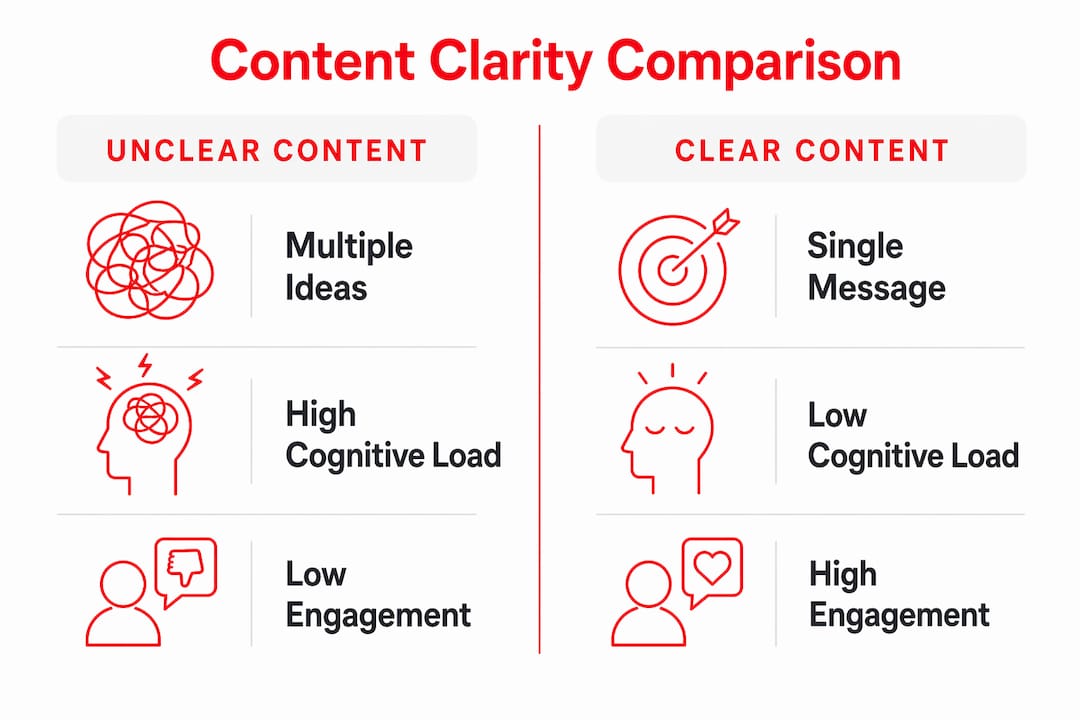
Here is how clarity and confusion compare in practice:
| Approach | Unclear Content | Clear Content |
|---|---|---|
| Messaging focus | Multiple competing ideas | One central message per piece |
| Call to action | Several options on one page | One specific next step |
| Language style | Jargon-heavy, complex sentences | Plain language, short sentences |
| Brand recognition | Fragmented, inconsistent | Consistent, recognisable |
| Audience response | Confusion, low engagement | Understanding, higher conversions |
Connected content expands depth and visibility over time and reduces fragmentation. This is why businesses that plan their content around clear pillars consistently outperform those that publish reactively.
To measure whether your clarity strategy is working, track these signals:
- Time on page. Longer dwell time suggests readers are following and engaging with your content.
- Bounce rate. A high bounce rate on key pages often signals a clarity problem, not a traffic problem.
- Enquiry quality. When your messaging is clear, the leads you attract already understand what you offer.
Pro Tip: Build a simple content pillar document. List your three to five core topics, then map every piece of content you create back to one of them. If a piece does not fit, question whether you should publish it.
You can also optimise your content creation process by building templates and frameworks around your central messages, which makes producing clear content faster and more consistent.
What are the most common content clarity mistakes?
The most common mistake is trying to say everything at once. Lack of clarity often stems from trying to cover too much in a single piece, which confuses users and dilutes brand authority. Successful content comes from removing noise and prioritising key messages.
Here are the mistakes that undermine clarity most often:
- Overloading with information. Every extra point you add competes with your main message for attention. Cut ruthlessly.
- Mixed messaging across channels. If your website says one thing and your social media says another, your audience will not know what to believe.
- Prioritising cleverness over comprehension. Witty headlines and elaborate wordplay can generate buzz, but clear messaging beats clever messaging in every competitive market when it comes to converting prospects into customers.
- Burying the main point. Many business owners write long preambles before getting to what they actually offer. Your audience will not wait. Lead with the answer.
- Ignoring the reader’s perspective. Content written from the inside out, focused on what you want to say rather than what your reader needs to know, almost always lacks clarity.
Simplifying complex information does not mean losing depth. It means presenting depth in a way that is accessible. A solicitor can explain a complex legal process in plain English without losing accuracy. A software company can describe a technical product without alienating non-technical buyers. The skill is in the structure, not the vocabulary.
Pro Tip: Apply the “so what?” test to every paragraph. After each point, ask yourself: “So what does this mean for my reader?” If you cannot answer that in one sentence, the paragraph needs rewriting.
Brands that prioritise clarity over cleverness convert at higher rates because clear and direct messages reduce buyer anxiety and build trust. That is the commercial case for plain language, and it is backed by results, not theory. You can explore the importance of clear marketing for UK SMEs to see how this plays out in practice.
Key takeaways
Content clarity is the single most effective lever for improving audience engagement, conversion rates, and brand trust across every channel.
| Point | Details |
|---|---|
| Clarity beats volume | Publishing more content without clear messaging produces no traction and confuses your audience. |
| Cognitive Load Theory applies | Limit information per page and use one call to action to improve comprehension and response. |
| Strategy requires structure | Define central messages and map all content back to them to build recognition over time. |
| Cleverness costs conversions | Clear, direct messaging reduces buyer anxiety and converts at higher rates than clever wordplay. |
| Measure clarity outcomes | Track time on page, bounce rate, and enquiry quality to identify and fix clarity problems. |
The hard truth about content that most marketers miss
I have worked with hundreds of businesses over the years, and the pattern is almost always the same. A business owner comes to us convinced they need more content. More blogs, more posts, more pages. When we dig into their existing content, the problem is never volume. It is almost always that nobody can tell, within ten seconds of landing on their site, exactly what the business does and who it is for.
That is a clarity problem. And it is far more damaging than most people realise.
Here is what I have found that most marketing advice gets wrong: clarity is treated as a writing skill when it is actually a thinking skill. Before you can write clearly, you have to think clearly about what you are trying to say and why it matters to your reader. Most businesses skip that step entirely. They write from the inside out, describing their services in the language they use internally, rather than in the language their customers actually use when they are searching for a solution.
The businesses I have seen grow fastest are not the ones with the most content. They are the ones with the clearest message. They know exactly who they serve, what problem they solve, and what they want the reader to do next. Every piece of content they produce reinforces that. There is no noise, no filler, no content for content’s sake.
The uncomfortable truth is that removing content is often more effective than adding it. Cutting a confusing page, simplifying a cluttered homepage, or replacing a clever tagline with a plain description of what you do can produce better results than months of new content production. I have seen it happen repeatedly.
If you want your content to work harder, start by making it clearer. That is not a compromise. It is the strategy. You might also find it worth reviewing when your brand messaging needs a refresh to identify whether your current content is still serving your audience or working against you.
— Martyn
How Bamsh uses content clarity to drive real business results
At Bamsh, clarity is not just something we write about. It is the foundation of every service we deliver. Clear content is also the engine behind Answer Engine Optimisation (AEO), which determines whether your business appears in AI tools like ChatGPT, Gemini, and Google’s AI Overviews. AI systems cite content that is direct, well-structured, and unambiguous. Vague or cluttered content is simply ignored.
If you want to boost your visibility through AEO, the starting point is always content clarity. Bamsh helps UK businesses build content strategies that are clear, consistent, and built to be found. Whether you are starting from scratch or refining what you already have, we make the process straightforward and the results measurable. Find out how to optimise for AEO and start turning your content into a lead-generating asset.
FAQ
What is content clarity in marketing?
Content clarity is the practice of communicating a message in plain, direct language that your audience understands immediately. It removes ambiguity, reduces cognitive load, and makes it easier for readers to take the action you want them to take.
How does unclear content affect conversions?
Unclear content increases cognitive load, which causes visitors to disengage and leave before converting. Clear, direct messaging reduces buyer anxiety and builds the trust needed to turn a visitor into an enquiry or sale.
Does clarity mean oversimplifying your message?
No. Clarity means presenting your message at the right level for your audience, using plain language and logical structure. You can communicate complex ideas clearly without losing accuracy or depth.
How do you measure content clarity?
Track time on page, bounce rate, and the quality of enquiries you receive. If visitors leave quickly or your leads arrive confused about what you offer, your content clarity needs attention.
Why does clear messaging outperform clever messaging?
Clear messaging signals confidence and a sharp understanding of customer needs. Clever messaging may attract attention but risks losing prospects who cannot quickly understand the value being offered.