
TL;DR:
- An effective content process is essential for consistent lead generation and measurable growth. Implementing a structured workflow and preparing your business beforehand enhances content quality, collaboration, and ROI. Small and medium enterprises can outperform larger competitors by focusing on discipline, automation, and continuous improvement.
If you’re producing blog posts, social updates, and email campaigns but still not seeing consistent leads or measurable growth, the problem probably isn’t your content quality. It’s your process. Content marketing generates 3x more leads at 62% lower cost than traditional marketing, yet most small and medium businesses in the South West are leaving that value on the table simply because they’re working without a repeatable system. This guide gives you a practical, proven framework to fix that.
Table of Contents
- Why an optimised content creation process matters
- Preparing your business for content success
- Step-by-step content creation workflow that delivers
- Troubleshooting and refining your process for better outcomes
- Why the right process matters more than the fanciest content tools
- Build your marketing edge with expert support
- Frequently asked questions
Key Takeaways
| Point | Details |
|---|---|
| Document your process | A documented content creation strategy consistently outperforms ad-hoc efforts and reduces wasted resources. |
| Prep before you create | Setting goals, clarifying roles, and having the right tools in place boosts campaign success and quality. |
| Follow a reliable workflow | Structured steps from ideation to distribution make content production efficient and results easier to track. |
| Refine and measure regularly | Reviewing and adjusting your process based on ROI ensures ongoing improvement in marketing performance. |
Why an Optimised Content Creation Process Matters
Let’s be honest. Most SMEs produce content reactively. Someone suggests a blog post on Monday, it gets written by Thursday with no clear brief, published the following week with no distribution plan, and forgotten about within a month. Sound familiar? That cycle wastes time, demoralises your team, and produces results that are impossible to measure or improve.
The good news is that documented processes change everything. According to B2B content marketing research, 97% of the most effective B2B marketers have a documented content creation strategy, with 61% reporting improvement through strategy refinement, team changes, and adoption of new technology. The pattern is clear: structure produces results. Yet only 47% of B2B marketers have a documented strategy at all. That gap is your competitive opportunity.
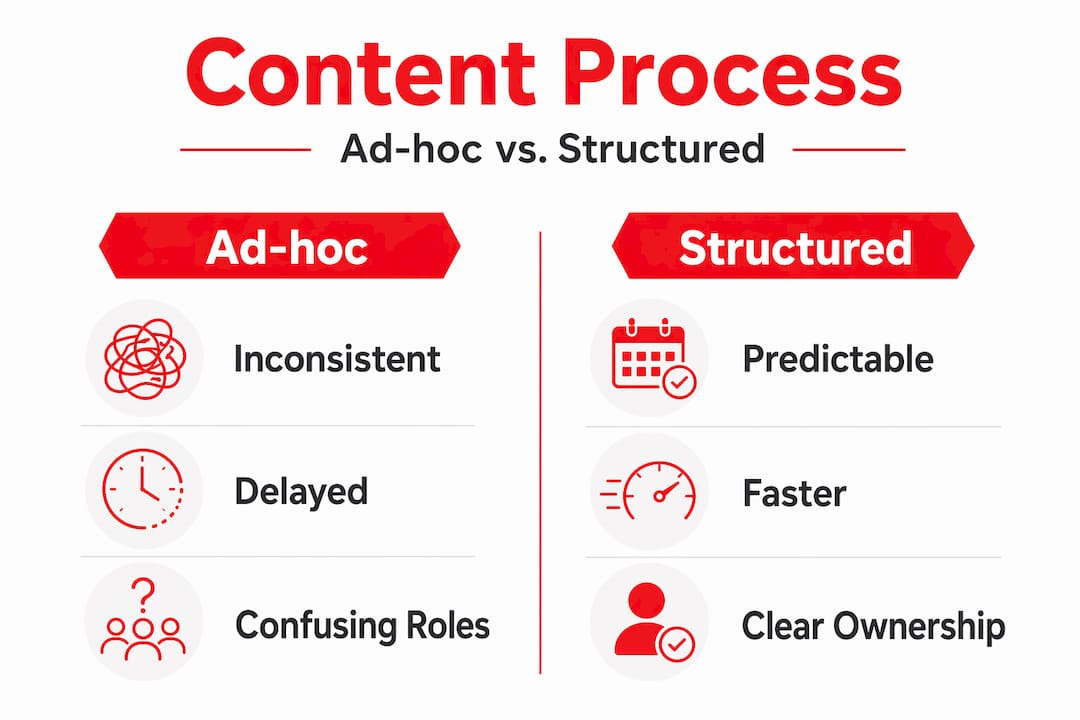
Here’s a simple comparison to illustrate what’s actually at stake:
| Factor | Ad-hoc content process | Structured content process |
|---|---|---|
| Time to publish | Unpredictable | Consistent and planned |
| Content quality | Varies widely | Standardised and improving |
| Team collaboration | Siloed and reactive | Clear roles and handoffs |
| Lead generation | Inconsistent | Measurable and scalable |
| Cost efficiency | Higher per piece | Lower through reuse and batching |
| Performance measurement | Rarely tracked | Built into the workflow |
Adopting a content marketing process from the outset gives your team a shared language, reduces rework, and makes it far easier to spot what’s working. Pairing that with a solid content marketing checklist ensures nothing critical gets skipped between ideation and publication. Tools like Markbin can also help you document and organise your content assets so nothing gets lost between team members.
Having established why effective content creation matters, the next step is ensuring your business is set up for success before you even start producing content.
Preparing Your Business for Content Success
Before any content gets written, you need the right foundations in place. Skipping this step is like starting a building project without drawing up plans. You might make progress initially, but cracks will appear quickly.

Start by defining what you actually want content creation to achieve. Awareness? Lead generation? Customer retention? Each goal requires a different type of content and a different success metric. Without this clarity, your team will pull in different directions and produce content that satisfies no one.
Top challenges for B2B content marketers include creating engaging content (40%), resource constraints (39%), and measuring effectiveness (33%). These aren’t unique to large organisations. They’re exactly the pressures South West SMEs face daily. The answer isn’t more budget. It’s better preparation.
Here’s what needs to be in place before you produce a single piece of content:
Essential roles, tools, and their impact
| Role | Responsibility | Recommended tool |
|---|---|---|
| Content lead | Strategy, tone, approval | Notion, Trello |
| Writer or copywriter | Drafting and editing | Google Docs, Grammarly |
| Designer | Visuals, formatting | Canva, Adobe Express |
| Distribution manager | Scheduling and publishing | Buffer, Later |
| Analyst | Performance tracking | Google Analytics 4 |
You don’t need five separate people to fill these roles. In many SMEs, one or two people wear multiple hats. The important thing is that each responsibility is assigned, not assumed.
Key areas for resource and budget allocation:
- Writers and copywriters (in-house or freelance)
- Design assets and brand templates
- AI tools for research, ideation, and drafting support
- Analytics platforms for tracking performance
- Editorial calendar software for planning and coordination
Pro Tip: Keep your role assignments documented and revisit them quarterly. As your team changes, responsibilities can drift without anyone noticing, leading to bottlenecks and missed deadlines.
The content marketing steps that drive lead generation all depend on this preparation phase. And building a clear content marketing workflow around these roles transforms preparation from a one-off exercise into a repeatable system.
With your foundational setup in place, you’re ready to put structure around the actual content creation, from brainstorming through to publication.
Step-by-step Content Creation workflow that delivers
A solid workflow removes guesswork from content creation. Every piece your team produces should follow the same logical path. Here’s a seven-step process that works reliably for SMEs:
-
Ideation — Gather topic ideas based on audience questions, keyword research, competitor gaps, and sales team feedback. Aim to build a rolling ideas backlog so you’re never starting from scratch.
-
Outlining — Before any writing begins, create a brief. This should include the target keyword, audience intent, key messages, call to action, and desired outcome. A good brief prevents rewrites.
-
Assignment — Assign the brief to the right writer or team member with a clear deadline. Include any brand voice guidelines and examples of similar content that hit the mark.
-
Drafting — The writer produces the first draft following the brief. This is where AI tools genuinely add value. 86.4% of marketers now use AI for content creation, with personalised content (48.57%) and automation (47.38%) topping the list of effective strategies. AI can accelerate ideation and structure, but a human must review the final output to ensure accuracy and brand alignment.
-
Review and editing — This stage is about quality assurance, not rewriting. Use a checklist: does it match the brief? Is the tone right? Is the call to action clear? Are internal and external links included?
-
Distribution — Publishing is not the endpoint. Plan how each piece will be shared: which social channels, whether it will feature in an email newsletter, and whether paid promotion is warranted. Great content creation with no distribution is invisible.
-
Measurement — Within two to four weeks of publication, review performance data. What traffic did it generate? Did it contribute to enquiries or conversions? Use this data to inform future briefs.
Pro Tip: Leverage AI tools for ideation and first drafts, but always keep the final review human. AI cannot replicate your brand voice, local knowledge, or nuanced understanding of your customers.
“Modular content creation allows you to reuse assets, saving time and increasing return on investment.”
This is especially powerful for SMEs. A single well-researched blog post can become a social carousel, an email sequence, a short video script, and a lead magnet. Understanding content marketing fundamentals helps you build content that stretches further.
Pairing this workflow with marketing automation tools means your distribution and follow-up happen consistently without manual effort. For SMEs using social media as a primary channel, AI chatbots can even extend the life of your content creation by handling follow-up questions automatically.
Following the workflow can still go awry if common errors creep in. Here’s what to watch for and how to keep improving.
Troubleshooting and refining your process for better outcomes
Even a well-designed workflow breaks down under real-world pressure. Knowing where the common failure points are means you can spot problems early and fix them before they derail a campaign.
Common bottlenecks to watch for:
- Approval delays — Content creation stalls in review because the decision-maker is too busy or the approval criteria aren’t clear. Fix this by setting a 48-hour review window and providing a simple approval checklist.
- Unclear briefs — Writers produce content creation that misses the mark because the brief was vague. Fix this by including a brief template and requiring sign-off before drafting begins.
- Weak distribution — Content is published but reaches almost no one. Fix this by building a distribution checklist into the workflow and scheduling promotion at the same time as you schedule writing.
- Poor measurement — Teams track page views but not conversions or lead quality. Fix this by defining success metrics before you publish, not after.
- Inconsistency — Sporadic publishing kills momentum and damages search rankings. Fix this with a realistic editorial calendar that accounts for team capacity honestly.
CMI data confirms that while strategy effectiveness improves with better technology and people, 56% of marketers still struggle with ROI measurement. Smaller businesses that focus on consistency and genuine value often outperform larger competitors who produce more content creation but with less focus. Agility is your competitive edge. Use it.
When it comes to improvement, resist the urge to overhaul your entire process at once. Instead, tracking marketing ROI on a campaign-by-campaign basis reveals exactly where the weakest links are. Fix one thing at a time. Simple benchmarks to track include:
- Cost per lead generated from content creation
- Time to publish from brief to live
- Organic traffic growth month over month
- Content-influenced conversion rate
For a structured way to review workflows as they scale, enterprise-level content scaling frameworks offer useful benchmarks even for smaller teams. The principles of batching, modular production, and staged approvals translate well regardless of team size.
Pro Tip: Review your content creation process monthly, not annually. Use outcome data to drive decisions. If a content type is consistently underperforming, stop doing it rather than producing more of it.
Having mastered the fundamentals, it’s worth sharing a broader perspective gained from years of hands-on marketing experience.
Why the right process matters more than the fanciest content creation tools
Here’s something that might surprise you. In over a decade of working with SMEs across the UK, we’ve seen businesses invest in expensive content creation platforms, premium AI tools, and elaborate MarTech stacks, only to produce fewer leads than a competitor using a shared Google Doc and a consistent publishing schedule. The tool is rarely the limiting factor. The process almost always is.
There’s a common trap that catches ambitious businesses. They mistake tactics for strategy. They hear about a new AI content creation tool, a new social format, or a new SEO technique, and they pivot their entire approach to chase it. Meanwhile, the businesses quietly winning in their sectors are doing something far less glamorous: they’re following the same documented process, week after week, and making small improvements every quarter.
Those incremental improvements compound. A workflow that saves 30 minutes per content piece, applied to 20 pieces per month, saves 10 hours. A brief template that reduces rewrites by half doubles your team’s effective output. A distribution checklist that ensures every piece reaches its intended audience doubles the return on every hour spent writing. None of these require a new tool. They require discipline and documentation.
We’d also push back gently on the idea that bigger always wins in content creation. Large enterprises produce vast volumes of content, but they’re slow to adapt, burdened by complex approvals, and often disconnected from the real questions their customers are asking. As a South West SME, you can publish a genuinely helpful, locally relevant piece of content this week that a large national competitor couldn’t organise in a month. That agility is worth more than any platform.
The actionable content ideas that generate real leads tend to come from businesses that truly understand their customers. Process gives you the structure to capture and act on those insights consistently. The right process unlocks creativity, not just efficiency.
Build your marketing edge with expert support
If reading this has made you realise your content creation process has gaps, you’re already ahead of most businesses in your area. Knowing where the problem lies is the first step toward fixing it. At Bamsh Digital Marketing, we work with South West SMEs to audit current content and marketing practices, build structured workflows that fit their team and budget, and implement systems that generate consistent, measurable leads. Whether you’re exploring AEO vs SEO strategies to improve how customers find you, or looking for practical Google Business Profile tips to strengthen your local presence, we can help you connect the dots. Get in touch with our team for a no-jargon conversation about where your content creation process stands and what your next move should be.
Frequently asked questions
What is the biggest mistake SMEs make with content creation?
The most common error is working without a documented process, which leads to wasted effort and inconsistent results. Content marketing generates 3x more leads at 62% lower cost, but only 47% of B2B marketers have a documented strategy to capture that value.
How can SMEs create more content without hiring more staff?
Use AI for ideation and automation, reuse modular content across multiple formats, and streamline workflows to get more from existing resources. 86.4% of marketers now use AI for content creation, making it one of the most accessible ways to scale output without scaling headcount.
Which tools help document and manage content creation effectively?
Content management systems, editorial calendars, and collaboration platforms help keep processes clear and efficient across your team, ensuring nothing falls through the gaps between planning and publication.
How should SMEs measure content process success?
Focus on business outcomes rather than vanity metrics. Track ROI improvements, lead generation from content, and conversion rates. CMI research shows that 56% of marketers still struggle with ROI measurement, so defining your success metrics before you publish gives you a genuine edge.