

Responding to a lead within five minutes increases your qualification chances by 21 times compared to waiting 30 minutes, yet most small businesses struggle to reply within hours. For UK SMBs competing in 2026, this gap between customer expectations and reality costs sales daily. Answer bots solve this challenge by providing instant, intelligent responses around the clock, transforming how you capture and convert leads without hiring additional staff or working nights.
Table of Contents
- How Answer Bots Meet Modern Customer Expectations
- The Technology Behind Answer Bots And Their Return On Investment
- Common Pitfalls And How To Successfully Implement Answer Bots
- Practical Benefits Of Answer Bots For Uk Small And Medium Businesses
- Discover How Bamsh Can Help Your Business Harness Answer Bots
- Frequently Asked Questions
Key Takeaways
| Point | Details |
|---|---|
| Instant 24/7 engagement | Answer bots deliver under 1-minute lead responses, improving qualification 21 times whilst saving 15-20 hours weekly. |
| Proven ROI for SMBs | Hybrid AI models deliver 300-600% ROI within 3-6 months when properly trained and continuously optimised. |
| Implementation matters | Poor deployment causes up to 20% sales drop; start small with FAQs and lead qualification for quick wins. |
| Competitive advantage | Answer bots give UK SMBs enterprise-level customer engagement at affordable cost, levelling the playing field. |
How Answer Bots Meet Modern Customer Expectations
Your potential customers aren’t patient anymore. 82% of customers expect instant responses, and waiting even 10 minutes can mean losing them to a competitor who replied faster. This expectation spans industries, from professional services to retail, and it’s only intensifying as consumers grow accustomed to instant gratification from major platforms.
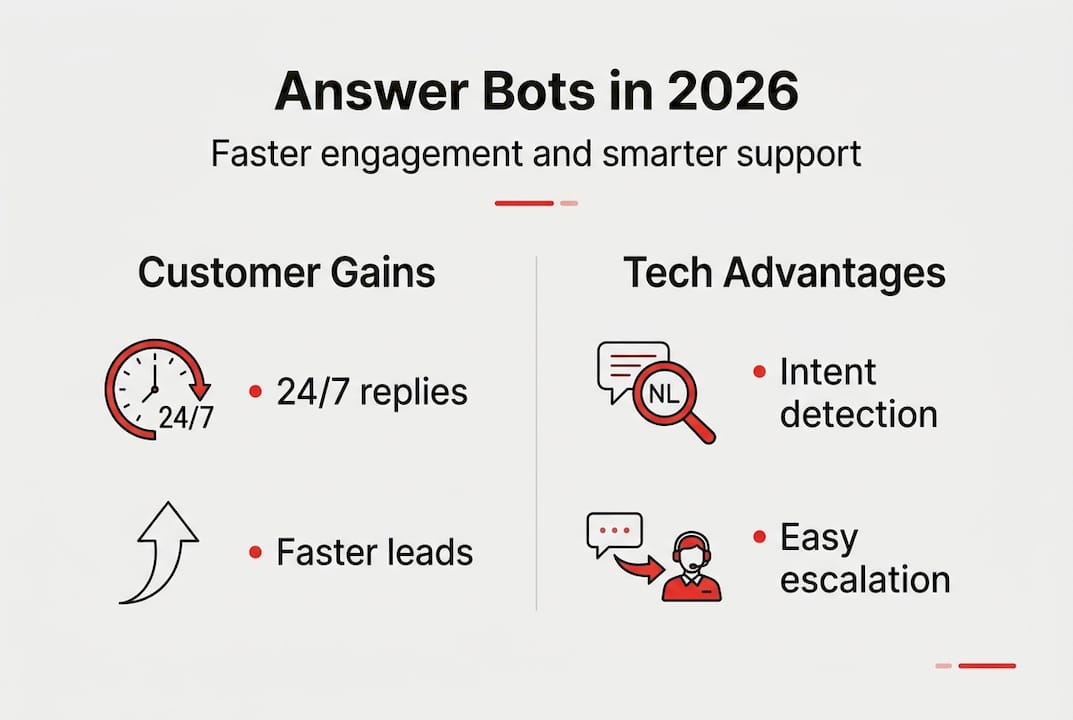
Answer bots address this challenge head-on by providing 24/7 availability without requiring you to hire night shift staff or weekend teams. When a lead submits an enquiry at 11pm on Saturday, your bot responds immediately, capturing their details, answering initial questions, and keeping them engaged until your team follows up Monday morning. This consistent presence transforms your business from a 9-to-5 operation into an always-available resource.
The time savings prove substantial in practice. Businesses implementing answer bots report saving 15-20 hours weekly on routine enquiries, freeing staff to focus on complex customer needs and high-value activities. Your team stops playing email tag over simple questions about opening hours, pricing tiers, or appointment availability.
Speed directly impacts your bottom line. Research shows that responding under 1 minute improves qualification 21 times compared to traditional response times. When you automate lead follow up, you capture prospects at peak interest before they cool off or contact competitors.
Answer bots level the playing field for smaller businesses competing against larger enterprises. Whilst big companies employ dedicated customer service teams working shifts, you achieve similar response speeds through intelligent automation. Your 10-person company can deliver the same instant engagement as a 500-person competitor, making size less relevant to customer experience.
Key benefits of instant response:
- Capture leads at peak interest before they move on
- Provide consistent service quality regardless of time or staff availability
- Reduce customer frustration from waiting for basic information
- Increase conversion rates through immediate engagement
- Free human agents to handle complex, high-value interactions
Pro Tip: Monitor your current average response time for one week before implementing an answer bot. This baseline helps you demonstrate ROI clearly when response times drop from hours to seconds.
The Technology Behind Answer Bots and Their Return On Investment
Modern answer bots rely on hybrid systems combining natural language processing with machine learning, creating tools that understand context and improve over time. These systems analyse incoming messages to identify user intent, whether someone’s asking about pricing, booking an appointment, or troubleshooting a problem. The bot then matches that intent to appropriate responses from its trained knowledge base.
Intent recognition forms the foundation of effective bot performance. When a customer types “How much does it cost?”, the system recognises this as a pricing enquiry even if they phrase it differently next time as “What are your rates?” or “Tell me about pricing”. This flexibility comes from training the bot on diverse phrasings of common questions, building a robust understanding of customer language patterns.
Context learning adds sophistication to basic pattern matching. Hybrid NLP/ML chatbots remember earlier parts of conversations, allowing them to provide relevant follow-up responses. If someone asks about your services and then says “What’s the price for that?”, the bot understands “that” refers to the previously discussed service.
Escalation protocols ensure complex queries reach human agents appropriately. When the bot encounters questions outside its training or detects customer frustration, it smoothly transfers the conversation to your team with full context. This hybrid approach combines automation efficiency with human judgement, preventing the frustrating dead ends that plague poorly designed systems.
The financial returns justify the investment quickly. Businesses implementing properly trained bots achieve ROI of 300-600% within 3-6 months, driven by increased conversion rates, reduced staffing costs, and improved customer satisfaction. The payback period typically ranges from 3 to 6 months depending on implementation quality and business volume.
Implementation timeline for maximum ROI:
- Identify your 20 most common customer questions through existing support data
- Train the bot on these FAQs with multiple phrasings and edge cases
- Set clear escalation triggers for complex queries or frustrated customers
- Deploy to a small segment of traffic whilst monitoring performance
- Optimise weekly based on real conversation data and customer feedback
- Gradually expand to full traffic as confidence and accuracy improve
| Metric | Before Bot | After Bot | Improvement |
|---|---|---|---|
| Average response time | 4 hours | 30 seconds | 99% faster |
| Lead qualification rate | 8% | 67% | 738% increase |
| Weekly staff hours on FAQs | 18 hours | 2 hours | 89% reduction |
| Customer satisfaction | 72% | 91% | 26% increase |
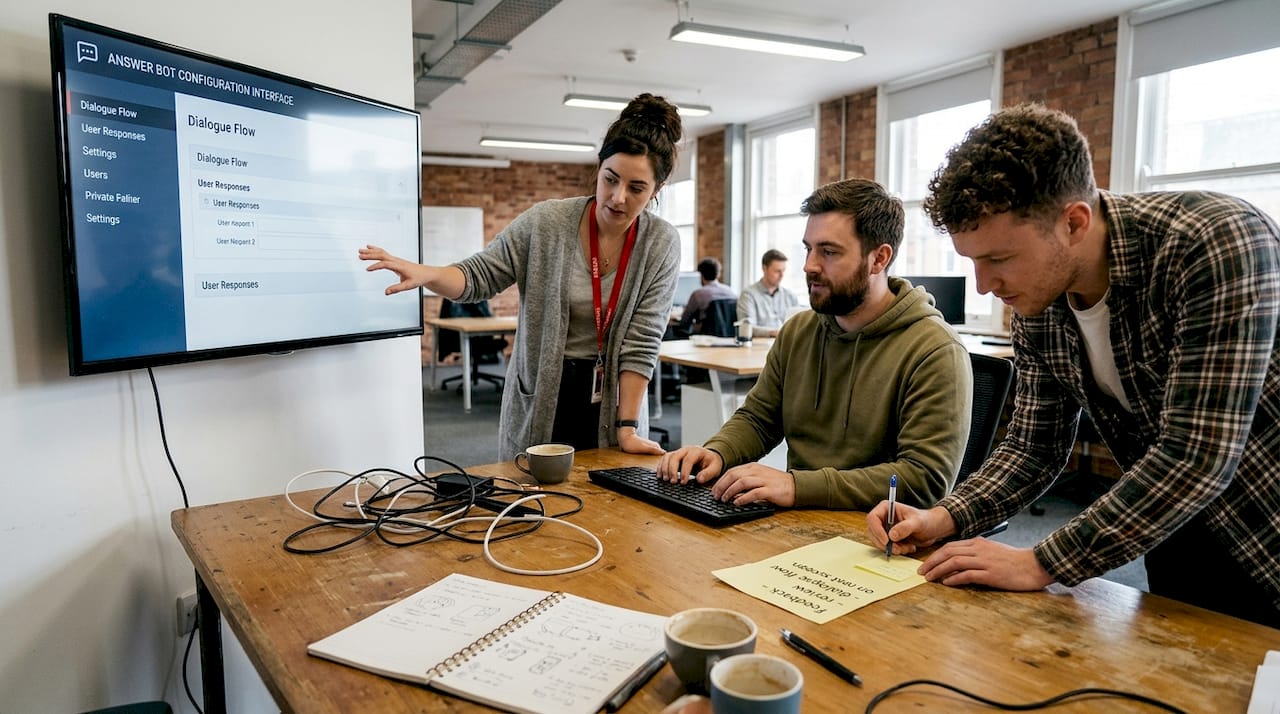
Training quality determines success more than technology sophistication. A simple bot trained on real customer conversations outperforms a complex system fed generic responses. Invest time upfront analysing actual enquiries, identifying patterns, and crafting natural-sounding replies that match your brand voice.
Pro Tip: Test your bot with intentional typos, abbreviations, and informal language before launch. Customers rarely type perfectly, and your bot must handle “hw much 4 installation?” as well as “How much does installation cost?”
Continuous optimisation separates successful implementations from abandoned projects. Review conversation logs weekly, identifying questions the bot struggled with and adding those scenarios to training data. This iterative improvement transforms adequate performance into exceptional results over months. Social media AI chatbots particularly benefit from this ongoing refinement as platform conventions and user expectations evolve rapidly.
Common Pitfalls and How to Successfully Implement Answer Bots
Poor implementation damages sales rather than improving them. Studies show poorly implemented bots cause up to 20% sales drop as frustrated customers abandon conversations with unhelpful automated responses. This risk makes careful planning essential, not optional.
The “set and forget” mentality kills bot projects faster than technical limitations. Businesses launch their bot, celebrate the initial deployment, then ignore it for months whilst performance degrades. Customer language evolves, new products launch, and policies change, but the bot continues giving outdated answers. Setting and forgetting leads to failure as accuracy drops and customer frustration rises.
Team resistance creates internal obstacles even when the technology works perfectly. Staff worry about job security, resent changing workflows, or distrust AI capabilities. Some employees prefer maintaining control over customer interactions despite AI showing 87% accuracy advantage in lead qualification. Address these concerns early through transparent communication about how bots augment rather than replace human roles.
Overscoping dooms projects before they start. Ambitious teams try building bots that handle every possible customer scenario, leading to 35% failure rates for overly complex implementations. The scope expands beyond initial requirements, timelines stretch, and stakeholders lose confidence. Meanwhile, competitors launch simpler bots that deliver immediate value.
Critical success factors:
- Start with a narrow focus on FAQs and basic lead qualification
- Involve frontline staff in training data creation and testing
- Set realistic accuracy targets like 80% rather than perfection
- Schedule weekly optimisation sessions for the first three months
- Measure specific metrics like response time and conversion rate, not vague “customer satisfaction”
Real user data beats assumptions every time. You might think customers primarily ask about pricing, but conversation logs reveal they actually want to know about delivery times or compatibility with existing systems. Build your training data from actual support tickets, chat transcripts, and email threads rather than guessing what people will ask.
Edge cases deserve attention during testing. What happens if someone asks about a discontinued product? How does the bot handle profanity or aggressive language? Can it recognise when someone’s describing an emergency? Test these scenarios deliberately before launch to avoid embarrassing failures with real customers.
“The difference between a successful bot and a failed one isn’t technology sophistication. It’s whether you commit to weekly optimisation based on real conversations. The companies seeing 600% ROI treat their bots like living systems requiring care, not static software requiring occasional patches.”
Pro Tip: Create a dedicated Slack channel or Teams group where your bot posts daily summaries of conversations it struggled with. This keeps optimisation visible to your team and makes continuous improvement a natural part of your workflow rather than a quarterly project. Understanding the future of search engine optimisation helps contextualise how answer bots fit into broader digital strategy.
Many businesses also make common social media marketing mistakes when deploying bots across platforms, treating each channel identically rather than adapting to platform-specific user behaviours and expectations.
Practical Benefits of Answer Bots for UK Small and Medium Businesses
Answer bots democratise customer engagement technology that previously belonged exclusively to enterprises with large budgets. A Manchester accounting firm with five employees can now provide the same instant response capability as a Big Four consultancy. This shift fundamentally changes competitive dynamics in sectors where responsiveness drives customer choice.
Hybrid human-AI models deliver the optimal balance for most SMBs. Pure automation risks feeling impersonal and struggles with nuanced questions, whilst purely human support limits scalability and availability. The sweet spot combines bot efficiency for routine queries with human expertise for complex situations, giving you both speed and quality.
Focused implementation on high-volume, low-complexity questions generates fastest returns. Analyse your support data to identify the 15-20 questions consuming most staff time. These typically include opening hours, pricing basics, appointment booking, product availability, and delivery timeframes. Training your bot thoroughly on these specific scenarios produces immediate time savings and improved customer experience.
The sales uplift reported around 67% comes primarily from capturing leads who would have otherwise abandoned their enquiry. When someone visits your website at midnight with a question, they’re not waiting until 9am for your office to open. They’re moving to the next Google result. Your bot keeps them engaged, collects their details, and schedules follow-up, transforming lost opportunities into qualified prospects.
| Deployment Strategy | Time to Value | Complexity | Best For |
|---|---|---|---|
| FAQ-only bot | 2-4 weeks | Low | Businesses with high volume of simple questions |
| Lead qualification bot | 4-6 weeks | Medium | Service businesses needing appointment booking |
| Hybrid support bot | 8-12 weeks | Medium-High | Companies wanting to reduce support team workload |
| Full CRM integration | 12-16 weeks | High | Established businesses with existing automation |
Best practices for UK SMB deployment:
- Begin with website chat before expanding to social platforms
- Use British spelling and idioms in training data for natural conversations
- Include GDPR-compliant data handling in all customer interactions
- Set business hours expectations clearly whilst offering 24/7 basic support
- Integrate with existing CRM systems to maintain unified customer records
Start small with a pilot programme covering one channel or customer segment. This contained approach lets you learn quickly, make mistakes cheaply, and build internal confidence before full deployment. A successful pilot creates advocates within your organisation who champion broader implementation.
Test edge cases deliberately rather than discovering them through customer complaints. What happens when someone asks about services you don’t offer? How does the bot handle price negotiations or discount requests? Can it recognise and escalate urgent technical problems? Walking through these scenarios during development prevents embarrassing gaps in live deployment.
Real-world performance data should drive expansion decisions. Don’t scale up because the technology works. Scale up because you’ve proven measurable improvements in conversion rates, customer satisfaction, or operational efficiency. Let results justify investment rather than following trends. Comparing options through AI lead generation software comparison helps identify the right solution for your specific needs.
Pro Tip: Create a monthly “bot report card” tracking five key metrics like accuracy rate, escalation frequency, customer satisfaction, leads captured, and time saved. Share this with your entire team to maintain visibility and accountability for continuous improvement.
Discover how Bamsh Can Help Your Business Harness Answer Bots
Implementing answer bots successfully requires more than just technology. You need strategic guidance, proper training, and ongoing optimisation to achieve the ROI we’ve discussed. Bamsh specialises in helping UK SMBs deploy social media AI chatbot solutions that actually work, avoiding the common pitfalls that cause projects to fail.
Our approach starts with understanding your specific customer questions and business processes, then building bots trained on real conversation data rather than generic templates. We handle the technical complexity whilst you focus on running your business. Explore our AI lead generation software comparison to understand which solution fits your needs and budget.
Ready to transform how you engage customers and capture leads? Book a 15-minute expert consultation to discuss your specific situation and discover how answer bots can deliver measurable results for your business in 2026.
Frequently Asked Questions
What types of questions can answer bots handle effectively?
Answer bots excel at routine enquiries like opening hours, pricing basics, appointment booking, product availability, and common troubleshooting steps. They handle preliminary lead qualification by collecting contact details and understanding basic customer needs. More complex situations involving nuanced judgement, negotiations, or technical expertise get escalated smoothly to human agents with full conversation context.
How quickly can answer bots improve lead response times?
Answer bots enable lead response times under one minute, increasing qualification likelihood 21 times compared to traditional methods where staff respond within hours or days. This rapid engagement meets growing customer expectations for instant support. Most businesses see response time improvements within the first week of deployment, with conversion rate increases following within 30-60 days.
What are common pitfalls to avoid when implementing answer bots?
Avoid the “set and forget” mentality by scheduling weekly optimisation sessions to review performance and update training data. Manage team expectations early by involving staff in bot development and clearly explaining how automation augments rather than replaces their roles. Start with a narrow scope focused on FAQs and lead qualification rather than attempting to automate every customer interaction immediately.
Can answer bots deliver a good ROI for small businesses?
Properly trained answer bots deliver ROI between 300% and 600% within 3 to 6 months through increased conversion rates, reduced staffing costs, and improved customer satisfaction. Small businesses often see faster returns than enterprises because they can implement focused solutions quickly without bureaucratic delays. The key is starting with high-volume, straightforward questions where automation provides clear time savings and customer value.