

Marketing professionals often chase the latest analytics tools and data dashboards, yet people remember stories 22 times better than isolated facts. Whilst data reveals patterns, storytelling transforms those patterns into memorable narratives that drive action. This disconnect explains why so many campaigns generate clicks but fail to convert. UK businesses investing in storytelling see measurably stronger engagement, higher conversion rates, and lasting brand recall. This guide explores why storytelling works at a psychological level, which frameworks deliver results, how to measure impact, and practical strategies tailored for UK SMEs operating on realistic budgets.
Table of Contents
- Why Storytelling Matters In Marketing
- Core Storytelling Frameworks For Marketing Success
- Measuring The Impact And Limits Of Storytelling In Uk Marketing
- Practical Storytelling Strategies For Uk Marketing Professionals And Smes
- Enhance Your Marketing With Expert Digital Storytelling Support
Key takeaways
| Point | Details |
|---|---|
| Memory advantage | Stories achieve 65 to 70 percent retention compared to just 5 to 10 percent for raw facts |
| Structured frameworks | The Hero’s Journey and CIIA models provide proven templates for crafting compelling marketing narratives |
| Measurable ROI | Emotional storytelling delivers 44 to 51 percent higher returns and boosts B2B conversions by 37 percent |
| UK SME reality | 58 percent of UK small businesses deploy storytelling on budgets under £250 monthly with strong local engagement |
| Context matters | Storytelling can backfire in high scepticism scenarios like CSR claims, requiring authenticity and balance |
Why storytelling matters in marketing
Your brain processes narratives differently than bullet points. When you encounter a story, multiple regions light up: language centres, sensory areas, and emotional processors work simultaneously. This neural symphony creates deeper encoding than data alone ever could. Stories yield 65 to 70 percent retention whilst facts languish at 5 to 10 percent, explaining why customers recall brand stories years later but forget product specs within hours.
The preference gap proves equally dramatic. Research shows 92 to 94 percent of consumers favour narrative advertisements over straightforward product pitches. This isn’t sentiment, it’s survival instinct. Humans evolved sharing knowledge through stories around fires long before spreadsheets existed. Your customers’ brains still crave that narrative structure.
Many marketers mistakenly position storytelling against data, creating a false choice. Effective campaigns weave both together. Stories provide the emotional hook whilst data supplies credibility. Consider how content optimisation for online visibility works best when technical SEO supports compelling narratives rather than replacing them. The numbers prove your point; the story makes people care.
Storytelling triggers specific psychological responses that drive marketing outcomes:
- Empathy activation: Narratives about real challenges help prospects see themselves in your customer’s shoes
- Sustained attention: Plot progression keeps audiences engaged far longer than feature lists
- Enhanced recall: Emotional peaks create memory anchors that persist through purchase cycles
- Persuasive power: Stories bypass logical resistance by engaging the limbic system directly
Think of your last memorable advert. Chances are it told a story rather than listing specifications. That’s not coincidence. Your marketing competes for attention in an oversaturated landscape where standing out requires emotional resonance, not just rational arguments. Stories create that resonance by transforming abstract benefits into concrete human experiences your audience can feel.
Core storytelling frameworks for marketing success
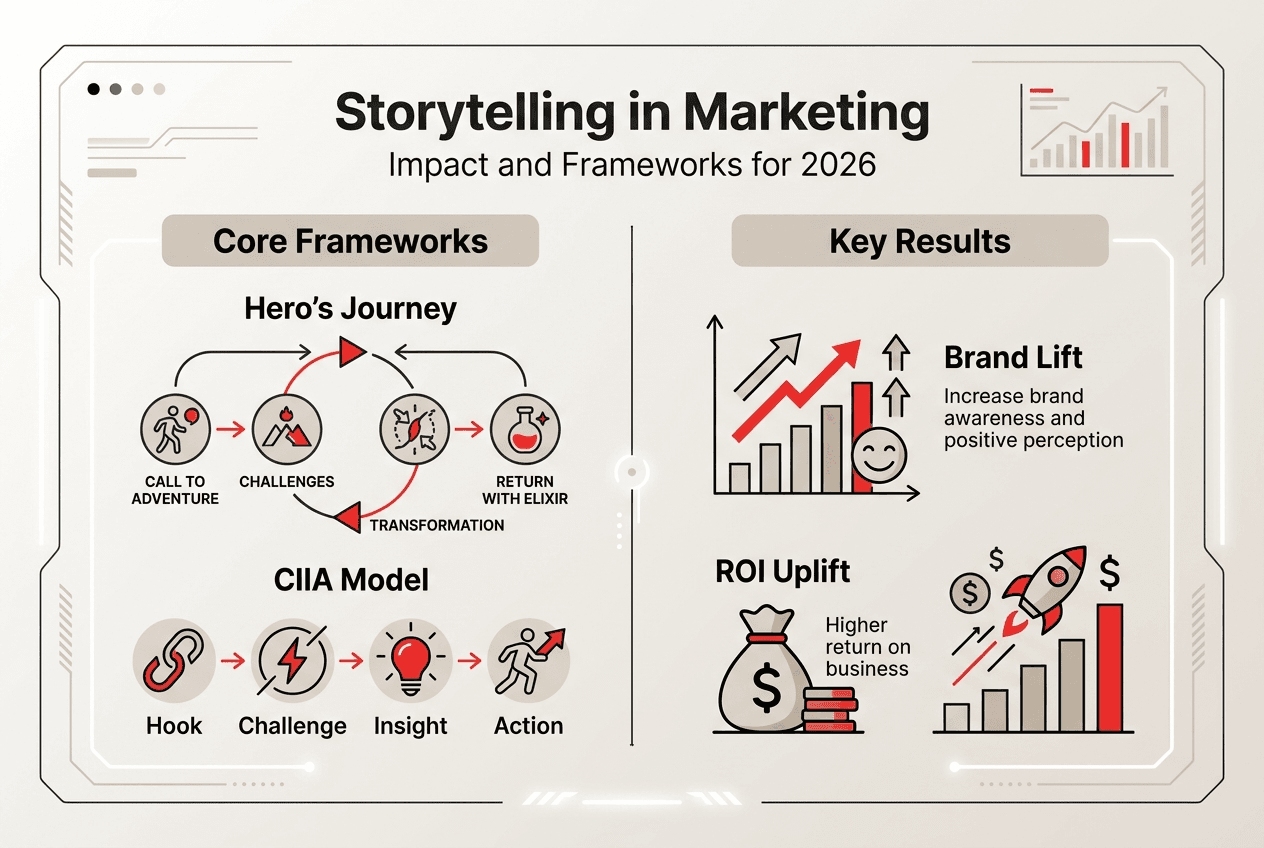
Random anecdotes don’t constitute strategy. Effective marketing storytelling follows proven structures that guide audiences through deliberate emotional journeys. Two frameworks dominate professional practice: the Hero’s Journey and the CIIA model. Understanding both gives you flexibility to match structure to context.
The Hero’s Journey positions your customer as the protagonist facing a challenge. Your brand becomes the wise guide providing tools or knowledge to overcome obstacles. This framework follows predictable stages: the customer’s ordinary world, the problem that disrupts it, initial reluctance, meeting the guide (your brand), acquiring new capabilities, confronting the challenge, achieving transformation, and returning changed. Notice your brand never plays hero. That’s your customer’s role. You’re Yoda, not Luke Skywalker.

The CIIA framework suits data storytelling particularly well. It stands for Context, Insight, Impact, and Action. Context establishes the situation and stakes. Insight reveals the surprising pattern or truth hidden in data. Impact explains consequences of acting or ignoring the insight. Action provides clear next steps. This structure works brilliantly for case studies, research reports, and thought leadership where numbers anchor the narrative.
| Framework | Best for | Structure | Brand role |
|---|---|---|---|
| Hero’s Journey | Emotional connection, brand positioning | Customer faces challenge, brand guides solution, transformation achieved | Mentor or guide |
| CIIA | Data storytelling, B2B content, case studies | Context sets stage, insight surprises, impact clarifies stakes, action directs | Analyst or advisor |
Implementing these frameworks requires deliberate planning:
- Identify your audience’s core challenge or question that your offering addresses
- Choose the framework that matches your content type and business goals
- Map your actual customer experiences to the chosen structure’s stages
- Develop specific story beats with concrete details rather than generic statements
- Test narratives with sample audiences before full deployment
- Refine based on engagement metrics and qualitative feedback
Pro Tip: The most effective stories align with your audience’s existing motivations rather than imposing new ones. Research what already drives your customers, then frame your narrative to amplify those existing desires. Fighting against established motivations wastes energy; riding them multiplies impact.
These frameworks aren’t creative straitjackets. They’re scaffolding that supports your unique brand voice and customer insights. The structure ensures your story delivers emotional payoff whilst your specific details make it memorable. Combine framework discipline with authentic customer understanding, and you’ll create content marketing that generates leads rather than just consuming budget.
Measuring the impact and limits of storytelling in UK marketing
Intuition suggests storytelling works, but UK SMEs need numbers before committing resources. The data validates the investment decisively. Emotional storytelling generates 44 to 51 percent higher ROI compared to purely rational messaging. B2B contexts see 37 percent conversion improvements when narrative replaces feature dumps. Narrative advertisements prove twice as effective at changing behaviour and deliver three times better memorability than standard formats.
| Metric | Storytelling approach | Traditional approach | Improvement |
|---|---|---|---|
| ROI uplift | 44 to 51 percent higher | Baseline | 44 to 51 percent gain |
| B2B conversion rate | 37 percent increase | Standard rate | 37 percent boost |
| Behaviour change effectiveness | 2x impact | 1x baseline | 100 percent improvement |
| Message memorability | 3x retention | 1x baseline | 200 percent improvement |
These figures explain why storytelling dominates marketing discussions. However, context determines success. Storytelling isn’t universally superior, and misapplication damages rather than enhances results.
Consider these limitations carefully:
- Corporate social responsibility claims told as stories can increase consumer scepticism and reduce loyalty when audiences detect virtue signalling
- Narrative overload fatigues audiences who encounter story after story without substance
- Complex technical decisions require detailed specifications that stories can obscure
- Time constrained scenarios demand direct answers rather than narrative preambles
- Forced narratives that don’t authentically connect to your offering feel manipulative
Pro Tip: Monitor audience feedback signals like comment sentiment, time on page, and direct responses to gauge whether your storytelling resonates or irritates. If engagement drops after adding narrative elements, you’ve likely misjudged context or authenticity. Pull back and reassess rather than doubling down.
UK SMEs face particular constraints. Budget limitations mean every pound must justify itself. Authenticity matters more in tight knit local markets where reputation spreads quickly. The good news? Clear marketing results for UK SMEs don’t require Hollywood budgets. Customer testimonials, founder origin stories, and local community connections provide rich narrative material at minimal cost.
The measurement challenge lies in attribution. Storytelling influences brand perception and trust, which affect conversion over time rather than immediately. Track leading indicators like engagement duration, social sharing, return visits, and qualitative feedback alongside lagging indicators like conversion rates and customer lifetime value. The full picture emerges from multiple metrics, not single numbers.
Balance remains critical. Use storytelling to create emotional connection and memorability, but support claims with data. Provide narrative context for your numbers, but don’t hide behind stories when customers need facts. The most effective marketing combines both elements strategically rather than choosing sides.
Practical storytelling strategies for UK marketing professionals and SMEs
Theory matters less than execution. UK SMEs need actionable approaches that fit realistic budgets and deliver measurable results. The encouraging reality: 58 percent of UK SMEs deploy storytelling on budgets under £250 monthly. Local narratives drive 34 percent higher engagement than generic content, giving regional businesses a natural advantage.
Budget friendly storytelling tactics that work:
- Mine customer testimonials for authentic story seeds rather than inventing fictional narratives
- Document your founder’s journey or business origin as ongoing content series
- Capture behind the scenes processes that humanise your team and operations
- Repurpose single customer success stories across multiple formats: video, written case study, social posts, email sequences
- Partner with local organisations for co-created community stories that benefit both parties
- Use smartphone video for authentic storytelling rather than waiting for professional production budgets
Creating localised narratives and integrating them into your digital presence follows a systematic process:
- Interview three to five customers about their challenges before finding you and transformations after
- Identify common themes and emotional turning points across these experiences
- Structure one story using the Hero’s Journey framework with specific local details
- Adapt the core narrative for different channels: longer form for blog, condensed for social media, visual for video
- Embed stories naturally within your website’s service pages and about section
- Share stories through email nurture sequences at strategic journey points
- Measure engagement metrics and qualitative responses to identify resonant elements
- Refine subsequent stories based on what connected most strongly with your audience
Pro Tip: Customer testimonials contain ready made stories if you ask better questions. Instead of “Were you satisfied?”, ask “What specific moment made you realise this was working?” or “What would you tell someone facing the same challenge you had?” These prompts generate narrative gold.
Integration matters as much as creation. Stories sitting in isolation don’t drive results. Weave narratives throughout your customer journey. Use origin stories in awareness content, customer transformation stories in consideration stage materials, and detailed case studies for decision stage prospects. Each story serves specific strategic purposes rather than existing as standalone entertainment.
Social advertising for UK SMEs amplifies storytelling reach efficiently. Paid promotion ensures your best stories reach beyond existing audiences. Target local demographics with community focused narratives. Test different story elements to identify what drives engagement. The combination of authentic local storytelling and strategic paid distribution punches well above its weight class.
Investing in local SEO ensures your stories reach people searching for solutions in your area. Optimise story content with local keywords and location specific details. Google rewards locally relevant content, particularly when it demonstrates genuine community connection. Your authentic local narratives become SEO assets that competitors struggle to replicate.
Set measurable KPIs for storytelling campaigns. Track engagement rate, average time on page, social shares, and conversion rate changes before and after implementing narrative approaches. Monitor qualitative signals like customer comments and sales team feedback about how prospects respond. Storytelling’s value emerges across multiple metrics rather than single numbers, so build dashboards that capture the full picture.
The most successful UK SMEs treat storytelling as systematic practice rather than occasional inspiration. They document customer experiences continuously, maintain story banks for different contexts, and refine narratives based on performance data. This disciplined approach transforms storytelling from creative luxury into reliable marketing asset.
Enhance your marketing with expert digital storytelling support
You’ve learned why storytelling works, which frameworks deliver results, how to measure impact, and practical implementation strategies. The next question: how do you amplify these efforts to reach more of your ideal customers? Professional digital marketing services multiply storytelling effectiveness by ensuring your narratives reach the right audiences through optimised channels.
Answer engine optimisation ensures your stories appear when prospects ask questions in Google, ChatGPT, or other AI tools. Technical optimisation combined with compelling narratives creates content that both algorithms and humans value. Your storytelling reaches further when search engines recognise and reward it.
PPC management for UK businesses puts your best stories in front of high intent audiences actively searching for solutions. Strategic ad campaigns target prospects at the exact moment they need what you offer. Combining paid visibility with authentic storytelling accelerates results whilst you build organic presence.
Google Business Profile management services amplify local storytelling impact. Optimised profiles with customer reviews, regular updates, and local content drive more calls, visits, and conversions from your area. Your community narratives gain visibility where local customers actually search.
Pro Tip: The most effective marketing combines storytelling authenticity with technical optimisation and strategic promotion. Stories create connection, SEO ensures discovery, and paid campaigns accelerate reach. This integrated approach delivers faster, more predictable results than any single tactic alone.
FAQ
What is the role of storytelling in marketing?
Storytelling creates emotional connections that transform abstract benefits into concrete experiences your audience can feel and remember. It helps brands differentiate themselves in crowded markets by making messages memorable and relatable. Stories guide customers through decision journeys by addressing doubts and building trust through narrative rather than just listing features.
How can UK SMEs use storytelling effectively on a budget?
Focus on authentic local stories and customer testimonials that require minimal production costs but deliver strong emotional resonance. Integrate these narratives into existing digital channels like your website, social media, and email rather than creating separate expensive campaigns. With budgets under £250 monthly, prioritise smartphone video testimonials, written case studies, and founder story content that you can repurpose across multiple formats.
Are there situations where storytelling might not work well in marketing?
High scepticism environments like corporate social responsibility claims often backfire when told as stories, increasing consumer doubt rather than building trust. Complex technical decisions requiring detailed specifications can be obscured by narrative approaches when customers need facts first. Avoid forcing stories where they don’t authentically fit your offering, as manufactured narratives damage credibility faster than they build connection.
Which storytelling framework should I use for my marketing?
Use the Hero’s Journey when building emotional brand connection and positioning your customer as the protagonist overcoming challenges with your guidance. Choose the CIIA framework for data driven content like case studies, research reports, or B2B materials where insights and evidence anchor the narrative. Your content type and audience expectations should determine framework selection rather than personal preference.
How do I measure if my storytelling is actually working?
Track multiple metrics including engagement duration, social sharing rates, return visitor percentages, and conversion rate changes before and after implementing narrative approaches. Monitor qualitative signals like customer comments, sales feedback, and testimonial themes to understand emotional impact. Storytelling influences brand perception over time, so measure both immediate engagement and longer term trust indicators like customer lifetime value and referral rates.