

Standing out online feels harder than ever for UK small and medium-sized businesses. You invest time creating content, building a website, and trying marketing tactics, yet leads remain inconsistent. 87% of consumers search online before contacting any business, meaning missed visibility equals lost revenue. This practical guide walks you through proven steps to optimise your online presence, capture local search traffic, and convert browsers into loyal customers.
Table of Contents
- Prerequisites: Tools And Knowledge You Need Before Starting
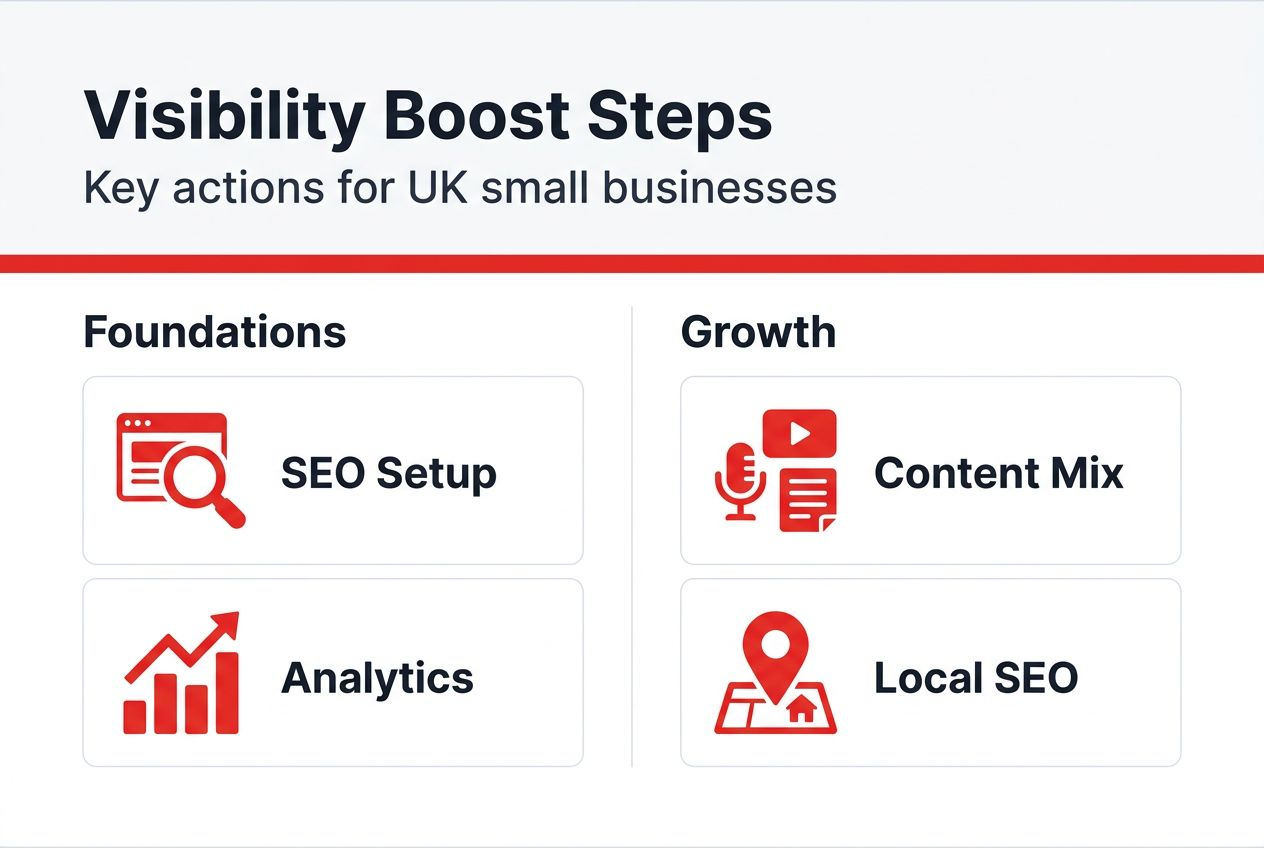
- Step 1: Technical SEO Optimisation For Foundations
- Step 2: Content Creation And SEO Leveraging
- Step 3: Leveraging Local SEO For Market Reach
- Step 4: AI Tools For Customer Engagement And Lead Nurturing
- Common Mistakes And Troubleshooting
- Expected Results, Timelines And Success Metrics
- Boost Your Online Visibility With Expert Help
- Frequently Asked Questions
Key Takeaways
| Point | Details |
|---|---|
| Essential tools first | Setup Google Search Console and Analytics before implementing any visibility strategies to track progress accurately. |
| Technical foundations matter | Mobile optimisation, page speed, and security form the base layer that determines whether your site can rank competitively. |
| Local SEO drives nearby customers | Optimising your Google Business Profile and managing reviews captures up to 70% of available local search traffic. |
| AI automation converts leads | Chatbots and CRM automation nurture prospects effectively, recovering up to 30% more leads without hiring additional staff. |
| Avoid common pitfalls | Technical errors like slow mobile loading or inconsistent business citations can cost half your potential organic traffic. |
Prerequisites: Tools and Knowledge You Need Before Starting
Before implementing visibility improvements, you need the right monitoring tools and foundational knowledge. Without proper tracking, you cannot measure progress or identify what works.
Start by claiming your Google Search Console account and connecting it to your website. This free tool shows which search queries bring visitors, which pages rank well, and any technical errors blocking Google from indexing your content. Next, install Google Analytics to monitor visitor behaviour, traffic sources, and conversion paths. These two platforms provide the data foundation for every decision you make.
Understanding basic SEO concepts saves confusion later. Keywords are terms your customers type into search engines when looking for your services. Indexing means Google has catalogued your pages and can show them in search results. Ranking factors include technical performance, content quality, backlinks, and user experience signals that determine where your pages appear in search results.
Test your current website performance using free tools:
- Google PageSpeed Insights for loading speed analysis
- Mobile-Friendly Test to verify smartphone accessibility
- SSL Checker to confirm HTTPS security is active
- Screaming Frog (free version) to audit basic technical SEO
These diagnostics reveal immediate issues blocking your visibility. Our website SEO optimisation guide explains how to interpret these results and prioritise fixes. For businesses targeting local customers, review our local SEO checklist to ensure you cover all essential elements.
Pro Tip: Schedule monthly reviews of Search Console to catch indexing problems early. A single technical error can remove dozens of pages from Google overnight if left unnoticed.
Step 1: Technical SEO Optimisation for Foundations
Technical SEO creates the infrastructure allowing search engines to find, crawl, and rank your content effectively. Neglecting this foundation guarantees poor visibility regardless of content quality.
Mobile responsiveness is non-negotiable. Mobile optimisation affects up to 60% of potential traffic since Google prioritises mobile-friendly sites in search results. Your website must display properly on smartphones and tablets, with readable text, clickable buttons, and fast loading. Test every key page on multiple devices to verify functionality.

Page speed directly impacts both rankings and conversions. Visitors abandon sites loading longer than three seconds, and Google penalises slow pages. Use Google PageSpeed Insights to identify specific problems like oversized images, render-blocking scripts, or inadequate server response times. Compress images to under 200KB, enable browser caching, and minify CSS and JavaScript files. These technical improvements often boost speed scores from 40 to 80+ within hours.
HTTPS security builds trust and improves rankings. Google marks non-HTTPS sites as “not secure” in browsers, scaring visitors away. Purchase an SSL certificate from your hosting provider (many include them free) and redirect all HTTP pages to HTTPS versions. This encryption protects customer data and satisfies Google’s security requirements.
Additional technical priorities include:
- Creating and submitting an XML sitemap to Search Console
- Fixing broken links that damage user experience
- Implementing structured data markup for rich search results
- Ensuring proper heading hierarchy (H1, H2, H3) on every page
Our website SEO optimisation guide provides detailed walkthroughs for each technical element. For location-based businesses, review local SEO best practices to combine technical foundations with geographic targeting.
Pro Tip: Technical SEO issues often cluster together. Fixing one problem (like site speed) frequently resolves related issues (like mobile usability scores) simultaneously, creating compounding improvements.
Step 2: Content Creation and SEO Leveraging
High-quality content remains the most reliable path to sustainable organic visibility. Search engines reward sites publishing valuable, authoritative information that genuinely helps visitors.
Publish relevant content consistently, targeting twice monthly as a realistic minimum. Each piece should address specific questions your customers ask, demonstrating deep expertise in your field. Answer common concerns thoroughly rather than superficially covering many topics. A comprehensive guide solving one problem outperforms ten shallow articles saying nothing meaningful.
Google’s EEAT framework (Experience, Expertise, Authoritativeness, Trustworthiness) determines content rankings. Demonstrate experience by sharing real case studies, client outcomes, and practical insights from your work. Establish expertise through detailed explanations showing deep knowledge. Build authority via industry recognition, quality backlinks, and consistent publishing. Maintain trust by citing sources, providing accurate information, and keeping content updated.
Optimise content for AI-powered search tools like ChatGPT, Gemini, and Copilot. These systems increasingly influence how people find information, making answer engine optimisation essential alongside traditional SEO. Structure content with clear headings, concise definitions, and factual statements AI systems can extract and reference. Use natural language matching how people speak questions aloud.
Follow this content creation process:
- Research keywords your customers actually search using Google’s autocomplete and “People Also Ask” sections
- Analyse top-ranking competitor content to identify gaps you can fill better
- Write comprehensive answers addressing the core question plus related concerns
- Include specific examples, data points, and actionable advice readers can implement
- Format with short paragraphs, subheadings, bullet points, and visual breaks for readability
- Optimise meta titles and descriptions to improve click-through rates from search results
“Content marketing costs 62% less than traditional advertising while generating three times as many leads. The key is consistency and genuine value, not promotional fluff.”
Understanding benefits of SEO for UK businesses helps frame content strategy around measurable outcomes rather than vanity metrics like page views.
Step 3: Leveraging Local SEO for Market Reach
Local SEO transforms how nearby customers discover your business, particularly crucial for service providers, retailers, and regional specialists.
Google Business Profile optimisation boosts local visibility by 70%, making it the highest-impact action for location-based businesses. Claim your profile immediately if you have not already. Complete every section thoroughly: business name, address, phone number, website, hours, services, and detailed descriptions. Add high-quality photos of your premises, team, products, and completed work. Update the profile weekly with posts, offers, and news to signal active management.
Customer reviews dramatically influence local rankings and conversion rates. Google prioritises businesses with frequent, positive reviews when displaying local search results. Actively request reviews from satisfied customers via email, text, or in-person asks. Respond to every review, positive or negative, within 48 hours. Thank customers for positive feedback and address concerns professionally in negative reviews. This engagement shows prospective customers you value feedback and resolve problems.
Business citation consistency across directories affects local search performance significantly. Ensure your business name, address, and phone number (NAP) match exactly across:
- Google Business Profile
- Bing Places
- Apple Maps
- Yelp and industry-specific directories
- Your website footer and contact page
- Social media profiles
Inconsistent information (like “St” versus “Street” or old phone numbers) confuses search engines and dilutes local authority.
| Local SEO Element | Impact on Visibility | Implementation Difficulty | Time to Results |
|---|---|---|---|
| Google Business Profile | Very High | Low | 2-4 weeks |
| Customer Reviews | High | Medium | Ongoing |
| Local Citations | Medium | Low | 4-8 weeks |
| Location Pages | Medium | Medium | 6-12 weeks |
Our Google Business Profile guide walks through advanced optimisation techniques, while Google My Business benefits quantifies the revenue impact of proper local SEO.
Step 4: AI Tools for Customer Engagement and Lead Nurturing
Automation transforms how you capture and convert leads, particularly when staffing limits your responsiveness.
AI chatbots provide instant responses to website visitors, answering common questions about services, pricing, and availability. This immediate engagement captures interest before prospects browse competitor sites. Modern chatbots sound natural, handle complex queries, and escalate to humans when needed. They work 24/7, responding to midnight enquiries you would otherwise miss.
Automated CRM lead nurturing recaptures and converts up to 30% more leads by eliminating follow-up gaps. Most businesses lose opportunities simply because enquiries are not contacted promptly or persistently. Automation solves this by triggering personalised email sequences, SMS reminders, and task assignments based on prospect behaviour. A lead downloading your pricing guide might receive case studies two days later, then a consultation invitation after five days.
Integrate AI tools with your CRM system for seamless customer journey management. When a chatbot captures contact details, the information flows directly into your CRM, triggering appropriate nurture sequences. This connection ensures no lead falls through administrative cracks. Track which automated messages generate responses, which content prospects engage with, and where conversions happen.
Key AI implementation priorities include:
- Installing website chatbots on service pages and contact forms
- Building automated email sequences for common customer journeys
- Setting up SMS appointment reminders to reduce no-shows
- Creating lead scoring systems prioritising high-intent prospects
Compare solutions using our AI lead generation software comparison. For specific nurturing strategies, review lead nurturing for businesses. Learn broader implementation approaches via strategies to improve business visibility.
Pro Tip: Start with one automated sequence (like new lead follow-up) before building complex workflows. Master simple automation first, then layer additional sophistication as you understand what converts your specific audience.
Common Mistakes and Troubleshooting
Avoiding frequent pitfalls saves months of wasted effort and prevents visibility losses.
Keyword stuffing damages rankings rather than improving them. Google penalises pages overusing exact keywords unnaturally. Write for humans first, ensuring content reads smoothly and provides genuine value. Keywords should appear naturally in headings and body text without forced repetition.
Neglecting mobile usability kills traffic potential. Over 60% of searches happen on smartphones, yet many businesses ignore mobile testing. Your site must load quickly on 4G connections, display readable text without zooming, and offer easy navigation via touchscreen. Test thoroughly on actual mobile devices, not just desktop browser emulators.
Inconsistent local SEO efforts confuse search engines and customers. Update your Google Business Profile weekly with posts and photos. Respond to reviews within 48 hours. Verify NAP consistency monthly across all directories. Sporadic attention creates sporadic results.
Failing to follow up leads automatically wastes marketing investment. Most enquiries need five to seven touchpoints before converting. Manual follow-up misses prospects, creates delays, and depends on individual discipline. Automated sequences ensure consistent, timely contact regardless of workload.
Additional mistakes to avoid:
- Publishing thin content under 300 words that provides no real value
- Ignoring Search Console warnings about indexing or security issues
- Building backlinks from low-quality spam sites that trigger penalties
- Forgetting to update content as information becomes outdated
When visibility drops suddenly, check Search Console for manual actions or technical errors first. Audit recent website changes that might have broken functionality. Review Google Business Profile for suspended listings or guideline violations. Our website SEO optimisation guide includes troubleshooting checklists for common problems.
Expected Results, Timelines and Success Metrics
Setting realistic expectations prevents frustration and helps you measure genuine progress.
Most SEO improvements show measurable gains within three to six months. Technical fixes often improve rankings faster (four to eight weeks) because they remove immediate barriers. Content strategies require longer (three to six months) as Google evaluates quality and relevance over time. Local SEO typically delivers visible results within six to twelve weeks as review volume and citation consistency build.
Track these key performance indicators monthly:
- Organic traffic volume from Google Analytics
- Keyword rankings for priority search terms
- Google Business Profile views and actions (calls, direction requests, website clicks)
- Lead conversion rates from enquiries to customers
- Content engagement metrics (time on page, scroll depth)
- Review quantity and average rating
Understand how different channels deliver results at different speeds:
| Strategy | Speed to Results | Cost | Sustainability | Best For |
|---|---|---|---|---|
| SEO | 3-6 months | Low | High | Long-term growth |
| Google Ads | Immediate | High | Low | Quick lead generation |
| Social Media | 2-4 months | Medium | Medium | Brand awareness |
| Local SEO | 6-12 weeks | Low | High | Geographic targeting |
Organic SEO provides the most sustainable visibility long-term, but paid advertising delivers faster initial results. Most successful businesses combine approaches, using paid ads for immediate leads whilst building organic authority for sustainable growth.
Realistic first-year expectations for a typical UK SME implementing these strategies:
- Months 1-3: Technical foundations complete, initial content published, local profiles optimised
- Months 4-6: Organic traffic increases 40-80%, local rankings improve for priority keywords
- Months 7-9: Lead volume grows 50-100%, conversion rates improve via automation
- Months 10-12: Sustainable visibility established, reduced reliance on paid advertising
Our guide on boosting local business online provides detailed benchmarks and case studies showing typical results across industries.
Boost Your Online Visibility With Expert Help
Implementing these strategies takes time and specialised knowledge. Professional support accelerates results whilst avoiding costly mistakes. Our Google Business Profile management services optimise your local presence, generate reviews, and monitor performance monthly. For businesses preferring hands-on control, our DIY SEO tool provides step-by-step guidance and automated recommendations. Not sure where you stand currently? Request an SEO audit report identifying your biggest visibility gaps and priority fixes. We combine technical expertise with transparent communication, showing exactly what we do and why it works.
Frequently Asked Questions
How long does it typically take to see improvements in online visibility?
SEO improvements generally show measurable results between three to six months depending on competition and implementation quality. Technical fixes like site speed may improve rankings within four to eight weeks. Content strategies require longer as search engines evaluate authority over time.
What are the most common mistakes that reduce online visibility for UK SMEs?
Ignoring mobile optimisation costs up to 60% of potential traffic since most searches happen on smartphones. Keyword stuffing, neglecting local citations, and poor lead follow-up also significantly reduce visibility. Inconsistent Google Business Profile management prevents local search success.
Which digital marketing strategies offer the fastest lead generation for small businesses?
Paid Google Ads deliver immediate visibility and leads, often within 24 to 48 hours of launch. However, costs remain ongoing and leads stop when spending stops. SEO provides sustainable long-term growth but requires three to six months for substantial results. Most successful businesses combine both approaches strategically.
How can AI tools improve my customer engagement and lead nurturing?
AI chatbots provide instant 24/7 responses to website enquiries, capturing interest before prospects browse competitors. Automated CRM lead nurturing converts up to 30% more leads by eliminating follow-up gaps and maintaining consistent contact. Integration with CRM systems ensures seamless customer journey management without additional staffing costs.